
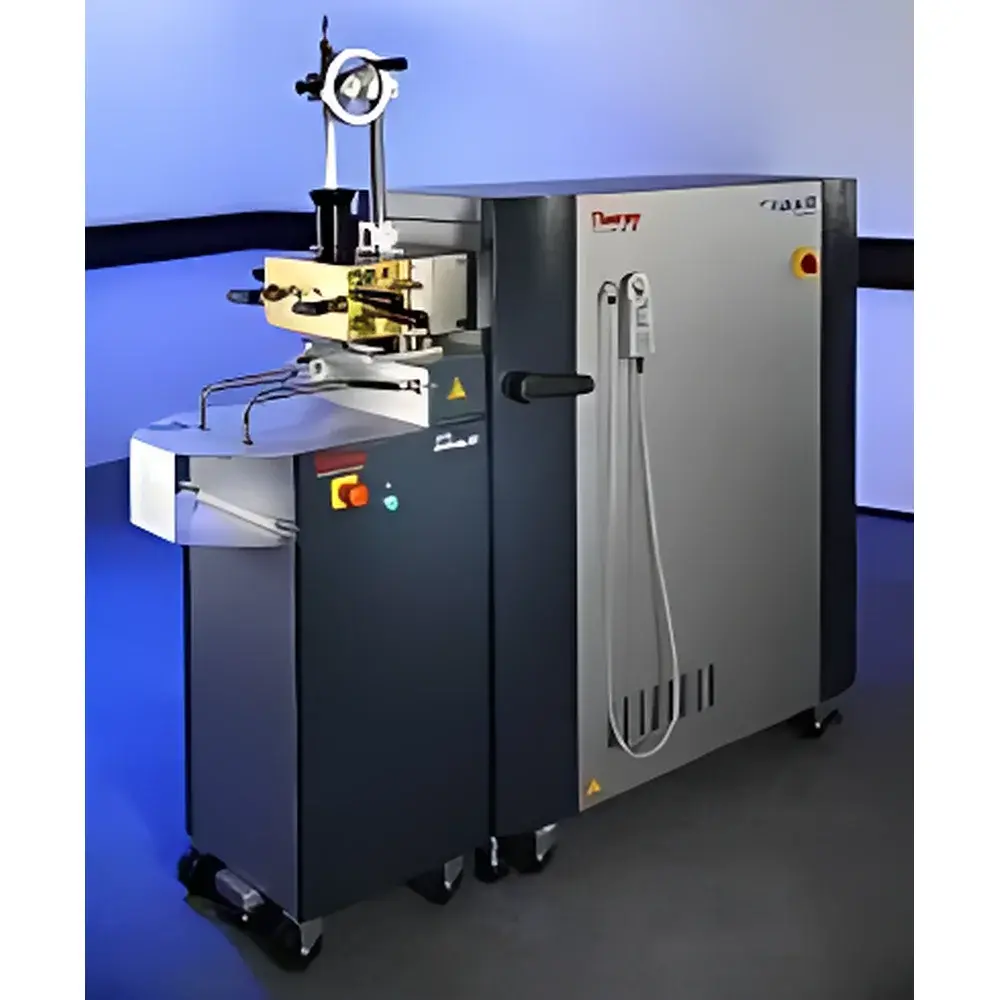
Thermo Fisher HAAKE PolyLab OS Torque Rheometer
| Brand | Thermo Fisher |
|---|---|
| Origin | USA |
| Manufacturer Status | Authorized Distributor |
| Origin Category | Imported |
| Model | HAAKE PolyLab OS |
| Instrument Type | Torque Rheometer |
| Screw Bearing | Precision Ball Screw |
| Minimum Speed | 1 rpm |
| Frequency Range | 0.1–115 rad/s |
| Maximum Speed | 250 rpm (up to 1100 rpm optional) |
| Maximum Torque | 120 / 400 Nm |
| Torque Resolution | 0.01 / 0.1 Nm |
| Power Rating | 7 kW / 16 kW |
| Mixing Chamber Volume | 120 cm³ or 625 cm³ |
| Screw Diameter | 19.05 mm (single-screw), 31.8 / 20 mm (conical counter-rotating twin-screw), 16 mm or 24 mm (parallel co-rotating twin-screw) |
| Screw L/D Ratio | 10:1, 25:1, 33:1 (single) |
| 25 | 1 to 40:1 (twin-screw) |
| Extrusion Output | ~5 kg/h (typical polymer feedstock) |
| Temperature Range | Up to 400 °C (optional 450–500 °C) |
| Heating/Cooling | Electric heating + compressed air cooling |
| Barrel Configuration | Modular, horizontally split |
| Max Pressure | 700 bar |
| Gear Ratio | 3:2 (optional 2:3) |
| Torque Accuracy | ±0.15% of full scale |
| Temperature Control Zones | 7–10 independent zones |
| Construction Materials | DIN 1.4301 stainless steel (mixing chamber), DIN 1.8550 nitrided stainless steel (screws) |
Overview
The Thermo Fisher HAAKE PolyLab OS Torque Rheometer is an industrial-scale, modular torque rheometry platform engineered for comprehensive process simulation and material characterization in polymer compounding, extrusion, and reactive processing. Unlike conventional laboratory rheometers, the PolyLab OS operates on the principle of controlled mechanical energy input—measuring real-time torque, temperature, pressure, and rotational dynamics during active melt processing. Its open-system architecture (denoted by “OS”) adheres to IEC 61131-3 and EtherCAT industrial communication standards, enabling seamless integration of third-party sensors—including inline FTIR, UV-Vis spectrometers, laser micrometers, and pressure transducers—for multi-parameter process analytics. Designed for R&D labs and pilot-scale production facilities, it replicates commercial-scale extrusion and mixing conditions while maintaining high reproducibility across batch-to-batch testing under GLP-compliant workflows.
Key Features
- Modular hardware platform supporting interchangeable processing units: internal mixer (120 cm³ or 625 cm³), single-screw extruder, conical counter-rotating twin-screw extruder, and parallel co-rotating twin-screw extruder—all mounted on a common base with unified drive and control architecture.
- Dual-range torque measurement system (120 Nm / 400 Nm) with resolution down to 0.01 Nm, calibrated per ISO 11443 Annex B for melt flow consistency and shear viscosity derivation.
- Precision screw drive with ball-screw bearing assembly and programmable speed control from 1 rpm to 250 rpm (optionally up to 1100 rpm), enabling dynamic frequency sweeps (0.1–115 rad/s) compliant with ASTM D3835 for dynamic rheological profiling.
- Multi-zone temperature control (7–10 independently regulated zones) with electric heating and compressed-air cooling, supporting stable thermal profiles up to 400 °C (optional 450–500 °C), meeting requirements of ISO 2040 and ASTM D3364.
- Horizontally split, modular barrel design facilitating rapid tooling changeover and full access to screw geometry—critical for formulation development, cleaning validation, and wear analysis per GMP Annex 15 guidelines.
- Real-time data acquisition at ≥1 kHz sampling rate, synchronized across torque, temperature, pressure, motor current, and position signals—enabling time-resolved analysis of transient melt behavior and viscoelastic response.
Sample Compatibility & Compliance
The HAAKE PolyLab OS accommodates thermoplastics (e.g., PP, PE, PC, PA), thermoplastic elastomers, filled composites (glass/carbon fiber, mineral fillers), reactive systems (polyurethanes, epoxies), and biopolymers (PLA, PHA). All wetted components comply with FDA 21 CFR 177.2400 for food-contact applications and EU Regulation EC No. 1935/2004. The system supports audit-ready operation under 21 CFR Part 11 through optional electronic signature and audit trail modules. Calibration protocols align with ISO/IEC 17025:2017, and routine verification follows ASTM D3835 Annex A2 for torque rheometer performance qualification.
Software & Data Management
Control and analysis are performed via HAAKE RheoWin OS software—a Windows-based application built on Microsoft .NET Framework with deterministic real-time kernel extensions. It provides fully scriptable test sequences (VBScript/C#), automated SOP execution, and integrated reporting templates compliant with ISO 17025 documentation requirements. Raw data is stored in HDF5 format with embedded metadata (operator ID, timestamp, instrument configuration, calibration history), ensuring traceability. Export options include CSV, XML, and direct SQL database push for LIMS integration. Remote monitoring and diagnostics are supported via secure TLS-encrypted VNC and OPC UA server interfaces—enabling off-site supervision without compromising network security policies.
Applications
- Formulation screening of polymer blends and masterbatches under realistic shear and thermal histories.
- Process window definition for extrusion lines—identifying onset of degradation, melt fracture, or die swell anomalies.
- Reaction kinetics monitoring in reactive extrusion (e.g., grafting, polymerization, crosslinking) using coupled torque-temperature-pressure signatures.
- Quality-by-Design (QbD) studies supporting regulatory submissions for medical device polymers (ISO 10993) and pharmaceutical excipients (USP ).
- Wear and corrosion assessment of screw/barrel materials under abrasive or corrosive compound feeds.
- Pilot-scale validation of scale-up parameters prior to commercial extruder commissioning (Technology Transfer per ICH Q5E).
FAQ
What distinguishes the PolyLab OS from legacy PolyLab systems?
The OS platform replaces proprietary bus architecture with open industrial standards (EtherCAT, OPC UA), enabling plug-and-play sensor integration, deterministic real-time control, and vendor-neutral data exchange—unlike earlier models reliant on closed-loop serial communication.
Can the system operate under GMP/GLP-regulated environments?
Yes—when configured with optional 21 CFR Part 11 compliance package (electronic signatures, audit trails, role-based access control), it meets FDA, EMA, and PMDA expectations for regulated R&D and stability testing.
Is remote troubleshooting supported without exposing lab networks?
Yes—via outbound-only TLS-secured diagnostic tunneling; no inbound ports required. Support engineers access only pre-authorized subsystems (drive firmware, sensor I/O, motion controller) without accessing local file systems or user data.
How is torque accuracy validated over time?
Through traceable dead-weight calibration kits (NIST-traceable), periodic verification against reference oils per ISO 3219, and in-situ cross-checks using standard reference polymers (e.g., NIST SRM 2910a) with certified melt flow rates.
Are downstream accessories like pelletizers or capillary dies supplied with full validation documentation?
All Thermo Fisher–certified accessories ship with IQ/OQ documentation, material certifications (EN 10204 3.1), and installation checklists aligned with ISO 9001:2015 and ASME BPE standards.



