
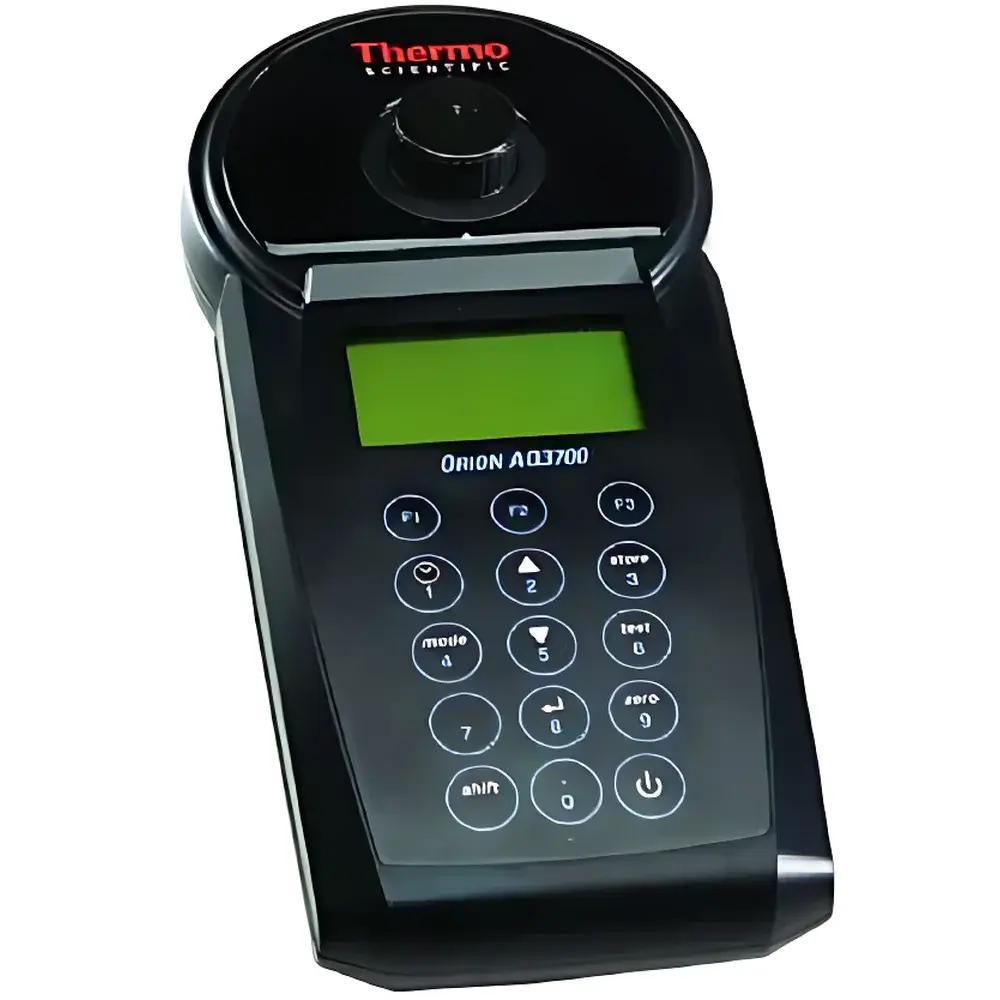
Thermo Fisher Orion AQ3700 Portable Multi-Parameter Water Quality Analyzer for Turbidity, Suspended Solids, and Color Measurement
| Brand | Thermo Fisher |
|---|---|
| Origin | USA |
| Manufacturer | Thermo Fisher Scientific |
| Product Type | Portable (not online) |
| Model | AQ3700-2 |
| IP Rating | IP67 |
| Operating Temperature | 0–50 °C |
| Relative Humidity | 0–90% RH (non-condensing at 30 °C) |
| Light Source | LEDs at 430, 530, 560, 580, 610, 660 nm |
| Photometric Accuracy | ±2% of full scale |
| Photometric Resolution | ±0.005 Abs |
| Zero Calibration | Deionized water |
| Sample Volume | 10 mL |
| Data Storage | 1000 measurements with timestamp |
| Power | Rechargeable battery (>3000 measurements per charge) |
| Communication | Infrared (IR) |
| Auto Power-Off | 20 min inactivity |
Overview
The Thermo Fisher Orion AQ3700 is a rugged, IP67-rated portable photometer engineered for field-deployable, reagent-free quantification of turbidity (FAU), suspended solids (TSS), and color (Pt-Co) in water and wastewater samples. Unlike traditional nephelometric or gravimetric methods, the AQ3700 employs fixed-wavelength LED-based absorbance and transmittance measurement principles—specifically optimized for APHA/Pt-Co color (430 nm), turbidity (via 860 nm-equivalent scatter detection in Method 386), and TSS estimation (via 660 nm absorption of particulate matter). Its optical architecture eliminates reliance on calibration standards or chemical reagents for these three parameters, reducing operational cost, operator variability, and regulatory documentation burden. Designed for compliance with U.S. EPA guidance and harmonized with ISO 7887:2011 (water color), ISO 7027-1:2016 (turbidity), and ASTM D1208 (color), the instrument supports both true color (post-filtration) and apparent color (unfiltered) assessment per GB 11903–1989 and APHA Standard Methods 2120B. The absence of moving parts, consumable optics, or fluidic pathways ensures long-term stability across environmental monitoring, municipal wastewater operations, and industrial effluent verification.
Key Features
- IP67-rated enclosure for immersion-resistant operation in rain, splashing, or temporary submersion—validated per IEC 60529
- Reagent-free, zero-calibration workflow for turbidity (0–1000 FAU, Method 386), TSS (0–750 mg/L, Method 384), and Pt-Co color (0–500 Pt-Co, Method 204)
- Integrated high-stability LED array with six discrete wavelengths (430, 530, 560, 580, 610, 660 nm) enabling multi-parameter spectral discrimination
- Automatic range selection and internal blank compensation for each stored method—including independent zeroing with deionized water or filtered DI water
- Infrared (IR) wireless data transfer compliant with ISO/IEC 11801 for secure, cable-free download of new methods or firmware updates
- Built-in method library of 70+ pre-programmed EPA, ISO, ASTM, and APHA protocols—including COD, total phosphorus, ammonia-N, chlorine species, and heavy metals
- Photometric performance certified to ±2% full-scale accuracy and ±0.005 Abs resolution per NIST-traceable verification
Sample Compatibility & Compliance
The AQ3700 accommodates standard 10 mL sample volumes in 13 mm, 16 mm, or 24 mm vials using interchangeable adapters—ensuring compatibility with legacy labware and field sampling kits. For TSS measurement, the protocol requires homogenization via high-speed stirring (≥1000 rpm for 2 min) to suspend settleable solids prior to analysis, aligning with ISO 11923:1997 practice. Detection limits meet regulatory thresholds: TSS LOD = 20 mg/L (satisfying GB 8978–1996 discharge criteria); turbidity LOD < 0.5 FAU; color LOD = 1 Pt-Co unit. All measurements adhere to Good Laboratory Practice (GLP) requirements, with audit-trail-capable timestamped storage (date/time stamp embedded in each of 1000 records). While not FDA 21 CFR Part 11–certified out-of-box, raw data export enables integration into validated LIMS environments supporting GMP-compliant wastewater reporting.
Software & Data Management
The onboard firmware supports user-defined method creation via intuitive keypad navigation and stores all calibration history, zero-point references, and measurement metadata. Each method retains its own blank correction routine, eliminating cross-method drift. Data export occurs via IR link to Windows-based Orion Desktop Software (v3.2+), which generates CSV- or PDF-formatted reports compliant with ISO/IEC 17025 documentation standards. Firmware updates are delivered as signed binary packages, ensuring integrity verification prior to installation. No cloud dependency or proprietary subscription is required—methods remain fully functional offline, critical for remote or infrastructure-limited deployment.
Applications
- Field verification of municipal wastewater treatment plant effluent against NPDES permit limits for turbidity and TSS
- Rapid screening of drinking water distribution systems for color anomalies indicative of corrosion or organic leaching
- Industrial pretreatment monitoring for textile, food processing, or pharmaceutical facilities discharging to POTWs
- EPA Method 180.1–compliant turbidity screening during stormwater outfall inspections
- Academic and NGO-led watershed assessments requiring portable, low-maintenance instrumentation
- QA/QC validation of laboratory benchtop turbidimeters and spectrophotometers using field-collected reference samples
FAQ
Does the AQ3700 require daily calibration for turbidity, TSS, or color measurements?
No. These three parameters use a zero-reference protocol only—deionized water (or filtered DI water for true color) serves as the sole reference. No calibration standards, formazin suspensions, or platinum-cobalt stock solutions are needed.
Can the AQ3700 measure true color without filtration?
No. True color requires removal of suspended particles via 0.45 µm membrane filtration prior to analysis. Apparent color is measured directly on unfiltered samples.
Is the instrument suitable for seawater or high-salinity samples?
Yes—its optical path design minimizes refractive index interference, and IP67 sealing prevents salt-induced corrosion. However, TSS quantification in saline matrices should be verified against gravimetric methods due to density-dependent particle settling behavior.
How is data integrity ensured during IR transmission?
All IR packets include CRC-16 checksums and sequence numbering. Orion Desktop Software validates payload integrity before committing to database, rejecting corrupted or out-of-order frames.
What is the expected lifetime of the LED light sources?
LEDs are rated for >100,000 hours of operation under nominal conditions—exceeding typical instrument service life and eliminating periodic lamp replacement costs.




