
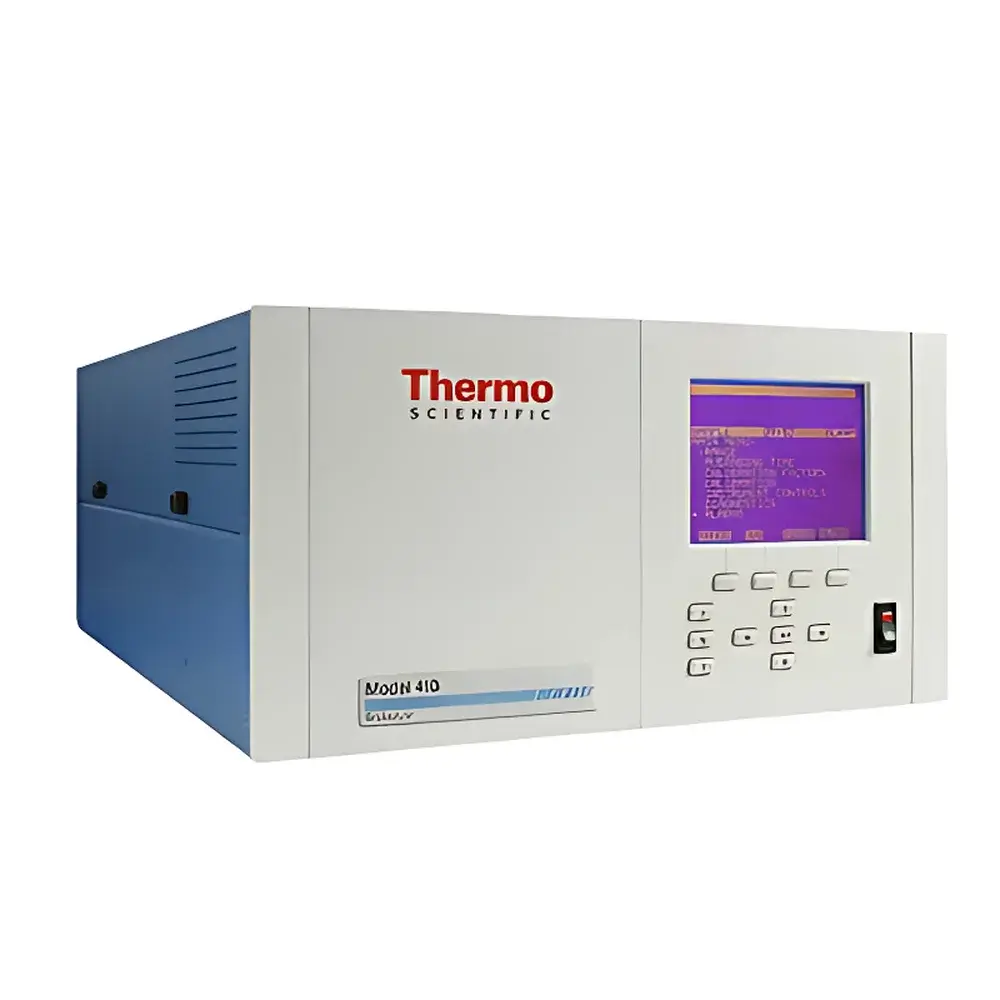
Thermo Fisher Scientific 410i Carbon Dioxide Analyzer
| Brand | Thermo Fisher Scientific |
|---|---|
| Origin | USA |
| Manufacturer Type | Original Equipment Manufacturer (OEM) |
| Product Origin | Imported |
| Model | 410i |
| Instrument Type | Online Analyzer |
| Target Analyte | CO₂ (single-component gas) |
| Measurement Range (Standard) | 0–200 ppm |
| Resolution | 0.2 ppm |
| Repeatability | ±1.0% of reading |
| Zero Drift (24 h) | ±1.0 ppm |
| Span Drift | <0.5% of reading per 24 hours |
| Linearity Error | ±1.5% of full scale |
| Response Time (t₉₀) | 90 seconds (typical average: 30 seconds) |
| Zero Noise (300 s avg) | 0.1 ppm RMS |
| Detection Limit (Standard Range) | 1 ppm |
| Warm-up Time | <1 hour to operational stability |
Overview
The Thermo Fisher Scientific 410i Carbon Dioxide Analyzer is a high-performance, continuous-emission monitoring (CEM) grade instrument engineered for precise, stable, and trace-level CO₂ quantification in ambient air, industrial process streams, and environmental compliance applications. It employs the gas filter correlation (GFC) infrared absorption technique — a highly selective variant of non-dispersive infrared (NDIR) spectroscopy — in which a rotating gas-filled cell modulates the IR beam path to isolate CO₂-specific absorption at 4.26 µm. This method eliminates spectral interference from water vapor, methane, and other common IR-active gases without requiring complex optical filters or frequent calibration adjustments. The analyzer operates continuously with minimal operator intervention, delivering real-time concentration data compliant with U.S. EPA Method TO-15 and ASTM D6348-18 for gaseous emissions characterization. Its robust architecture supports unattended operation in demanding field environments, including stack monitoring, greenhouse gas flux studies, indoor air quality (IAQ) assessment, and bioreactor off-gas analysis.
Key Features
- Gas Filter Correlation (GFC) infrared detection technology ensures exceptional selectivity for CO₂, minimizing cross-sensitivity to H₂O, CO, CH₄, and NO₂
- Standard measurement range of 0–200 ppm with sub-ppm resolution (0.2 ppm) and low zero noise (0.1 ppm RMS over 300 s)
- Configurable multi-range capability: additional standard ranges include 0–500, 0–1000, 0–2000, 0–5000, and 0–10,000 ppm; high-concentration options extend to 0–25% (v/v)
- Fast response time: t₉₀ ≤ 90 s (typical average ~30 s), enabling dynamic process monitoring and rapid event detection
- Stable baseline performance: zero drift ≤ ±1.0 ppm over 24 hours; span drift < 0.5% of reading per day
- Integrated 7-inch backlit LCD touchscreen with user-definable soft keys for intuitive local control and diagnostics
- Onboard flash memory for secure, timestamped data logging (configurable sampling intervals down to 1 second)
- Modular internal layout designed for tool-free access to optical bench, detector, and electronics — reducing mean time to repair (MTTR)
- Compliant with IEC 61000-6-2 (immunity) and IEC 61000-6-3 (emissions) for industrial electromagnetic compatibility
Sample Compatibility & Compliance
The 410i is optimized for clean, dry, particulate-free sample gas streams. For wet or contaminated matrices, optional heated sample lines, Nafion™ dryers, and particulate filters are available to maintain analytical integrity. It meets key regulatory and quality system requirements, including ISO/IEC 17025:2017 for testing laboratories, EPA Performance Specification 15 (PS-15) for CO₂ CEMS, and EN 15267-3 for certified emission monitoring systems. When integrated into validated workflows, the instrument supports GLP and GMP data integrity standards, including audit-trail-enabled configuration changes and user-access logs compatible with FDA 21 CFR Part 11-compliant software platforms.
Software & Data Management
The 410i communicates via standard Ethernet (TCP/IP), RS-232, and optional Modbus RTU/ASCII protocols. Its embedded firmware supports remote configuration, real-time data streaming, and diagnostic status polling through industry-standard SCADA and DCS interfaces. Thermo Fisher’s optional Teledyne TraceLine™ software provides centralized fleet management, automated calibration scheduling, trend visualization, and report generation aligned with EPA QA/QC reporting formats (e.g., QA Data Summary, Daily Calibration Logs). All raw and processed data are stored with ISO 8601 timestamps, instrument serial number, and operator ID — ensuring full traceability for regulatory submissions and internal audits.
Applications
- Continuous monitoring of CO₂ emissions from combustion sources (boilers, incinerators, cement kilns) per EPA 40 CFR Part 75
- Indoor air quality (IAQ) surveillance in schools, offices, and healthcare facilities per ASHRAE Standard 62.1
- Carbon sequestration site verification and atmospheric background monitoring networks (e.g., NOAA/ESRL global flask program)
- Biological process control in fermentation, cell culture, and anaerobic digestion systems
- Calibration laboratory reference instrumentation for transfer standards and secondary calibration gas validation
- Research-grade measurements in eddy covariance flux towers and ecosystem carbon budget studies
FAQ
What is the recommended sample gas conditioning for humid or corrosive streams?
For relative humidity >40%, a heated sample line (maintained at 50–60 °C) combined with a Nafion™ membrane dryer is strongly recommended to prevent condensation-induced signal attenuation and optical contamination.
Does the 410i support automatic zero/span calibration?
Yes — it accepts external zero gas (N₂ or synthetic air) and span gas inputs via solenoid-valve manifold; programmable auto-calibration cycles can be scheduled daily, weekly, or on-demand.
Can the instrument be integrated into a LIMS or enterprise MES platform?
Yes — via its native Ethernet interface and OPC UA-compatible drivers (available through Thermo Fisher Integration Services), enabling bidirectional data exchange with LabVantage, STARLIMS, and Siemens Opcenter.
Is firmware update capability available remotely?
Yes — authenticated firmware updates can be deployed over HTTPS using signed binary packages, with rollback functionality and version-controlled change logs.
What maintenance intervals are recommended for optimal long-term accuracy?
Optical window cleaning and detector gain verification every 6 months; full system performance verification (per ASTM D6348 Annex A3) annually or after major component replacement.
Related Products







