
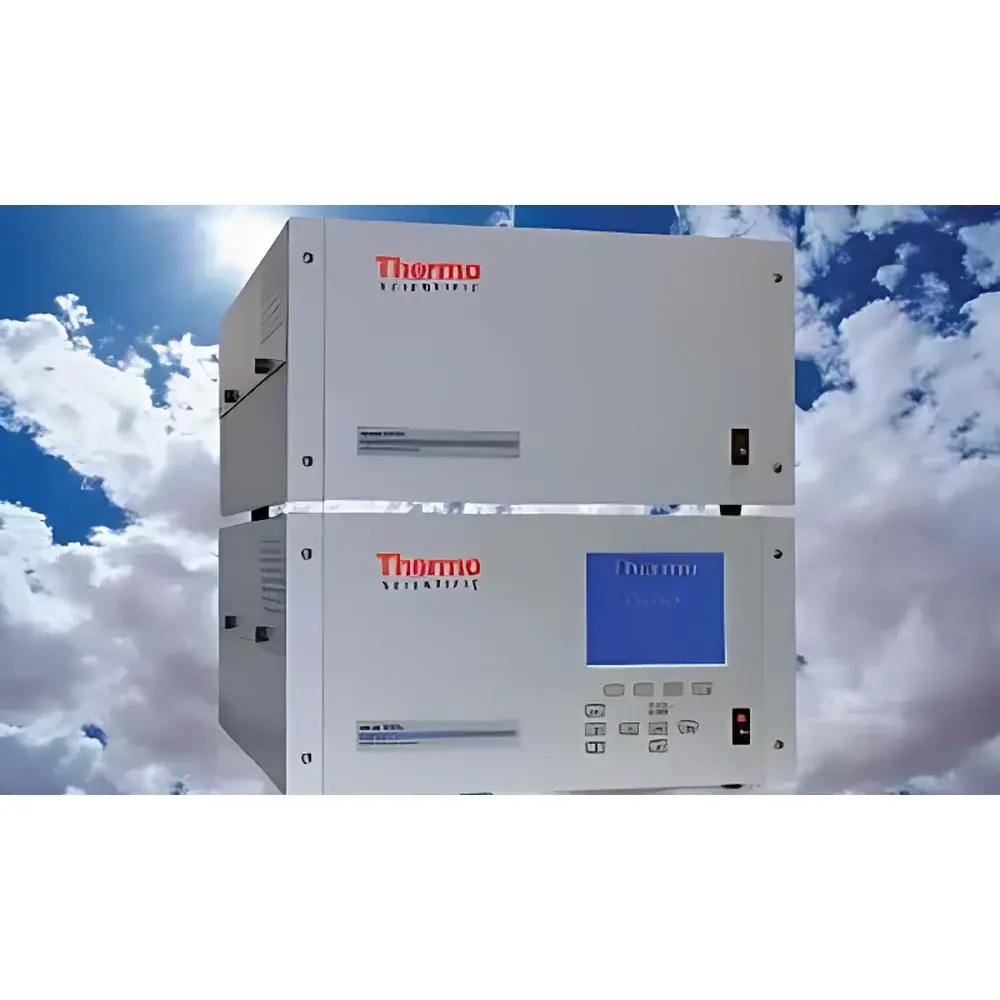
Thermo Fisher Scientific 5020i Sulfate Particulate Analyzer
| Brand | Thermo Fisher Scientific |
|---|---|
| Origin | USA |
| Manufacturer Type | Original Equipment Manufacturer (OEM) |
| Import Status | Imported |
| Model | 5020i |
| Measurement Principle | Pulsed Ultraviolet Fluorescence (PUVF) |
| Measured Parameter | Ambient Air Sulfate Aerosol Mass Concentration (as SO₄²⁻) |
| Range | 0–5, 10, 25, 50, or 100 μg/m³ (user-selectable) |
| Zero Noise | 0.20 μg/m³ (15-min average) |
| Limit of Detection (LOD) | 0.5 μg/m³ (15-min average) |
| Span Drift (24 h) | ±1% of full scale |
| Response Time (t₉₀) | 90 seconds |
| Sample Flow Rate | 0.4–0.5 L/min |
| Operating Temperature | 20–30 °C |
| Denuder Lifetime | 30 days (replaceable) |
| Converter Lifetime | >6 months (replaceable) |
| Dimensions (Analyzer/Converter) | 426 mm (W) × 219 mm (H) × 584 mm (D) |
| Weight (Analyzer) | ~20 kg (detector module) |
| (Converter) | ~17 kg (sample conditioning module) |
Overview
The Thermo Fisher Scientific 5020i Sulfate Particulate Analyzer is a continuous, real-time ambient air monitoring instrument engineered for the selective quantification of sulfate aerosol mass concentration (expressed as SO₄²⁻) in atmospheric particulate matter (PM). It employs pulsed ultraviolet fluorescence (PUVF) detection—a highly specific optical technique wherein sulfate ions, following thermal conversion to sulfur dioxide (SO₂) and subsequent reaction with ozone, emit characteristic UV fluorescence at 340 nm. This principle enables direct, interference-resistant measurement without reliance on gravimetric or ion-chromatographic post-processing. Designed for regulatory-grade network deployment, the 5020i meets the performance expectations of long-term air quality surveillance programs targeting secondary inorganic aerosol formation, regional haze assessment, and source apportionment studies.
Key Features
- Optimized PUVF optical path with enhanced signal-to-noise ratio, delivering sub-μg/m³ resolution and high reproducibility across environmental temperature gradients
- Integrated automated zero-air generation system—eliminates manual zero-gas cylinder dependency and ensures traceable background subtraction every 24 hours
- Compliant sampling interface: accepts standard EPA-designated PM2.5 and PM10 inlets (e.g., WINS, BGI), including sharp-cut cyclones and inertial impactors per ISO 7708 and EN 12341
- i-Series modular architecture: separates detector (analyzer) and sample conditioning (converter/denuder) modules for independent maintenance, calibration verification, and field serviceability
- Robust thermal management system maintains stable converter temperature within ±0.5 °C during operation, critical for consistent SO₄²⁻ → SO₂ conversion efficiency
- Self-diagnostic firmware with real-time fault logging, flow monitoring, lamp intensity tracking, and optical alignment validation
Sample Compatibility & Compliance
The 5020i is validated for use with ambient air matrices containing typical urban, rural, and coastal aerosol compositions—including ammonium sulfate, sodium sulfate, and mixed sulfate-nitrate-ammonium particles. It excludes interference from gaseous SO₂, NO₂, and VOCs through upstream denuder-based removal and optimized residence time control. The analyzer conforms to U.S. EPA Reference Method equivalency criteria under 40 CFR Part 53 for PM2.5 speciation monitors and supports compliance with ISO 21502:2020 (ambient air—determination of sulfate mass concentration in PM) and EU Directive 2008/50/EC Annex IX technical specifications. Data output formats adhere to ASTM D6216 and EN 14211 requirements for automated environmental instrumentation reporting.
Software & Data Management
Operated via Thermo Fisher’s iSeries Command Center software (v3.2+), the 5020i supports local touchscreen control, remote web-based configuration, and secure data export in CSV, NetCDF, and EPA AQS-compatible formats. All measurement events—including zero/span checks, calibration logs, maintenance alerts, and raw fluorescence integrals—are timestamped with NTP-synchronized UTC and stored with full audit trail capability. The system complies with FDA 21 CFR Part 11 requirements for electronic records and signatures when deployed in GLP/GMP-aligned air monitoring laboratories. Optional integration with central data acquisition platforms (e.g., EQuIS, AirWatch, or custom SCADA) is supported via Modbus TCP and HTTP RESTful APIs.
Applications
- Long-term trend analysis of secondary sulfate aerosol formation in national air quality networks (e.g., U.S. IMPROVE, EMEP, or China’s CNEMC)
- Source-receptor modeling support by providing high-temporal-resolution sulfate time series co-located with meteorological and gaseous precursor (SO₂, NH₃) measurements
- Validation of chemical transport models (CTMs) such as CMAQ or CAMx for sulfate aerosol prediction accuracy
- Indoor/outdoor exposure assessment in occupational health studies where sulfate-rich combustion or industrial emissions are present
- Research on atmospheric aging processes, cloud condensation nuclei (CCN) activity, and radiative forcing contributions of sulfate particulates
FAQ
What is the primary measurement principle used by the 5020i?
It utilizes pulsed ultraviolet fluorescence (PUVF) following thermal conversion of particulate sulfate to SO₂, then ozone-induced fluorescence detection at 340 nm.
Does the 5020i require external zero gas cylinders?
No—it incorporates an internal zero-air generator that catalytically removes reactive species from ambient air, enabling fully automated zero checks without consumable gas supplies.
Can the 5020i be configured for PM10 or PM2.5 fractionation?
Yes—when paired with certified size-selective inlets (e.g., Tisch PM2.5 cyclone or BGI PM10 impactor), it measures sulfate mass concentration within the specified aerodynamic diameter cut-points.
How often must the denuder and converter be replaced?
The coated denuder tube is rated for 30 days of continuous operation; the high-efficiency thermal converter module exceeds 6 months under typical ambient conditions and is field-replaceable without recalibration.
Is the 5020i suitable for unattended operation in remote monitoring stations?
Yes—its i-Series platform includes embedded environmental monitoring (temperature, pressure, flow), power-fail recovery, and watchdog-timer reset functionality, supporting >12-month deployment intervals with biannual preventive maintenance.







