
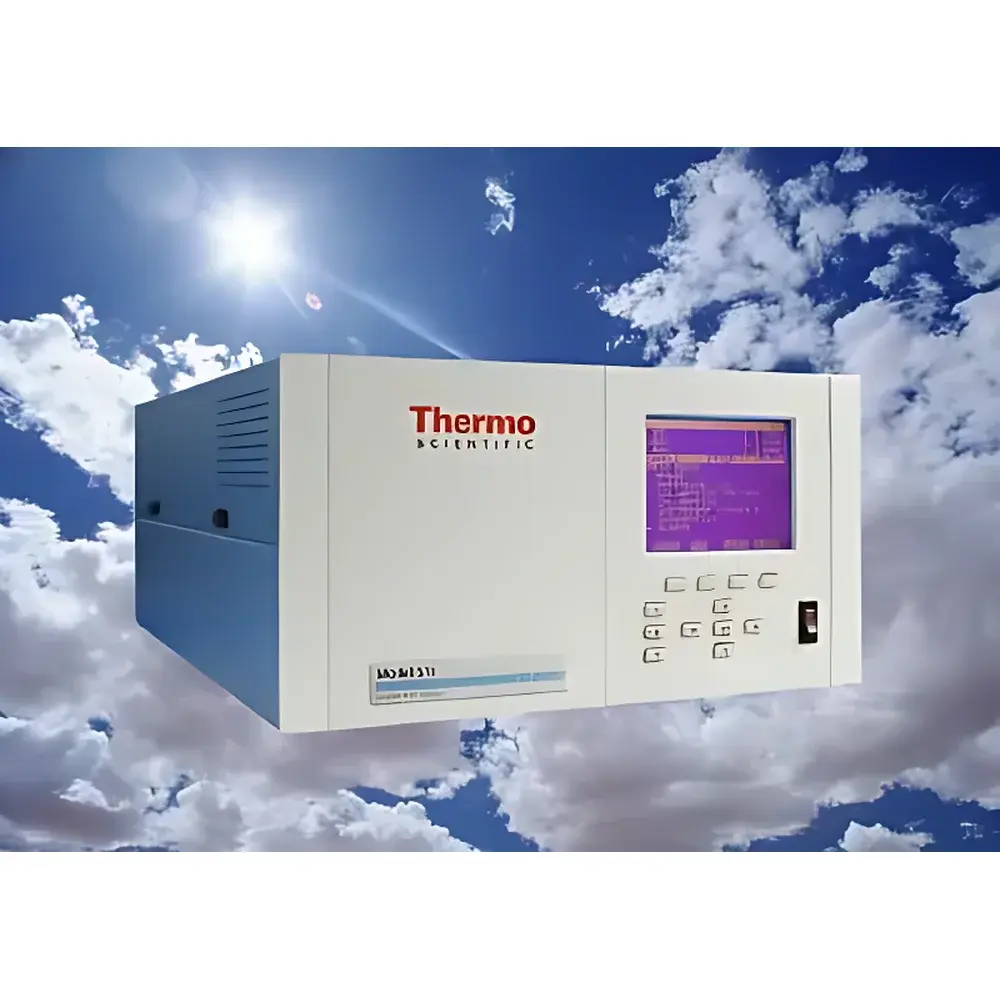
Thermo Fisher Scientific 51i Total Hydrocarbon Analyzer
| Brand | Thermo Fisher Scientific |
|---|---|
| Origin | USA |
| Manufacturer Type | Original Equipment Manufacturer (OEM) |
| Product Origin | Imported |
| Model | 51i |
| Pricing | Available upon Request |
| Detection Principle | Flame Ionization Detection (FID) |
| Measurement Range | 0–1 to 0–10,000 ppmC |
| Zero Noise | 0.025 ppmC RMS (10-sec avg) |
| LOD | 0.050 ppmC (10-sec avg) |
| Zero Drift (24 h) | < 0.50 ppmC |
| Span Drift (24 h) | < 2% of full scale or 0.20 ppmC (whichever is greater) |
| T90 Response Time | 15 s (1-sec avg) |
| Accuracy | ±2.0% of reading or ±0.1 ppmC (whichever is greater) |
| Linearity | ±2% of span (10–150% of span) |
| Sample Flow Rate | 0.75–1.50 L/min |
| Combustion Air Flow | 150–300 mL/min |
| Hydrocarbon-Free Air Flow | 10–35 mL/min (H₂) or 50–120 mL/min (H₂/He mixture) |
| Operating Temperature | 15–35 °C |
| Power Supply | 100/115/220–240 VAC ±10%, 50/60 Hz, 420 W |
| Dimensions (W×H×D) | 425 × 219 × 584 mm |
| Weight | 22.7 kg |
| Output Options | Isolated 0–20 mA / 4–20 mA, RS232/RS485, TCP/IP Ethernet, 10 status relays, power-fail indication |
| Input Options | 16 digital inputs (standard), 8 channels 0–10 VDC analog inputs (optional) |
Overview
The Thermo Fisher Scientific 51i Total Hydrocarbon Analyzer is a high-performance, laboratory-grade and field-deployable gas analyzer engineered for continuous, real-time quantification of total hydrocarbons (THC) in ambient air, stack emissions, and process streams. It employs flame ionization detection (FID)—a mature, reference-grade analytical technique standardized under ASTM D6348, ISO 8573-5, and EPA Method 25A—as its core measurement principle. In the FID, sample gas is mixed with hydrogen and combusted in an air-supported flame; organic carbon compounds undergo pyrolysis and generate ions proportional to their carbon mass flow rate. These ions are collected at a polarized electrode, producing a current signal linearly correlated to total carbon concentration (expressed as ppmC, where “C” denotes carbon-equivalent units). Unlike catalytic or photoionization detectors, FID delivers exceptional selectivity for hydrocarbons, minimal interference from CO₂, H₂O, or common inorganic gases, and robust performance across wide dynamic ranges—making the 51i suitable for regulatory monitoring, fugitive emission surveys, and industrial hygiene applications requiring trace-level sensitivity and long-term stability.
Key Features
- Flame Ionization Detection (FID) architecture compliant with international reference methods including ASTM D6348 and EPA Method 25A
- Configurable low-temperature and high-temperature variants to accommodate condensable or thermally labile hydrocarbon matrices
- Multi-range capability: factory-predefined spans (0–1, 0–10, 0–100, 0–1,000, 0–5,000, 0–10,000 ppmC) plus user-defined custom ranges from 0–1 to 0–10,000 ppmC
- Real-time baseline correction algorithms that dynamically compensate for zero drift without manual intervention
- Integrated Ethernet (TCP/IP) interface enabling remote configuration, data retrieval, firmware updates, and alarm notification via standard IT infrastructure
- Programmable soft keys allow operators to assign frequently used functions—including calibration initiation, span check, or diagnostic mode—to dedicated front-panel buttons
- High-resolution backlit LCD display (≥320 × 240 pixels) supports simultaneous visualization of real-time concentration, system status, flow diagnostics, and navigation menus
- Onboard flash memory (≥2 GB) stores ≥12 months of second-by-second data with time-stamped audit trails, supporting GLP/GMP-compliant record retention
Sample Compatibility & Compliance
The 51i is validated for direct analysis of uncompressed ambient air, diluted stack effluents, and conditioned process gas streams containing saturated and unsaturated aliphatic/aromatic hydrocarbons (e.g., methane, propane, benzene, toluene). It excludes halogenated, oxygenated, or highly polar organics (e.g., methanol, formaldehyde) unless calibrated specifically for those species. The instrument meets CE marking requirements per Directive 2014/30/EU (EMC) and 2014/35/EU (LVD); its analog and digital I/O interfaces support integration into SCADA systems compliant with IEC 61131-3. Data integrity features—including immutable timestamping, electronic signature-capable calibration logs, and configurable audit trail depth—align with FDA 21 CFR Part 11 expectations for regulated environments. Optional analog input channels enable synchronized acquisition of auxiliary parameters (e.g., temperature, pressure, humidity) for environmental correction.
Software & Data Management
Instrument operation and data handling are managed through Thermo Fisher’s proprietary Teledyne iSeries Control Software (v4.2+), accessible locally or remotely via secure HTTPS. The software provides role-based user access control (administrator, operator, viewer), automated calibration scheduling with pass/fail criteria, and export-ready reports in CSV, PDF, and XML formats compatible with LIMS and EPA CDX submission protocols. All raw sensor outputs, diagnostic flags (e.g., flame-out, flow fault, detector saturation), and maintenance events are time-synchronized and stored with millisecond precision. Remote firmware upgrades preserve configuration integrity and support backward-compatible data schema evolution. Optional OPC UA server module enables seamless interoperability with enterprise MES and IIoT platforms.
Applications
- Ambient air quality monitoring networks (e.g., urban background, roadside, industrial fence-line)
- Continuous emissions monitoring systems (CEMS) for combustion sources per EPA 40 CFR Part 60 Subpart Ja and EU IED Annex VI
- Fugitive emission detection and quantification (LDAR) programs under EPA OOOO/OOOOa and ISO 16000-29
- Indoor air quality assessment in laboratories, cleanrooms, and semiconductor fabrication facilities
- Process safety and solvent recovery verification in petrochemical, pharmaceutical, and coating manufacturing
- Calibration transfer standard for portable FID analyzers and GC-FID systems
FAQ
What detection technology does the 51i use, and why is it preferred for total hydrocarbon measurement?
The 51i uses flame ionization detection (FID), which offers superior sensitivity (sub-ppmC LOD), wide linear dynamic range (>10⁶), and near-universal response to organic carbon. Its physical detection mechanism avoids chemical interferences common in PID or MOS sensors, making it the de facto reference method for regulatory THC reporting.
Does the 51i require zero and span calibration gases—and how often?
Yes. Daily zero checks using certified hydrocarbon-free air and weekly span verification with NIST-traceable methane-in-air standards (e.g., 50% of full scale) are recommended per EPA guidance. Automated calibration sequences reduce operator dependency and improve repeatability.
Can the 51i operate unattended for extended periods in outdoor enclosures?
Yes—when installed in climate-controlled, NEMA 4X-rated shelters with stable power conditioning and inlet filtration (e.g., particulate + moisture traps), the 51i achieves >95% uptime over 12-month deployments per ISO 5667-2 guidelines.
Is the 51i compatible with third-party data acquisition systems?
Yes. Native Modbus TCP, ASCII over RS232/RS485, and HTTP REST API interfaces enable integration with PLCs, DCS, and cloud-based analytics platforms without proprietary middleware.
How is data security and traceability ensured for compliance audits?
All configuration changes, calibration events, and measurement records include cryptographic hash signatures, immutable timestamps, and user ID attribution—fully satisfying ALCOA+ principles and FDA 21 CFR Part 11 electronic record requirements.







