
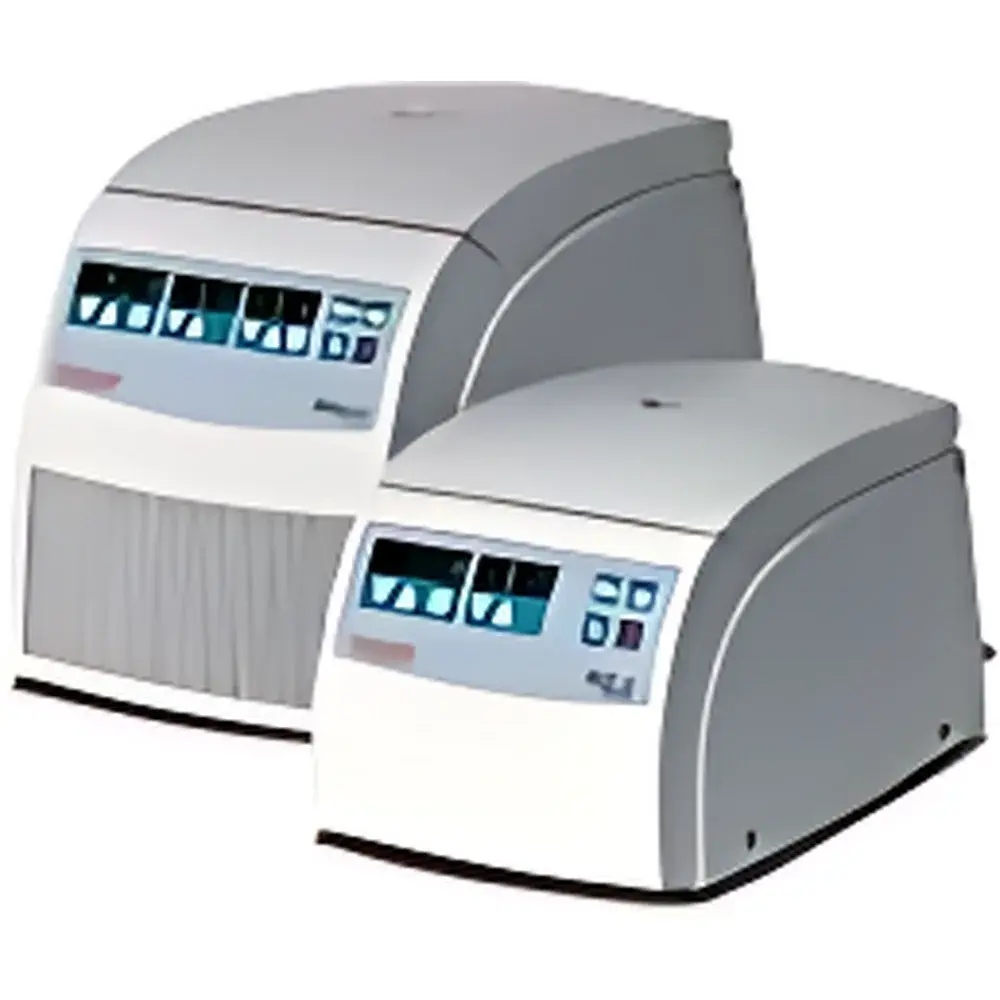
Thermo Fisher Scientific Espresso Personal Microcentrifuge
| Brand | Thermo Fisher Scientific |
|---|---|
| Origin | USA |
| Model | Espresso |
| Type | Benchtop Microcentrifuge |
| Max Speed | 15,000 rpm |
| Relative Centrifugal Force (RCF) | Up to 17,000 × g |
| Rotor Capacity | 24 × 1.5/2.0 mL tubes |
| Temperature Range | Ambient only (non-refrigerated) |
| Control Interface | Digital LED display with intuitive push-button operation |
| Safety Compliance | IEC 61010-1, UL 61010-1 |
| Dimensions (W×D×H) | 20.3 × 25.4 × 19.7 cm |
| Weight | 4.5 kg |
Overview
The Thermo Fisher Scientific Espresso Personal Microcentrifuge is an engineered solution for rapid, precise, and reproducible micro-volume sample separation in resource-constrained or high-throughput laboratory environments. Designed around the principles of compact rotor dynamics and optimized airflow management, the Espresso employs a brushless DC motor coupled with a fixed-angle aluminum rotor to deliver consistent centrifugal force across all tube positions. Its operational range—up to 15,000 rpm and 17,000 × g—is calibrated for routine nucleic acid pelleting, protein precipitation, cell harvesting, and spin-column purification workflows. Unlike refrigerated systems, the Espresso operates at ambient temperature, eliminating thermal stress on thermolabile biomolecules while maintaining mechanical stability during short-duration spins (typically 10–60 seconds). This design aligns with Good Laboratory Practice (GLP) requirements for instrument traceability and user-defined protocol repeatability.
Key Features
- Compact footprint (20.3 × 25.4 × 19.7 cm) enables placement on crowded benchtops or inside biosafety cabinets without compromising ergonomic access.
- Digital LED interface with dedicated speed, time, and run/start/stop controls supports single-handed operation and minimizes training overhead.
- Auto-locking rotor lid with integrated safety interlock prevents accidental opening during operation and complies with IEC 61010-1 electrical safety standards.
- Brushless DC motor ensures low vibration, extended service life (>10,000 hours MTBF), and silent operation (<55 dB(A) at 1 m).
- Rotor accommodates 24 × 1.5/2.0 mL conical tubes—including PCR strip-compatible configurations—without adapters, reducing cross-contamination risk.
- No external cooling system required; ambient-temperature operation avoids condensation formation inside tubes and eliminates refrigerant maintenance cycles.
Sample Compatibility & Compliance
The Espresso is validated for use with standard polypropylene and polyethylene microcentrifuge tubes (1.5 mL and 2.0 mL), including those certified for DNase/RNase-free applications. It supports common molecular biology workflows involving plasmid DNA isolation, RNA cleanup, antibody conjugation spin steps, and small-volume cell lysate clarification. While not designed for clinical diagnostics under CLIA or ISO 15189, its mechanical performance meets ASTM E2500-13 guidelines for verification of laboratory equipment intended for non-regulated research use. All firmware logic adheres to GLP-compliant audit trail principles: each run logs timestamp, set parameters, and completion status internally (non-volatile memory), though it does not implement FDA 21 CFR Part 11 electronic signature functionality due to its standalone architecture.
Software & Data Management
The Espresso operates as a stand-alone instrument without proprietary software dependencies or USB/Bluetooth connectivity. Parameter settings are retained in non-volatile memory across power cycles, supporting repeatable execution of standardized protocols (e.g., “DNA pellet: 12,000 rpm × 30 s”). No data export capability is provided; users record run metadata manually or integrate the device into lab information management systems (LIMS) via external logging practices. This architecture prioritizes reliability over digital integration—consistent with ISO/IEC 17025 Clause 6.4.7, which permits manual documentation where automated data capture is not critical to result integrity.
Applications
- Routine nucleic acid purification using silica-membrane spin columns (e.g., QIAprep, Zymo Spin).
- Micro-scale protein concentration and buffer exchange via centrifugal filtration devices (e.g., Amicon Ultra).
- Preparative centrifugation of bacterial or mammalian cell suspensions prior to lysis.
- Removal of insoluble debris from clarified lysates in enzyme assay preparation.
- Quick-spin steps in ELISA plate washing protocols to eliminate residual wash buffer droplets.
- Field-deployable sample stabilization where portability and battery-independent operation are essential.
FAQ
Is the Espresso suitable for centrifuging radioactive or hazardous samples?
No. The Espresso lacks sealed rotor containment or secondary containment features required for biosafety level 2+ or radioisotope handling per NIH Guidelines and IAEA SSG-46.
Can the rotor be autoclaved?
Yes—the aluminum rotor and lid assembly are autoclavable at 121°C for 20 minutes; however, repeated sterilization may affect surface finish and should be limited to once per week unless contamination risk warrants more frequent cycles.
Does the Espresso support variable acceleration/deceleration rates?
No. It uses fixed ramp profiles optimized for microtube integrity; no programmable brake or soft-start functionality is included.
What maintenance is required?
Monthly visual inspection of rotor threads and lid latch mechanism; annual calibration verification using a certified tachometer and timer—per Thermo Fisher’s Service Manual SM-ESP-2023.
Is there a warranty extension option?
Yes. Thermo Fisher offers optional 3-year Comprehensive Care Plans covering parts, labor, and on-site technician visits for qualified institutions.



