
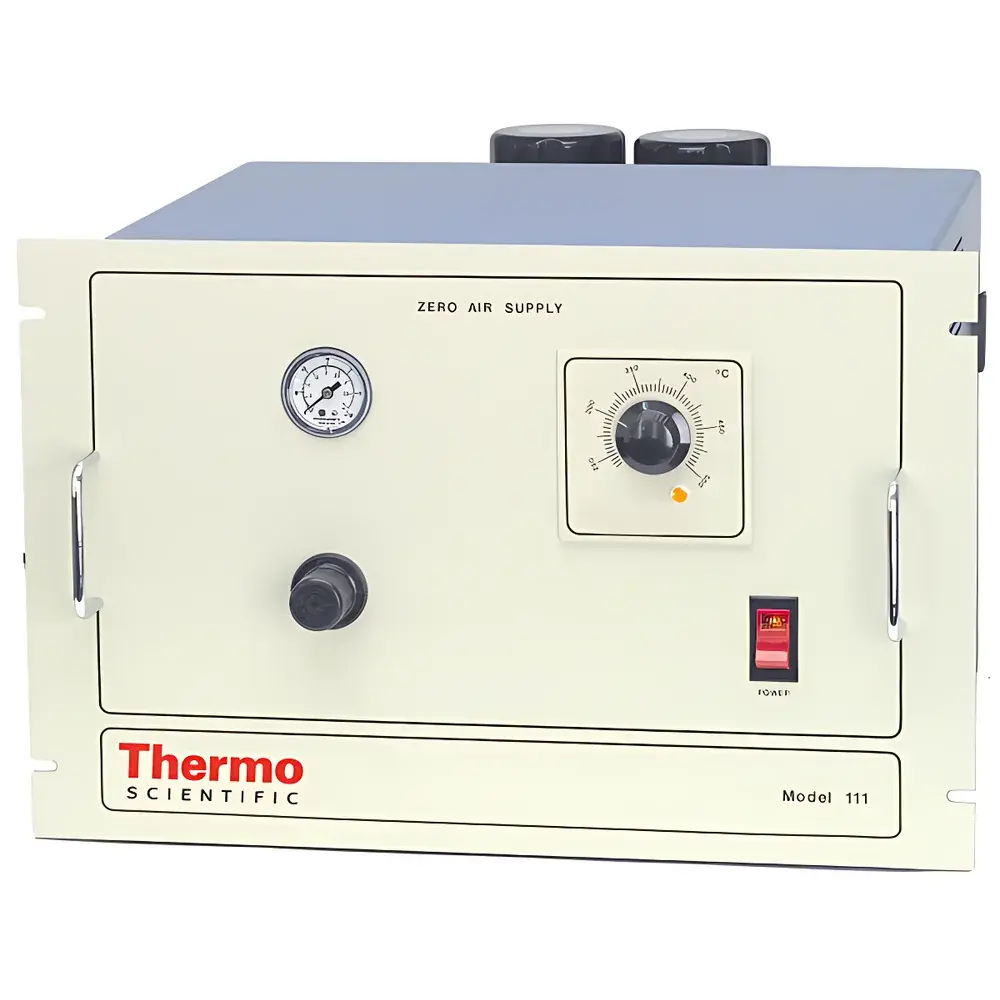
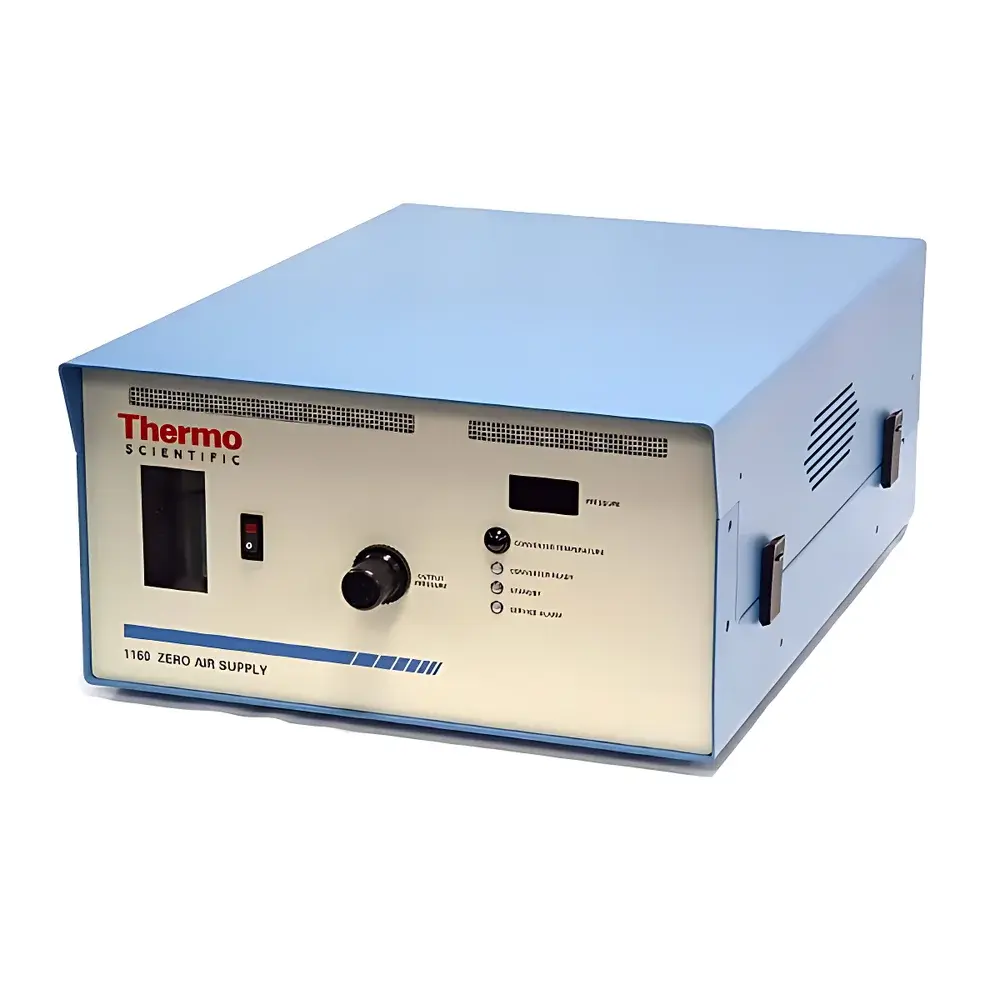
Thermo Fisher Scientific Model 111 / Model 1160 Zero Air Generator
| Brand | Thermo Fisher Scientific |
|---|---|
| Origin | USA |
| Manufacturer | Yes |
| Import Status | Imported |
| Model | 111 / 1160 |
| Flow Rate | 1–20 L/min |
| Output Pressure | 10–60 psi |
| Dew Point | −10 °C (membrane dryer) / −40 °C (heatless dryer) |
| Purity | SO₂ < 0.1 ppb, NO < 0.1 ppb, NO₂ < 0.1 ppb, O₃ < 0.4 ppb, H₂S < 0.1 ppb, NH₃ < 0.1 ppb, CO (optional) < 0.02 ppm |
Overview
The Thermo Fisher Scientific Model 111 and Model 1160 Zero Air Generators are engineered for precision environmental monitoring and analytical calibration applications requiring ultra-low-background carrier or purge gas. These systems produce laboratory-grade zero air—defined as synthetic air with trace-level contaminants removed to sub-part-per-trillion (ppt) equivalent concentrations—through a multi-stage catalytic and adsorptive purification process. Unlike bottled zero air, which risks batch-to-batch variability and logistical constraints, these generators deliver continuous, on-demand zero air with documented stability and reproducibility. The Model 111 employs thermal catalytic oxidation followed by selective adsorption to eliminate CO, hydrocarbons, NO, NO₂, SO₂, O₃, and volatile organic compounds (VOCs). The Model 1160 extends this architecture with modular filter cartridges, configurable CO/hydrocarbon removal modules, dual drying options, and integrated temperature monitoring—making it suitable for demanding trace-gas analysis in EPA Method-compliant ambient air monitoring stations, photometric ozone calibrators, and GC carrier gas supply systems.
Key Features
- Two-tier system architecture: Model 111 for general-purpose zero air generation; Model 1160 for high-integrity, trace-level applications requiring redundancy and configurability
- Thermal catalytic converter operating at 350 °C to quantitatively oxidize CO and C₁–C₄ hydrocarbons to CO₂ and H₂O
- Multi-stage purification train including Purolite® oxidation column (NO → NO₂), high-capacity activated carbon bed (removes NO₂, SO₂, O₃, VOCs, H₂S, NH₃), and optional CO-specific scrubber
- Integrated dew point control: membrane dryer (−10 °C) or heatless desiccant dryer (−40 °C) ensures consistent moisture suppression across variable ambient conditions
- Digital temperature monitoring with audible/visual alarm for catalytic converter integrity verification
- Pressure-regulated output (10–60 psi) with mass flow control up to 20 L/min, compatible with EPA Trace Gas Analyzers (e.g., TEI 49i, Thermo 42i, 43i) and photolysis-based calibration standards
Sample Compatibility & Compliance
Both models generate zero air compliant with U.S. Environmental Protection Agency (EPA) requirements for Method 21 (VOC leak detection), Method 7E (NOₓ analyzer calibration), and Method 25A (hydrocarbon analyzer span gas preparation). The certified purity levels—SO₂ < 0.1 ppb, NO < 0.1 ppb, NO₂ < 0.1 ppb, O₃ < 0.4 ppb, H₂S < 0.1 ppb, NH₃ < 0.1 ppb—meet or exceed ISO 8573-1:2010 Class 1 compressed air specifications for solid, liquid, and oil aerosol content, and align with ASTM D6167 for zero air used in ambient air quality instrumentation. All wetted materials (316 stainless steel tubing, electropolished fittings, fluoropolymer gaskets) conform to USP Class VI biocompatibility standards and are non-reactive toward acidic or oxidizing analytes. Units are designed for GLP/GMP environments and support audit-ready documentation via external data loggers interfacing with analog/digital I/O ports.
Software & Data Management
While the Model 111 operates as a standalone hardware system without embedded firmware, the Model 1160 includes analog voltage outputs (0–5 V DC) for real-time monitoring of dryer temperature, catalytic converter status, and outlet pressure. These signals can be integrated into SCADA platforms (e.g., Ignition, Siemens Desigo) or logged via third-party DAQ systems supporting Modbus RTU or 4–20 mA protocols. Optional RS-232 serial interface enables remote configuration of alarm thresholds and operational logs. All units comply with FDA 21 CFR Part 11 requirements when paired with validated electronic record systems—supporting electronic signatures, user access controls, and immutable audit trails for regulatory submissions under 40 CFR Part 58 (Good Laboratory Practice).
Applications
- Ambient air quality monitoring networks (AQS) requiring daily zero/span validation per EPA 40 CFR Part 58 Appendix A
- Calibration of chemiluminescence NO/NO₂ analyzers, UV photometric SO₂ analyzers, and pulsed fluorescence ozone monitors
- Carrier gas supply for gas chromatography–mass spectrometry (GC-MS) systems analyzing ultra-trace environmental VOCs
- Purge gas for cavity ring-down spectroscopy (CRDS) and tunable diode laser absorption spectroscopy (TDLAS) platforms
- Zero-air blanks in stack emission testing per Method 320 and Method 325B
- Reference gas generation in metrology laboratories accredited to ISO/IEC 17025
FAQ
What is the difference between Model 111 and Model 1160?
The Model 111 is a fixed-configuration generator optimized for routine zero air production with thermal oxidation and three-stage adsorption. The Model 1160 adds modularity (1–3 replaceable filter cartridges), optional CO/hydrocarbon removal, dual drying selection, and digital monitoring interfaces for regulated or high-accuracy applications.
Can these generators be used with ozone calibrators requiring <0.5 ppb O₃ background?
Yes—the verified O₃ output < 0.4 ppb meets photometric ozone calibrator specifications per EPA 40 CFR Part 53 and EN 14625, provided inlet air contains no residual ozone and dryer performance is maintained.
Is routine maintenance required, and what consumables need replacement?
Catalytic converter lifetime exceeds 2 years under continuous operation; Purolite® and activated carbon columns require replacement every 6–12 months depending on inlet air quality and duty cycle. Replacement intervals are tracked via pressure drop monitoring across each stage.
Do these units meet ISO 8573-1 Class 0 for particulate and oil content?
Yes—both models achieve ISO 8573-1:2010 Class 0 for particles and oil aerosols, and Class 1 for water content when equipped with the −40 °C heatless dryer, verified per ISO 8573-4 and ISO 8573-6 test protocols.
Can the output pressure be regulated down to 5 psi for low-pressure GC applications?
The internal pressure regulator supports 10–60 psi output; external precision regulators (e.g., Swagelok SSR series) may be added downstream for sub-10 psi delivery without compromising purity or flow stability.







