
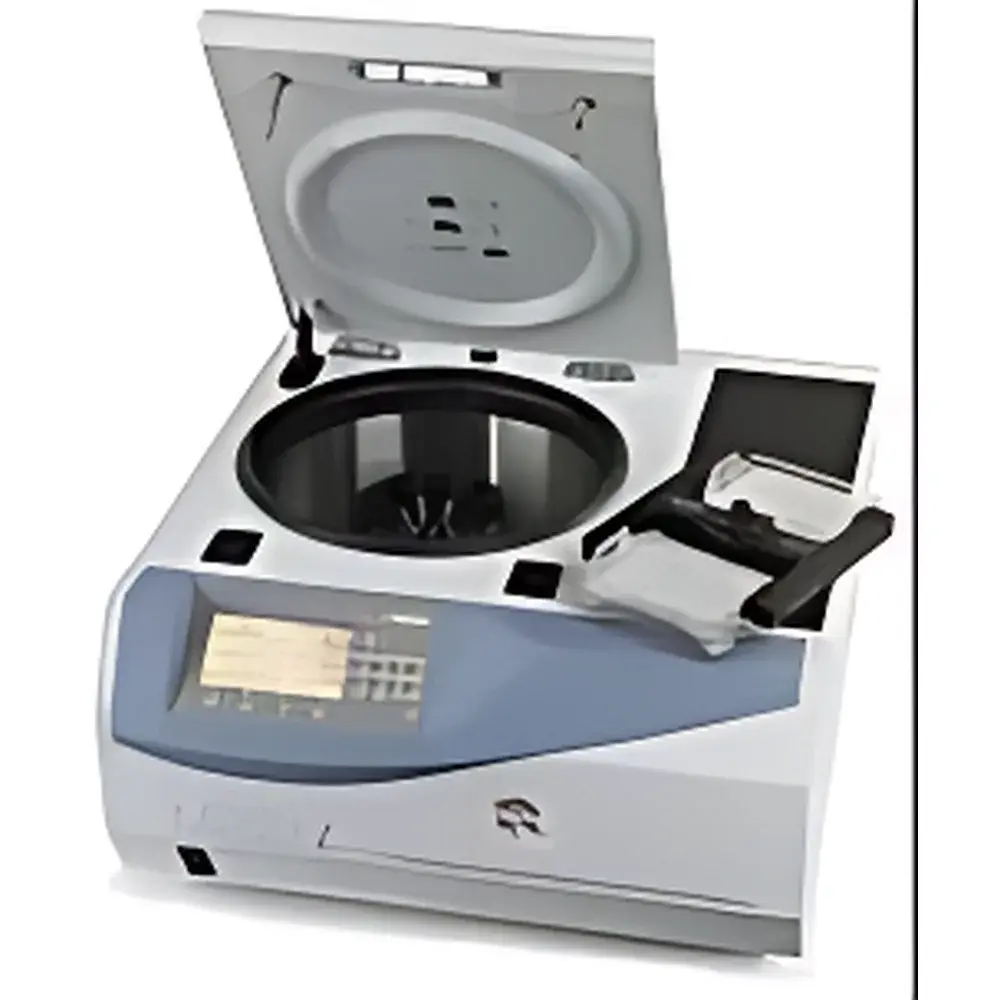
Thermo Fisher Scientific MR23i High-Performance Refrigerated Centrifuge
| Brand | Thermo Fisher Scientific |
|---|---|
| Origin | USA |
| Model | MR23i |
| Maximum RCF | 36,668 × g |
| Maximum Speed | 23,000 rpm |
| Temperature Range | −8 °C to +40 °C (1 °C increments) |
| RCF Range | 20–36,668 × g |
| Speed Range | 500–23,000 rpm |
| Acceleration/Deceleration Profiles | 10 each |
| Timer | 1 s–99 min 59 s + continuous |
| HRF (Centrifugation Integral) | 100–281 × 10¹² |
| Capacity | 4 × 200 mL (swing), 6 × microplates, 60 × 1.5/2 mL (fixed-angle), 192 × 0.4 mL (rotor-specific) |
| Safety Certifications | CAMR-compliant sealed rotors |
| Drive System | Brushless motor with AUTO-LOCK quick-change rotor interface (≤5 s) |
| Control Interface | VIDEOset™ graphical touchscreen panel (20-bit display, 4-language support: English, Spanish, French, German) |
| Data Management | 32 user-programmable protocols with password protection |
| Compliance | Designed for GLP/GMP environments |
Overview
The Thermo Fisher Scientific MR23i is a high-performance, refrigerated benchtop centrifuge engineered for precision, reproducibility, and operational flexibility across diverse life science and clinical laboratory workflows. Utilizing advanced brushless induction motor technology and a rigid, vibration-damped chassis, the MR23i delivers stable rotational dynamics at speeds up to 23,000 rpm and relative centrifugal forces (RCF) up to 36,668 × g—enabling efficient pelleting of subcellular organelles, viral particles, and nanoscale extracellular vesicles. Its active refrigeration system maintains sample temperature between −8 °C and +40 °C with ±0.5 °C accuracy across full-speed, full-load conditions, incorporating patented temperature compensation to ensure true sample thermal integrity regardless of rotor geometry or ambient fluctuations. The system operates on a microprocessor-based control architecture featuring real-time self-diagnostic monitoring, automatic imbalance detection, dual mechanical door interlocks, and overcurrent/overtemperature shutdown—meeting stringent safety requirements for unattended operation in regulated environments.
Key Features
- Auto-Lock™ rotor coupling system enables secure, tool-free rotor exchange in ≤5 seconds—minimizing downtime and reducing operator exposure during routine method changes.
- VIDEOset™ graphical user interface with 20-bit resolution display supports intuitive parameter entry, real-time run visualization, and contextual error diagnostics in four selectable languages (English, Spanish, French, German).
- True RCF programming: Automatically calculates and applies correct acceleration based on selected rotor, bucket, and adapter configuration—eliminating manual radius correction errors.
- Centrifugation Integral (HRF) function quantifies total centrifugal exposure (rpm × time × g-force), ensuring method reproducibility across instruments and operators—critical for SOP-driven QC and regulatory submissions.
- 10 programmable acceleration and 10 deceleration profiles allow optimization for shear-sensitive samples (e.g., intact nuclei, exosomes, or density gradient layers), including “no-brake” coast-down for gradient preservation.
- Brushless motor design ensures maintenance-free operation over extended service intervals, with no carbon dust accumulation or commutator wear—reducing contamination risk and lifecycle cost.
Sample Compatibility & Compliance
The MR23i accommodates an extensive range of sample formats via 12 interchangeable rotor types—including six CAMR-certified sealed rotors validated for biosafety level 2 (BSL-2) containment and aerosol mitigation during high-speed processing of infectious agents or clinical specimens. Compatible configurations include swing-bucket rotors (SWM 180.5: 4 × 200 mL; MTM 6.4: 2 deep-well plates + 6 microplates), fixed-angle rotors (up to 6 × 100 mL), and high-throughput drum rotors (60 × 1.5/2 mL or 192 × 0.4 mL). All rotors are precision-balanced and certified to ISO 15197 and IEC 61010-2-020 standards. The system’s thermal management and mechanical stability support compliance with USP , ISO 13485, and GLP/GMP documentation requirements when paired with validated electronic record systems.
Software & Data Management
While the MR23i operates autonomously via its embedded VIDEOset™ firmware, it integrates seamlessly with Thermo Fisher’s Connect™ ecosystem for centralized instrument fleet management, remote monitoring, and electronic logbook generation. Protocol storage includes 32 user-defined methods with individual password protection—supporting role-based access control (RBAC) and preventing unauthorized parameter modification. Timestamped run logs capture RCF, speed, temperature, time, HRF value, and fault codes. When deployed with validated LIMS or ELN platforms, the MR23i meets FDA 21 CFR Part 11 requirements for electronic signatures, audit trails, and data integrity—ensuring traceability from sample loading to final pellet recovery.
Applications
- Cell biology: Isolation of mitochondria, lysosomes, and plasma membranes via differential centrifugation using sequential rotor configurations.
- Clinical diagnostics: High-throughput processing of EDTA, heparin, and serum separator tubes (up to 20 × 5–7 mL vacuum tubes) with consistent hematocrit control.
- Biopharmaceutical development: Clarification of monoclonal antibody harvests and purification intermediates under controlled low-temperature conditions.
- Virology & gene therapy: Concentration of lentiviral and AAV vectors using sealed rotors compliant with BSL-2 containment guidelines.
- Proteomics & metabolomics: Rapid pelleting of protein precipitates or lipid droplets prior to LC-MS analysis—preserving labile post-translational modifications.
FAQ
Does the MR23i support validation documentation for GxP environments?
Yes—when operated with validated software interfaces and documented SOPs, the MR23i supports IQ/OQ/PQ execution and satisfies core requirements of FDA 21 CFR Part 11, EU Annex 11, and ISO/IEC 17025.
Can I set RCF directly without knowing the rotor radius?
Yes—the VIDEOset™ interface auto-calculates required rpm based on selected rotor model and adapter type, eliminating manual radius input errors.
Is temperature compensation active during all rotor types and speeds?
Yes—the system dynamically adjusts compressor output and airflow distribution to maintain target temperature within ±0.5 °C across all rotors and load conditions.
What safety certifications apply to sealed rotors?
All sealed rotors carry CAMR (Commission for the Accreditation of Medical Research) certification for aerosol containment during high-speed centrifugation of pathogenic materials.
How does the HRF (Centrifugation Integral) improve method transfer?
HRF expresses total centrifugal exposure as a single scalar value (×10¹² units), enabling direct comparison and replication of sedimentation kinetics across different centrifuges, rotors, or laboratories.



