
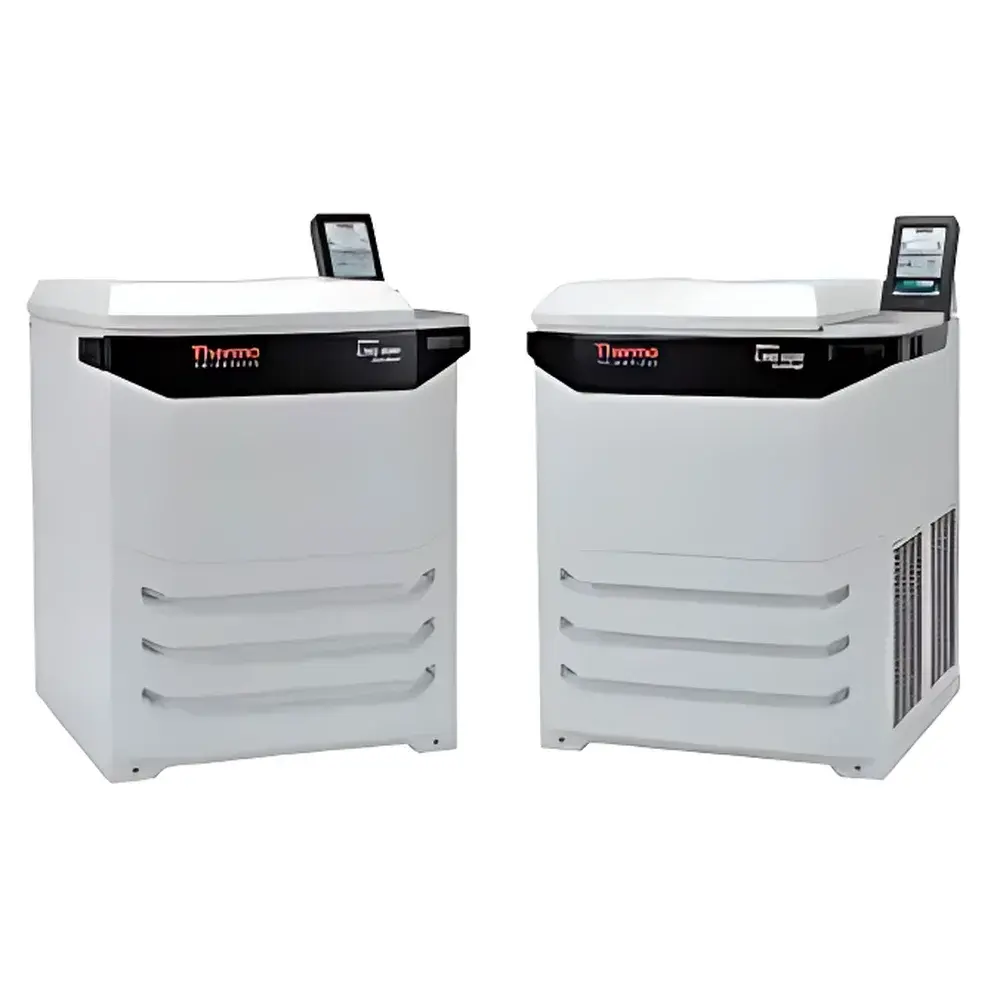
Thermo Fisher Sorvall LYNX High-Speed Floor Model Centrifuge
| Brand | Thermo Fisher |
|---|---|
| Origin | USA |
| Model | Sorvall LYNX |
| Instrument Type | Floor-standing centrifuge |
| Speed Range | 10,000–29,000 rpm |
| Max RCF | 100,650 × g |
| Max Capacity | 6 × 1000 mL |
| Dimensions (H×D×W) | 930 × 805 × 700 mm |
| Weight | 293 kg |
| Temperature Range | –20 to +40 °C |
| Vacuum System | Intelligent vacuum system with optional HEPA filtration |
| Drive | High-torque brushless motor |
| Rotor Locking | Auto-Lock® |
| Rotor Recognition | Auto-ID® |
| Rotor Material | Fiberlite® carbon fiber |
| Biosafety | ClickSeal® biocontainment lid |
| Acceleration/Deceleration | 9 acceleration / 10 deceleration profiles |
| Run Time | Up to 99 h continuous |
| Pre-cooling | Yes |
| ACE Integrator | Yes |
| Compliance Features | User log, role-based access control, audit trail, automatic door opening, rotor cover handle, integrated training videos, multilingual UI |
Overview
The Thermo Fisher Sorvall LYNX High-Speed Floor Model Centrifuge is an engineered platform for high-throughput, high-precision separation of biological and chemical samples in demanding laboratory environments. Designed around the principles of rotor dynamics, thermal management, and biosafety engineering, the LYNX leverages advanced centrifugal force generation—up to 100,650 × g—to resolve subcellular components, viruses, organelles, macromolecular complexes, and particulate suspensions with reproducible sedimentation kinetics. Its floor-standing architecture accommodates large-volume processing (up to 6 L per run) while maintaining mechanical stability under sustained high-speed operation. The system operates across a wide temperature range (–20 to +40 °C), enabling temperature-sensitive separations such as mitochondrial isolation or cold-active enzyme purification. Unlike benchtop units, the LYNX integrates intelligent vacuum control and active heat dissipation (<2 kW thermal output) to minimize sample warming during prolonged runs—critical for preserving labile biomolecules.
Key Features
- Auto-Lock® Rotor Engagement: One-button rotor installation and removal eliminates manual threading, reducing mechanical wear and operator error while ensuring precise axial alignment.
- Auto-ID® Instant Rotor Recognition: Embedded RFID tags in each certified rotor automatically configure speed, RCF, and time limits—preventing overspeed events and enforcing ISO 20957-compliant safety protocols.
- Fiberlite® Carbon Fiber Rotors: Lightweight, high-strength composite rotors reduce inertia and energy consumption while increasing fatigue life and enabling faster acceleration/deceleration cycles.
- ClickSeal® Biocontainment Lid: Patented dual-latch sealing mechanism achieves Class II BSL-2 containment integrity, validated per ANSI/NSF 49 and EN 12469 standards for aerosol suppression during high-speed spin-down of pathogenic samples.
- Intelligent Vacuum System: Maintains optimal chamber pressure during ultracentrifugation, minimizing convection currents and improving resolution—particularly for density gradient separations (e.g., sucrose or iodixanol gradients).
- ACE (Automatic Calibration & Error Correction) Integrator: Continuously monitors rotor imbalance, drive current, and bearing vibration; dynamically adjusts acceleration profiles to maintain operational tolerance within ±5% of rated load capacity.
Sample Compatibility & Compliance
The LYNX supports diverse sample formats including 6 × 1000 mL bottles, 40 × 50 mL conical tubes, 24 standard microplate carriers, or 96 × 15 mL screw-cap tubes—enabling scalable workflow integration from preparative to analytical applications. All rotors are certified to IEC 61010-2-020 and carry CE marking for safe operation in EU-regulated laboratories. The system meets FDA 21 CFR Part 11 requirements for electronic records and signatures when configured with user permission tiers, audit-trail logging, and password-protected method storage. Routine maintenance and calibration documentation align with GLP and GMP frameworks, supporting regulatory submissions in biopharmaceutical QC, clinical diagnostics, and academic core facilities.
Software & Data Management
Equipped with a 10.4-inch capacitive touchscreen interface, the LYNX provides intuitive program creation, real-time parameter visualization, and contextual help—including on-device video tutorials for rotor handling and emergency shutdown procedures. Method libraries support version-controlled protocol archiving with timestamped execution logs. Export options include CSV and PDF reports compliant with LIMS integration standards. Optional Thermo Fisher Connect software enables remote monitoring, predictive maintenance alerts, and centralized fleet management across multi-instrument labs—facilitating ISO/IEC 17025 traceability and instrument utilization analytics.
Applications
- Preparative isolation of exosomes, extracellular vesicles, and viral particles via differential ultracentrifugation (e.g., using T29-8×50 or A27-8×50 rotors)
- Large-scale cell pellet harvesting (mammalian, bacterial, yeast) with minimal shear stress
- Density gradient centrifugation for ribosome profiling, nucleosome mapping, or lipoprotein fractionation
- Continuous-flow processing of clarified fermentation broths in biomanufacturing pilot workflows
- High-volume plasma separation for biobanking and translational research cohorts
- Environmental sample concentration (e.g., waterborne pathogens, microplastics) per EPA Method 1623.1
FAQ
What safety certifications does the Sorvall LYNX hold?
The instrument complies with IEC 61010-1, IEC 61010-2-020, UL 61010-1, and carries CE, UKCA, and cTUVus marks. Rotor assemblies are individually serial-numbered and certified for maximum speed and RCF per ISO 21501-4.
Can the LYNX be integrated into a validated quality system?
Yes—when deployed with Thermo Fisher’s validated software package, it supports 21 CFR Part 11 compliance, including electronic signature capture, audit trails, and role-based access control for SOP-driven environments.
Is pre-cooling available before run initiation?
Yes—the compressor-based refrigeration system cools the chamber to setpoint prior to rotor insertion, with temperature stabilization verified by internal NIST-traceable thermistors.
How is rotor lifetime managed?
Each Fiberlite® rotor contains an embedded memory chip recording cumulative run hours, maximum speed history, and maintenance events—accessible via the touchscreen or Connect software for predictive replacement scheduling.
Does the system support third-party rotors or adapters?
No—only Thermo Fisher-certified rotors with Auto-ID® chips are recognized and enabled, ensuring mechanical integrity and regulatory compliance.



