
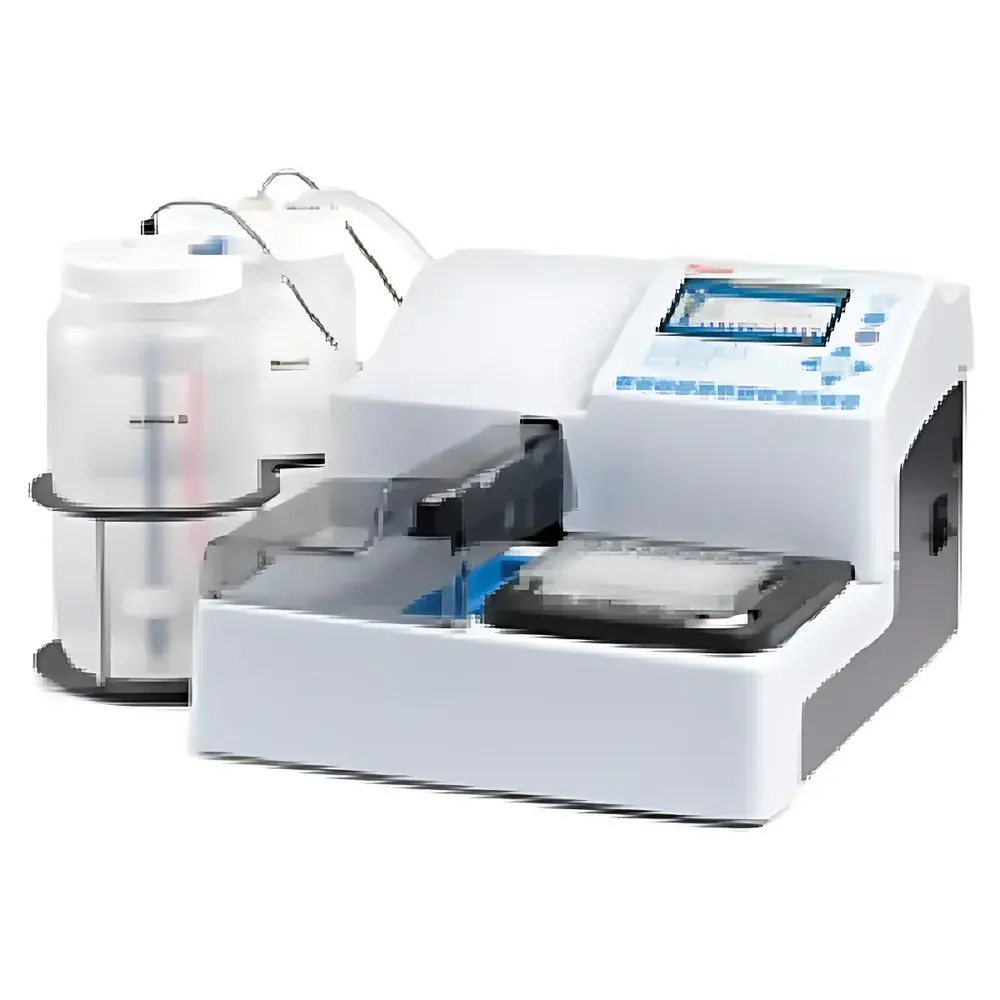
Thermo Fisher Wellwash / Wellwash Versa Microplate Washer
| Brand | Thermo Fisher |
|---|---|
| Origin | Shanghai, China |
| Manufacturer Type | Authorized Distributor |
| Product Origin | Domestic (China) |
| Model | Wellwash / Wellwash Versa Microplate Washer |
| Pricing | Available Upon Request |
| Display | Large-color TFT touchscreen with ergonomic keypad |
| User Interface | Intuitive graphical workflow editor with pre-configured assay templates |
| Fluid Handling | Non-pressurized reservoir system with integrated level sensors (2 L wash buffer bottle, 2 L waste bottle, 8 L rinse head) |
| Aerosol Containment | Integrated anti-aerosol lid with sealed aspiration path |
| Plate Detection | Optical microplate presence sensor (96-well and 384-well compatible) |
| Residual Volume | <2 µL per well after wash cycle (typical, using standard ELISA protocols) |
| Wash Modes | Programmable multi-step washing (pre-wash, main wash, final rinse), customizable soak times, variable aspiration speed control |
| Safety Compliance | Meets IEC 61010-1:2010 for laboratory equipment safety |
| Regulatory Support | Audit-trail ready configuration |
Overview
The Thermo Fisher Wellwash and Wellwash Versa Microplate Washers are benchtop automated plate washers engineered for precision, reproducibility, and operator safety in high-throughput immunoassay workflows. Based on gravimetric fluid delivery and vacuum-driven aspiration—principles aligned with ASTM E2575-18 (Standard Guide for Validation of Automated Immunoassay Systems)—these instruments deliver consistent wash performance across 96-well and 384-well microplates without pressurized fluid systems. The non-pressurized reservoir architecture eliminates risks associated with over-pressurization, tubing rupture, or uncontrolled splashing, making the platform especially suitable for BSL-2 environments handling infectious or biohazardous samples. Built and assembled in Shanghai under Thermo Fisher’s global quality management system (ISO 13485 compliant manufacturing oversight), the Wellwash series integrates hardware-level safeguards—including real-time liquid level monitoring, optical plate detection, and aerosol-tight lid engagement—ensuring process integrity from startup to completion.
Key Features
- Large-format color TFT touchscreen with context-sensitive soft keys and tactile keypad—designed for glove-compatible operation and rapid protocol navigation.
- Graphical workflow editor enabling drag-and-drop step sequencing (e.g., pre-wash → soak → aspiration → final rinse); no programming knowledge required.
- Non-pressurized fluid handling: wash buffer and waste bottles operate at ambient pressure, reducing maintenance frequency and eliminating need for pressure regulators or relief valves.
- Dual-level optical sensors in both 2 L wash and waste reservoirs provide continuous monitoring and automatic pause-on-low-fluid or full-waste conditions.
- Integrated anti-aerosol lid seals the plate during aspiration, suppressing droplet dispersion and minimizing cross-contamination risk—validated per ISO 22174:2021 (microbiological risk mitigation in automated lab devices).
- Microplate presence sensor confirms correct placement prior to cycle initiation, preventing dry aspiration and nozzle clogging.
- Aspiration speed and dwell time are independently adjustable per wash step, supporting optimization for low-volume assays (e.g., cytokine ELISAs) or viscous matrices (e.g., serum-based samples).
Sample Compatibility & Compliance
The Wellwash platform accommodates standard ANSI/SLAS-format microplates (96-well flat-bottom, U/V-bottom, and 384-well plates) with compatibility confirmed for common ELISA substrate types including TMB, OPD, and ABTS. All wetted components—including fluidic manifolds, tubing, and wash heads—are manufactured from chemically resistant polymers (e.g., PTFE-lined stainless steel aspiration probes, medical-grade PVC tubing) compliant with USP Class VI and ISO 10993-5 cytotoxicity standards. The instrument meets IEC 61010-1:2010 for electrical safety and is designed to support laboratories operating under GLP (OECD Principles) and GMP (FDA 21 CFR Part 11–ready data export via optional Thermo Fisher Connect software). While not an in vitro diagnostic (IVD) device, its performance validation protocols align with CLSI EP12-A2 and ISO 15197:2013 analytical reliability benchmarks.
Software & Data Management
Onboard firmware includes embedded method storage (up to 100 user-defined protocols), cycle logging (timestamped start/stop, error codes, fluid usage), and USB export of CSV-formatted run reports. When paired with Thermo Fisher Connect PC software (optional), users gain access to electronic signature-enabled method versioning, audit trail generation (user ID, timestamp, parameter changes), and integration into LIMS via HL7 or CSV batch import. All software modules adhere to ALCOA+ principles (Attributable, Legible, Contemporaneous, Original, Accurate, Complete, Consistent, Enduring, Available) for regulatory submissions.
Applications
Primary use cases include ELISA, ELISpot, and cell-based binding assays requiring stringent removal of unbound conjugates while preserving antigen–antibody complexes. The low residual volume (<2 µL/well) directly contributes to reduced background noise and improved signal-to-noise ratios in downstream spectrophotometric or chemiluminescent detection. Additional validated applications include plate pre-clearing prior to MSD (Meso Scale Discovery) assays, bead-based suspension array washing (e.g., Luminex xMAP), and preparation of plates for high-sensitivity electrochemiluminescence readouts. Routine QC testing confirms consistent CVs <3% across replicate wash cycles under controlled environmental conditions (20–25°C, 30–60% RH).
FAQ
Is the Wellwash Versa compatible with 384-well plates?
Yes—optical plate detection and adjustable wash head height support ANSI/SLAS-compliant 384-well microplates without adapter kits.
Does the system support FDA 21 CFR Part 11 compliance?
The standalone instrument does not include electronic signatures or role-based access control; however, when used with Thermo Fisher Connect software (v3.2+), it enables Part 11–compliant audit trails, secure user authentication, and electronic record retention.
What maintenance is required for long-term reliability?
Daily: Wipe exterior surfaces and inspect aspiration tips for blockage. Weekly: Flush fluid paths with deionized water and perform calibration verification using supplied test plate. Annually: Replace fluidic tubing and validate aspiration volume accuracy per manufacturer’s PQ protocol.
Can wash parameters be exported for SOP documentation?
Yes—protocol definitions, cycle logs, and error reports export as timestamped CSV files suitable for inclusion in laboratory SOPs and regulatory inspection packages.
Is service support available outside mainland China?
Thermo Fisher provides global technical support coordination through regional service centers; local distributor-certified engineers perform on-site repairs under the standard 12-month limited warranty.





