
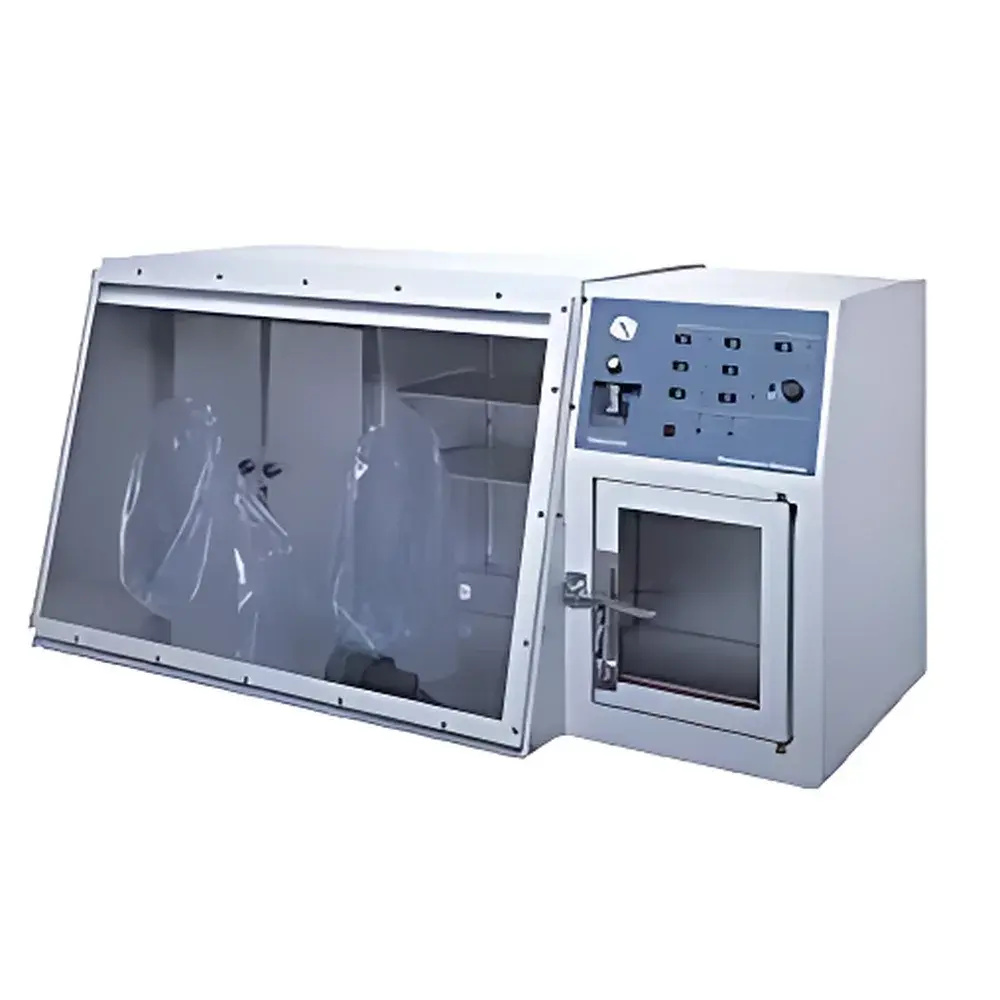
Thermo Scientific 1029 Anaerobic Chamber
| Brand | Thermo Fisher Scientific |
|---|---|
| Origin | USA |
| Model | 1029 |
| Internal Volume | 77 L |
| Operating Temperature Range | Ambient +4°C to 70°C (fixed at 35°C option available) |
| Temperature Uniformity at 37°C | ±0.4°C |
| Temperature Accuracy | ±0.3°C |
| Anaerobic Gas Requirement | High-purity N₂/H₂/CO₂ (e.g., 85/10/5 or 90/5–7/5 vol%) |
| O₂ Residual Level | <10 ppm |
| Catalyst System | Palladium-based with activated carbon H₂S scavenger |
| Gas Consumption Reduction | ~50% vs. conventional systems |
| Work Area Dimensions (W×H×D) | 445×559×305 mm |
| External Dimensions (W×H×D) | 1539×762×787 mm |
| Glove Port | Elliptical, full-access design |
| Viewing Panel | Flexible anti-fog acrylic (optional rigid polycarbonate) |
| Shelf Configuration | Two adjustable stainless-steel shelves in work area |
| Power Input | 230 V / 50 Hz |
| Compatible Vacuum Pump | Recommended model 901025 |
| Optional Enclosure | Thermo Scientific 1016 Outer Cabinet (1092×762×787 mm) |
Overview
The Thermo Scientific™ 1029 Anaerobic Chamber is a rigorously engineered, high-integrity workstation designed for the cultivation, isolation, and analysis of obligate anaerobes under strictly controlled oxygen-free conditions. Utilizing a closed-loop gas exchange architecture with continuous catalytic deoxygenation, the system maintains O₂ concentrations below 10 ppm—meeting ISO 11133:2014 and CLSI M45-A3 requirements for anaerobic microbiological testing. Its dual-zone thermal management—comprising an insulated incubation chamber and a thermally stabilized operator workspace—ensures stable physiological conditions for fastidious organisms including Clostridium difficile, Bacteroides fragilis, and Fusobacterium nucleatum. The chamber operates on standard high-purity gas mixtures (e.g., 85% N₂ / 10% H₂ / 5% CO₂), with integrated palladium catalysts and activated carbon filters enabling long-term catalyst integrity and reproducible atmospheric control without manual regeneration.
Key Features
- 77-liter internal working volume with optimized airflow distribution and uniform temperature profile (±0.4°C at 37°C)
- Stainless-steel, non-condensing interior featuring two independently adjustable shelves and multiple GFCI-protected power outlets
- Ergonomic elliptical glove ports enabling full-arm access to all zones while preserving seal integrity
- Anti-fog flexible acrylic front panel with optional rigid polycarbonate upgrade for enhanced durability and optical clarity
- Automated continuous gas recirculation system with real-time O₂ monitoring feedback loop
- Palladium-on-alumina catalyst combined with activated carbon sulfur scavenging—reducing H₂S-induced catalyst poisoning and extending service life by >300% versus non-scavenged systems
- Gas-efficient operation: achieves equivalent deoxygenation using ~50% less mixed gas than traditional single-pass chambers
- Configurable temperature setpoints from ambient +4°C to 70°C, with fixed 35°C mode pre-calibrated for clinical microbiology workflows
Sample Compatibility & Compliance
The 1029 chamber supports diverse sample formats—including Petri dishes (up to 425 × 100 mm plates), anaerobic jars, blood culture bottles, tissue explants, and microtiter plates—without compromising sterility or gas homogeneity. All wetted materials comply with USP Class VI biocompatibility standards, and internal surfaces are electropolished 316L stainless steel (ASTM A967 passivated). The system meets ISO 13485:2016 design controls for medical device manufacturing environments and supports GLP/GMP documentation via optional audit-trail-enabled data loggers. It is validated for use in accordance with FDA 21 CFR Part 11 when paired with Thermo Fisher’s Traceable™ software suite.
Software & Data Management
While the 1029 operates as a standalone hardware platform, it integrates seamlessly with Thermo Fisher’s optional Traceable™ Environmental Monitoring System (EMS) for continuous logging of temperature, O₂ concentration, pressure differential, and gas flow rates. EMS provides configurable alarms, encrypted CSV export, electronic signature support, and 21 CFR Part 11-compliant user access controls—including role-based permissions and immutable audit trails. All sensor calibrations are traceable to NIST standards, and firmware updates follow IEC 62304 Class B software lifecycle protocols.
Applications
- Clinical microbiology: Isolation and identification of anaerobic pathogens from stool, wound, and abscess specimens per CLSI M45-A3 guidelines
- Pharmaceutical QC: Anaerobic stability testing of probiotic formulations and live biotherapeutic products (LBPs)
- Gut microbiome research: Long-term co-culture of strict anaerobes with facultative strains under physiologically relevant pH and redox conditions
- Veterinary diagnostics: Culture of Actinobacillus lignieresii and other ruminant-associated anaerobes
- Biotechnology: Anaerobic fermentation optimization for next-generation biohydrogen and short-chain fatty acid production
- Regulatory submissions: Generation of data compliant with USP , EP 2.6.12, and JP 4.06 for anaerobic sterility testing
FAQ
What gas mixture is required for optimal operation?
High-purity N₂/H₂/CO₂ (e.g., 85/10/5 or 90/5–7/5 vol%) delivered via dedicated gas manifolds with inline particulate and moisture filtration. Hydrogen concentration must remain ≥5% to sustain catalytic O₂ removal efficiency.
Can the chamber be validated for GMP environments?
Yes—when equipped with optional calibrated sensors and Traceable™ EMS, the 1029 supports IQ/OQ/PQ protocols aligned with ASTM E2500 and EU Annex 15. Full validation documentation packages are available upon request.
Is external vacuum required for initial chamber evacuation?
A compatible vacuum pump (e.g., Thermo Fisher model 901025) is required for initial air purge and periodic maintenance cycles. The system includes automated pressure-sensing interlocks to prevent unsafe operation during vacuum phases.
How often must the palladium catalyst be replaced?
Under typical clinical usage (8 hrs/day, 5 days/week), catalyst replacement is recommended every 18–24 months. Activated carbon H₂S traps extend this interval by mitigating sulfur-induced deactivation.
Does the system support remote monitoring?
Via optional Ethernet-connected Traceable™ EMS, real-time environmental parameters can be accessed through secure web interfaces or integrated into facility-wide BMS platforms using Modbus TCP or OPC UA protocols.






