
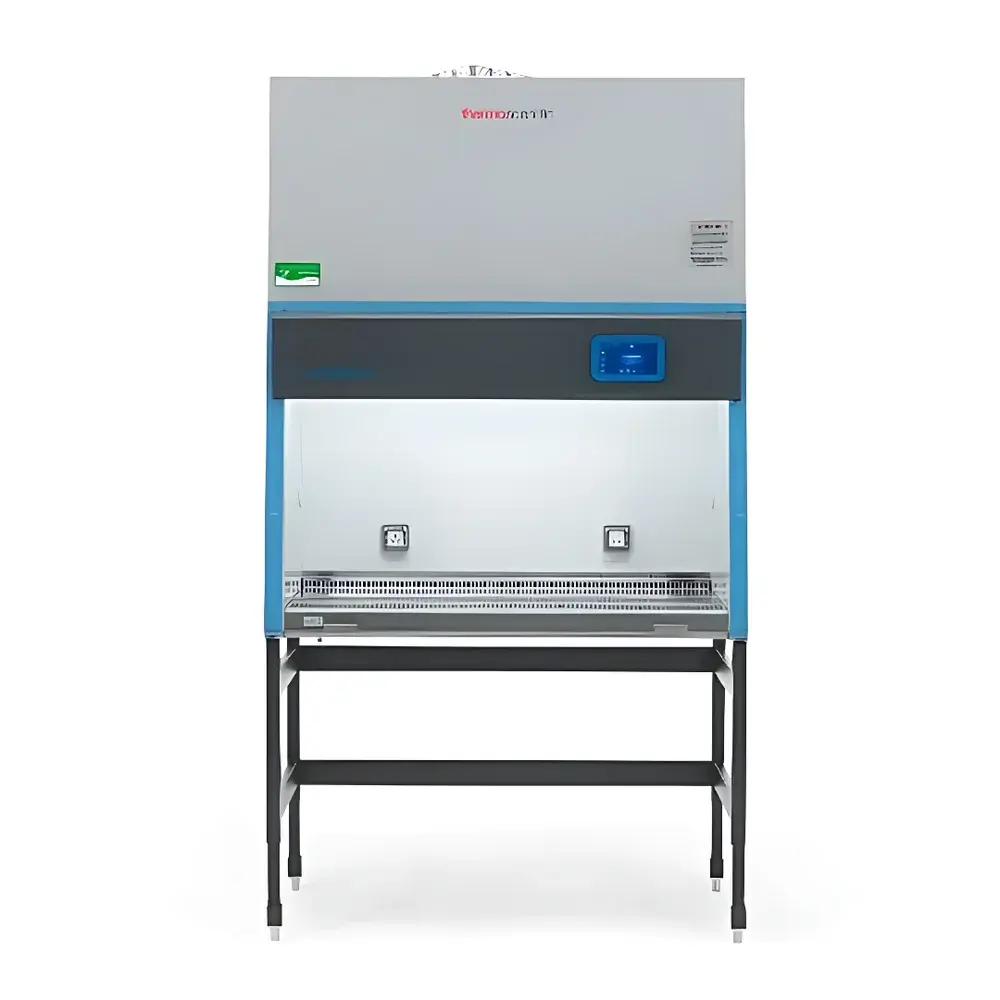
Thermo Scientific 1500 Series A2 Biological Safety Cabinet
| Brand | Thermo Fisher |
|---|---|
| Origin | USA |
| Manufacturer Type | Original Equipment Manufacturer (OEM) |
| Product Origin | Imported |
| Model | 1500 Series A2 BSC |
| Instrument Class | Class II Biological Safety Cabinet |
| External Dimensions (L×W×H) | 1300 × 800 × 1568 mm |
| Internal Dimensions (L×W×H) | 1200 × 630 × 780 mm |
Overview
The Thermo Scientific™ 1500 Series A2 Biological Safety Cabinet is a Class II, Type A2 biosafety cabinet engineered for precision containment and operational reliability in modern life science laboratories. It operates on the principle of inward airflow (70% recirculated through H14 HEPA filtration, 30% exhausted externally via ducted connection), providing simultaneous protection for personnel, product, and environment against biological aerosols and low-to-moderate risk chemical vapors. Designed to comply with NSF/ANSI 49-2022 and EN 12469:2000 standards, the cabinet integrates advanced aerodynamic control, real-time airflow monitoring, and fail-safe alarm architecture to maintain consistent performance under dynamic laboratory conditions.
Key Features
- SmartFlow™ Plus intelligent airflow balancing system dynamically adjusts blower speed to maintain nominal inflow velocity (≥0.5 m/s at work opening) and downflow velocity (≥0.3 m/s over work surface), compensating for filter loading and sash position changes.
- Digital Airflow Verification (DAVe™ Plus) continuously monitors inflow and downflow velocities; triggers visual and audible alarms if deviations exceed ±10% of setpoint, ensuring immediate operator awareness of compromised containment integrity.
- H14 HEPA filters (≥99.995% efficiency at 0.3 µm) installed in both supply and exhaust air paths provide validated particulate removal for microbial and particulate contaminants.
- 7-inch capacitive touchscreen GUI displays real-time airflow metrics, UV lamp status, filter life estimation, sash height, and system diagnostics—enabling intuitive operation and traceable performance logging.
- Ergonomic 10° sash tilt angle, LED task lighting (≥1000 lux uniformity across work surface), and low-noise operation (<65 dB[A] at 1 m) collectively reduce user fatigue during extended procedures.
- SmartClean™ front window design eliminates recessed joints and horizontal ledges, minimizing dust accumulation and enabling rapid decontamination with standard EPA-registered disinfectants.
- SmartPort™ integrated cable management system provides sealed, accessible pass-throughs for power, data, and fluid lines—preserving containment integrity without compromising workflow flexibility.
Sample Compatibility & Compliance
The 1500 Series A2 BSC supports routine handling of Risk Group 1–2 biological agents (per WHO classification) and limited use of volatile toxic chemicals (e.g., ethidium bromide, chloroform) when connected to an external exhaust system meeting ASHRAE 110 tracer gas testing requirements. Its structural integrity and airflow containment have been validated per NSF/ANSI 49-2022 Annex D (smoke pattern visualization), Annex E (inflow velocity mapping), and Annex F (airborne particle challenge). The cabinet’s construction materials—including stainless steel work surface and epoxy-coated interior panels—are compatible with common laboratory disinfectants and autoclave-compatible accessories. All firmware and UI logic are designed to support GLP/GMP-aligned documentation practices, including timestamped event logs and configurable audit trails.
Software & Data Management
The embedded controller firmware supports export of operational logs (CSV format) containing timestamps, sash position history, airflow readings, alarm events, and UV cycle records. While no proprietary desktop software is required for basic operation, optional integration with Thermo Fisher’s LabConnect™ platform enables centralized monitoring of multiple cabinets across facility networks. All data storage adheres to IEC 62304 Class B medical device software safety standards, and the system maintains full compliance with FDA 21 CFR Part 11 requirements for electronic records and signatures when deployed with appropriate IT infrastructure controls (e.g., role-based access, electronic audit trail, secure login).
Applications
This cabinet is routinely deployed in molecular biology labs for plasmid transfection, CRISPR-Cas9 editing, and viral vector preparation; in pharmaceutical QC environments for aseptic media fill simulations and sterility testing; in clinical microbiology for isolation and subculture of pathogenic bacteria and fungi; and in academic research settings involving recombinant DNA work governed by NIH Guidelines. Its dual-recirculation/exhaust configuration makes it suitable for applications requiring both sterile product protection and low-level chemical vapor mitigation—such as antibiotic susceptibility testing using disc diffusion assays or RNA extraction workflows involving phenol-chloroform steps.
FAQ
Does the 1500 Series A2 BSC require ducted exhaust to operate safely?
Yes—ducting is mandatory for safe operation when volatile toxic chemicals are used. For microbiological work only, recirculation mode is permitted, provided room air quality and ambient temperature/humidity remain within specified limits.
What is the recommended maintenance schedule for HEPA filters?
H14 filters should be certified annually per NSF/ANSI 49, with replacement typically required every 3–5 years depending on usage intensity and environmental particulate load.
Can the touchscreen interface be locked to prevent unauthorized parameter changes?
Yes—the GUI supports multi-level password protection (operator, supervisor, service technician) with configurable access rights for airflow setpoints, UV programming, and calibration functions.
Is the cabinet compatible with third-party peripheral devices such as centrifuges or pipette aids?
All peripherals must be certified for use inside biosafety cabinets; Thermo Fisher recommends selecting low-profile, low-heat-generation equipment with smooth, non-porous surfaces to avoid airflow disruption and facilitate cleaning.
How does the SmartFlow™ Plus system respond to sash movement during operation?
The system continuously samples sash position via integrated encoder feedback and adjusts blower RPM in real time to preserve inflow velocity within ±5% of nominal setpoint across the full sash travel range (200–400 mm).




