
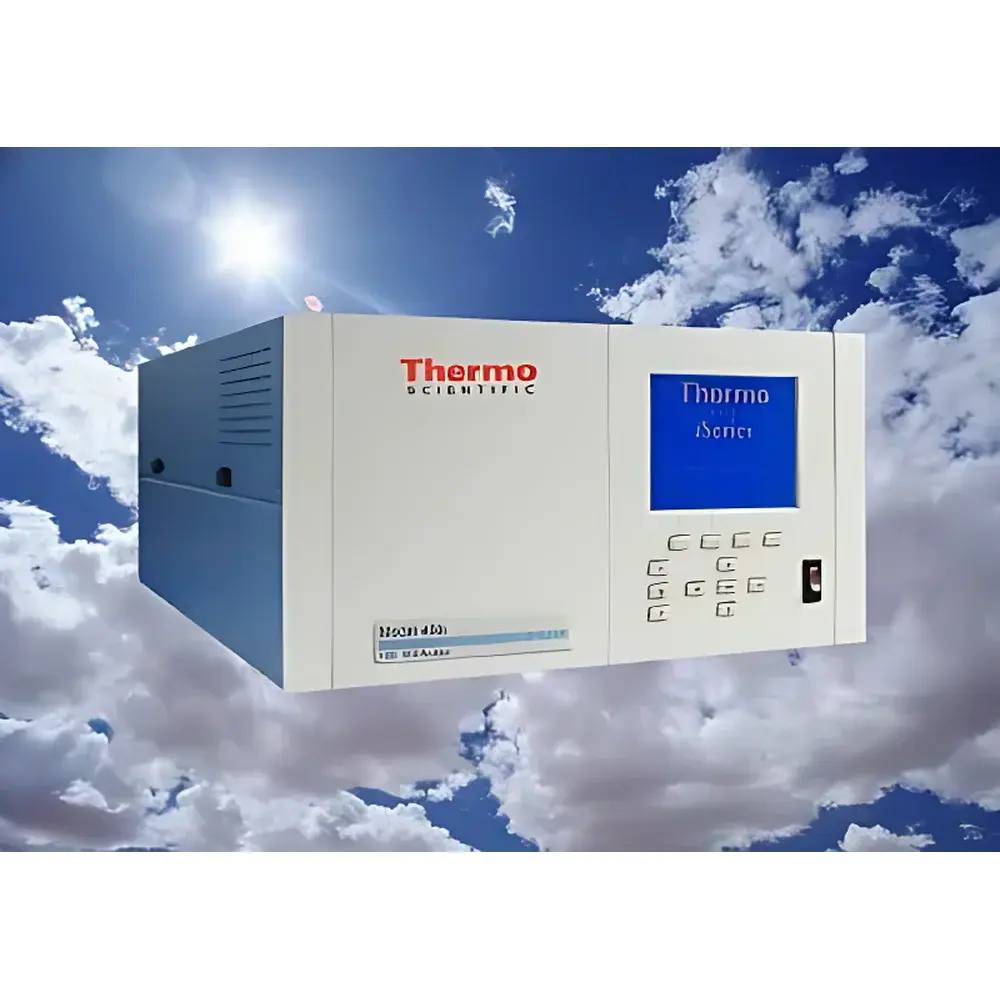
Thermo Scientific 450i H₂S and SO₂ Analyzer
| Brand | Thermo Fisher |
|---|---|
| Origin | USA |
| Manufacturer | Thermo Fisher Scientific |
| Product Type | Imported |
| Model | 450i |
| Detection Principle | Pulsed UV Fluorescence (H₂S converted to SO₂) |
| Measurement Range | 0–0.05 / 0.1 / 0.2 / 0.5 / 1 / 2 / 5 / 10 ppm |
| Zero Noise | 1.0 ppb RMS (60-sec avg) |
| LOD | 2.0 ppb (60-sec avg) |
| Zero Drift (24 h) | <1 ppb |
| Span Drift (30 days) | ±1% FS |
| Optical Filter | Reflective Bandpass |
| Reaction Chamber | Temperature-Stabilized |
| Light Source | Long-Life Pulsed UV Lamp |
| Data Storage | Internal Flash Memory |
| Connectivity | Ethernet (Remote Access, Firmware Update, Data Export) |
| Display | High-Resolution LCD with 5-line auxiliary info |
Overview
The Thermo Scientific™ 450i H₂S and SO₂ Analyzer is a high-performance, regulatory-grade ambient air quality monitor engineered for continuous, trace-level quantification of hydrogen sulfide (H₂S) and sulfur dioxide (SO₂) in outdoor and indoor environments. It operates on the principle of pulsed ultraviolet (UV) fluorescence spectroscopy, wherein sampled H₂S is catalytically oxidized to SO₂ in a temperature-controlled reaction chamber. The resulting SO₂ molecules are excited by short-duration, high-intensity UV pulses at 214 nm; upon relaxation, they emit characteristic fluorescence at ~350 nm. This emitted signal is isolated using a reflective bandpass optical filter—offering superior spectral selectivity and reduced photodegradation compared to conventional transmissive filters—and detected by a low-noise photomultiplier tube (PMT). The pulsed excitation architecture enhances signal-to-noise ratio, enabling sub-ppb detection limits and exceptional long-term baseline stability—critical for compliance monitoring under EPA Method 16A, ASTM D5016, and ISO 7935.
Key Features
- Pulsed UV fluorescence detection with optimized lamp lifetime (>2 years typical) and stable photon flux output
- Reflective bandpass interference filter assembly minimizing UV-induced aging and improving optical throughput
- Temperature-stabilized catalytic converter and reaction chamber ensuring consistent H₂S-to-SO₂ conversion efficiency across ambient temperature fluctuations (−30 °C to +50 °C operating range)
- Low-drift analog electronics with auto-zero and auto-span calibration routines compliant with EPA Performance Specification 2 (PS-2) requirements
- Integrated flash memory supporting ≥30 days of second-by-second data logging (configurable averaging intervals: 1 s, 1 min, 5 min, 1 hr)
- Ethernet interface (10/100BASE-T) enabling remote configuration, real-time data streaming, firmware updates, and secure FTP-based data export
- High-resolution graphical LCD display showing primary concentration value plus five auxiliary parameters simultaneously (e.g., zero/span status, lamp energy, flow rate, temperature, pressure, diagnostic flags)
- User-customizable soft keys for rapid access to frequently used functions including manual zero/span, calibration history review, and alarm threshold adjustment
Sample Compatibility & Compliance
The 450i is designed for continuous measurement of H₂S and SO₂ in ambient air, stack emissions, and fenceline monitoring applications. It accepts standard 1/4″ OD PTFE or stainless-steel sample lines and integrates seamlessly with certified sample conditioning systems (e.g., Nafion dryers, particle filters, heated lines per EPA CTM-008). Its measurement performance meets or exceeds the precision, accuracy, and stability criteria defined in U.S. EPA Reference Method 16A for SO₂ and Method 16 for H₂S (via oxidation), as well as European Standard EN 14625. The analyzer supports audit-ready operation with full GLP/GMP-compliant data integrity features—including electronic signatures, user-access levels, and tamper-evident audit trails—aligned with FDA 21 CFR Part 11 requirements when deployed in regulated industrial hygiene or pharmaceutical environmental monitoring programs.
Software & Data Management
Data acquisition and instrument control are managed via Thermo Scientific™ Emissions Monitoring Software (EMS), a Windows-based platform supporting multi-instrument network deployment. EMS provides automated calibration scheduling, QC flagging (e.g., out-of-range flow, low lamp energy), trend visualization, and customizable report generation (PDF, CSV, XML). All raw and processed data are timestamped with UTC synchronization and stored with metadata including calibration gas certificates, operator ID, and system diagnostics. Remote access is secured via TLS 1.2 encryption and configurable firewall rules; data exports support EPA Air Quality System (AQS) formatting and can be ingested directly into third-party platforms such as EnviroWatch, AQS, or custom SCADA architectures.
Applications
- Ambient air quality networks (state/local regulatory agencies, EPA Core Sites)
- Industrial fenceline monitoring for oil refineries, natural gas processing facilities, pulp & paper mills, and wastewater treatment plants
- Occupational health and safety assessments in confined-space entry and sour gas handling operations
- Research-grade atmospheric chemistry studies requiring high temporal resolution and low-background detection
- Compliance verification for Title V permits and National Ambient Air Quality Standards (NAAQS) for SO₂
- Odor impact assessment where H₂S serves as a surrogate marker for reduced sulfur compounds
FAQ
How does the 450i distinguish between native SO₂ and SO₂ generated from H₂S oxidation?
The instrument uses sequential dual-mode operation: in H₂S mode, all sample passes through the catalytic converter; in SO₂-only mode, the converter is bypassed. Software-controlled valve sequencing ensures unambiguous species assignment without cross-interference.
Is the 450i compatible with existing Thermo i-series infrastructure?
Yes—it shares identical mechanical mounting, power requirements (100–240 VAC, 50/60 Hz), communication protocols (Modbus TCP, ASCII over Ethernet), and calibration gas interface standards with other i-series analyzers (e.g., 42i, 43i, 48i), enabling seamless integration into legacy monitoring stations.
What maintenance intervals are recommended for routine operation?
Lamp replacement every 24 months (typical), catalytic converter every 12–18 months depending on H₂S loading, and quarterly zero/span verification using NIST-traceable calibration gases. Full preventive maintenance is advised annually per Thermo Scientific Service Bulletin SB-450i-01.
Does the analyzer support automatic zero and span correction during unattended operation?
Yes—scheduled auto-zero (using purified zero air) and auto-span (using certified span gas) can be programmed with user-defined frequency and pass/fail criteria, with event logs retained for regulatory review.
Can the 450i be configured for simultaneous H₂S and SO₂ measurement in a single sample stream?
No—it measures one species per operational mode. However, dual-unit configurations with shared sample manifold and synchronized data logging are widely deployed to achieve concurrent H₂S/SO₂ reporting.







