
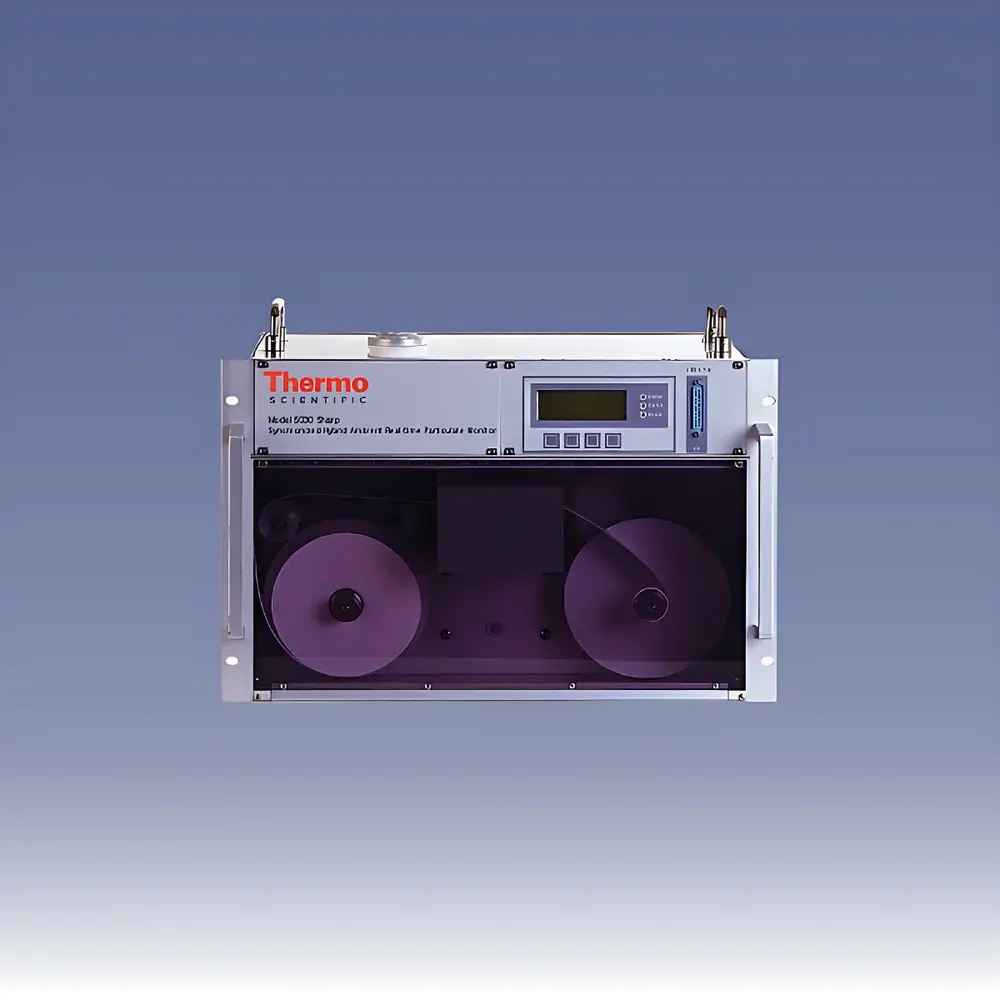
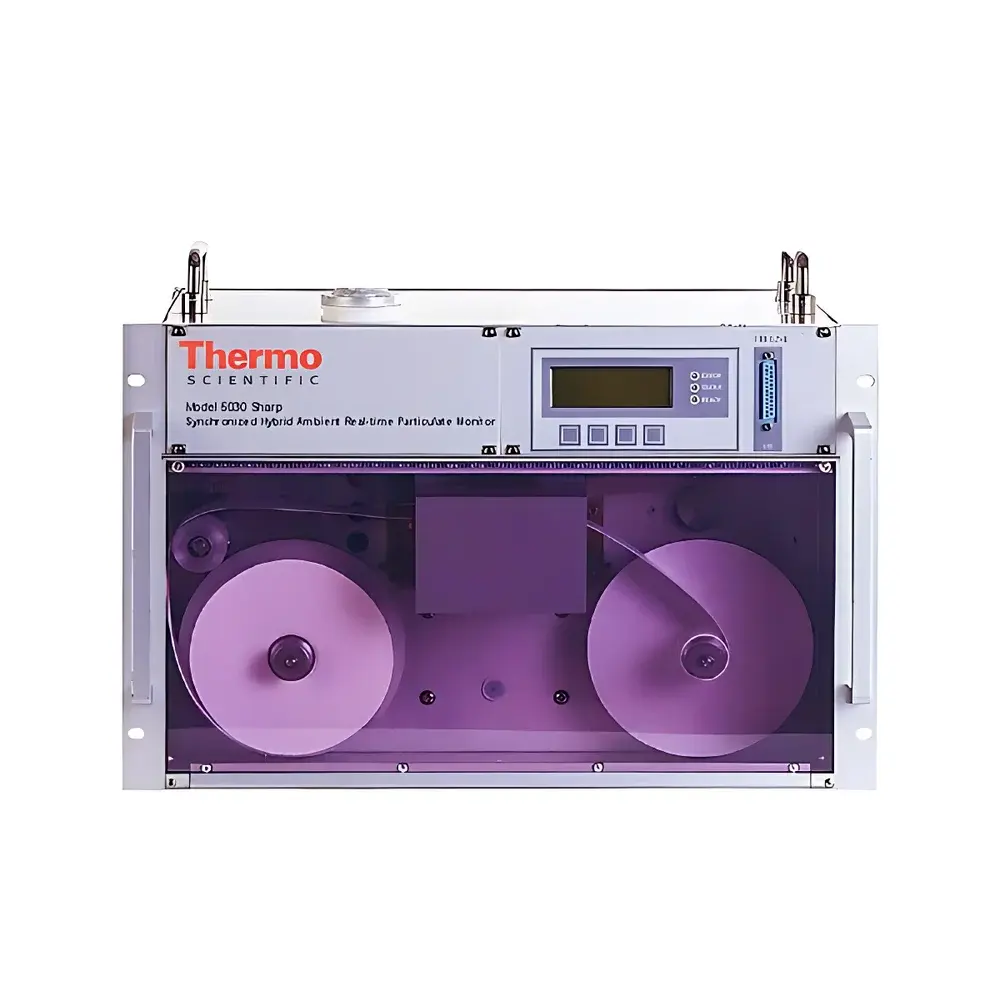
Thermo Scientific 5030 SHARP Particulate Matter Synchronized Hybrid Monitor
| Brand | Thermo Fisher |
|---|---|
| Origin | USA |
| Manufacturer | Thermo Fisher Scientific |
| Product Type | Imported |
| Model | 5030 (SHARP) |
| Measurement Method | Beta-ray Absorption + Light Scattering |
| Measured Parameters | PM₁₀ / PM₂.₅ |
| Concentration Range | 0–1,000 µg/m³ and 0–10,000 µg/m³ |
| LOD | <0.5 µg/m³ @ 2σ (1-hr resolution) |
| Accuracy | ±5% vs. 24-hr FRM |
| Time Resolution | 1 min (data updated every 4 s) |
| Drift | ≤0.02% per day |
| Flow Rate | 16.67 L/min |
| Radiation Source | ¹⁴C, 3.7 MBq (100 µCi), t₁/₂ = 5700 yr |
| Optical Source | IR LED, 880 nm, 6 mW |
| Operating Temperature | −30 to +60 °C |
| Power | Instrument: 100–240 VAC, 50/60 Hz, ≤330 W |
| Pump | 220–240 VAC, 50/60 Hz, 100 W |
| Dimensions (Instrument) | 483 × 311 × 330 mm (W×H×D) |
| Weight (Instrument) | 22.5 kg |
| Weight (Pump) | 8.1 kg |
Overview
The Thermo Scientific™ 5030 SHARP (Synchronized Hybrid Ambient Real-time Particulate) Monitor is an EPA-certified continuous ambient air quality instrument engineered for regulatory-grade measurement of PM₁₀ and PM₂.₅ mass concentrations. It employs a dual-method hybrid architecture—integrating beta-ray absorption (β-RA) as the primary gravimetric reference technique with real-time light scattering (nephelometry) as a high-temporal-resolution surrogate—enabling both traceable mass quantification and sub-minute dynamic response. Unlike single-method monitors, the 5030 continuously correlates scattering signals with β-RA-derived mass via an embedded dynamic digital filter, delivering validated hourly and sub-hourly data compliant with U.S. Federal Reference Method (FRM) and Federal Equivalent Method (FEM) requirements. Its design adheres to EPA EQPM-0609-184 certification for PM₂.₅, ensuring metrological traceability to NIST standards and full alignment with 40 CFR Part 53 performance criteria.
Key Features
- Dual-Method Synchronization: Simultaneous β-ray absorption (primary mass measurement) and 880 nm infrared light scattering (high-frequency signal proxy) enable real-time correction and calibration transfer without interrupting sampling.
- EPA EQPM-Certified Performance: Validated for PM₂.₅ under EPA Environmental Technology Verification (ETV) program; meets all precision, accuracy, and stability requirements of 40 CFR Part 53, Appendix L.
- Intelligent Humidity Management System (IHMS): Integrates a heated inlet with inline relative humidity (RH) sensing; applies selective heating only when RH exceeds user-defined thresholds—preserving semi-volatile organic compounds (SVOCs) while eliminating water-induced bias in β-RA and scattering measurements.
- Dynamic Digital Filter (DDF): A proprietary adaptive algorithm continuously adjusts the light scattering calibration factor using real-time β-RA mass data, compensating for filter loading effects, particle composition shifts, and optical aging—ensuring long-term stability without manual recalibration.
- Low-Maintenance Architecture: Designed for unattended operation in remote or harsh environments; annual preventive maintenance suffices for routine filter replacement, source verification, and optical path inspection—reducing total cost of ownership and field technician dependency.
- Regulatory-Ready Outputs: Dual RS-232 serial interfaces support direct connection to data acquisition systems (DAS) or SCADA networks; analog outputs (4–20 mA or 0–10 V) comply with industrial control system integration standards.
Sample Compatibility & Compliance
The 5030 SHARP is optimized for ambient outdoor air sampling across diverse climatic zones—from arctic (-30 °C) to desert (60 °C) conditions—and accommodates standard 47-mm quartz or Teflon filters. Its inlet design conforms to EPA PM₂.₅ and PM₁₀ size-selective criteria (ISO 10473, EN 12341), and its flow control system maintains 16.67 L/min ±2% across variable backpressure. The instrument satisfies U.S. Clean Air Act requirements for State Implementation Plans (SIPs), is listed on the EPA’s FEM database, and supports audit-ready data logging required under 40 CFR Part 58 (Ambient Air Monitoring Quality Assurance). All firmware and calibration records are timestamped and stored with non-volatile memory, enabling full GLP-compliant traceability for regulatory submissions.
Software & Data Management
The 5030 operates with Thermo Scientific™ EPAS (Environmental Parameter Acquisition Software), supporting local configuration, diagnostic monitoring, and automated report generation (e.g., hourly averages, daily maxima, method comparison summaries). Data files adhere to EPA AQS format (ASCII-based .dat), include embedded metadata (instrument ID, calibration history, RH/temperature logs), and support optional encryption for secure transmission. Firmware updates preserve historical calibration coefficients and maintain continuity for trend analysis. For laboratories operating under FDA 21 CFR Part 11 or ISO/IEC 17025, optional audit-trail modules provide electronic signature capability, user-access logs, and immutable record retention—fully compatible with LIMS integration.
Applications
- Ambient air quality monitoring networks (EPA Core Sites, NCore, STN)
- Urban and roadside pollution source apportionment studies
- Long-term trend analysis for PM₂.₅ compliance reporting under NAAQS
- Co-location validation against FRM/FEM reference instruments
- Indoor-outdoor exposure assessment in occupational health studies
- Research applications requiring high-temporal-resolution aerosol dynamics (e.g., fog evaporation events, traffic plume dispersion)
FAQ
Is the 5030 SHARP approved for regulatory compliance reporting in the U.S.?
Yes—the 5030 is EPA EQPM-certified for PM₂.₅ (EQPM-0609-184) and designated as a Federal Equivalent Method under 40 CFR Part 53.
How does the Intelligent Humidity Management System differ from conventional heated inlets?
Unlike fixed-temperature heaters, IHMS uses real-time RH feedback to modulate heating—minimizing thermal volatilization of semi-volatile aerosols while preventing hygroscopic growth artifacts.
What is the role of the Dynamic Digital Filter in daily operation?
The DDF continuously re-calibrates the light scattering channel using concurrent β-ray mass data, eliminating the need for periodic manual span checks and maintaining accuracy over extended filter cycles.
Does the 5030 require annual source replacement?
No—the ¹⁴C beta source has a 5700-year half-life; source activity verification is recommended every 5 years per EPA guidance, not replacement.
Can the instrument operate unattended for extended periods?
Yes—designed for continuous 24/7 operation with onboard diagnostics, power-failure recovery, and event-triggered data buffering; typical uptime exceeds 99.5% in network deployments.
Related Products







