
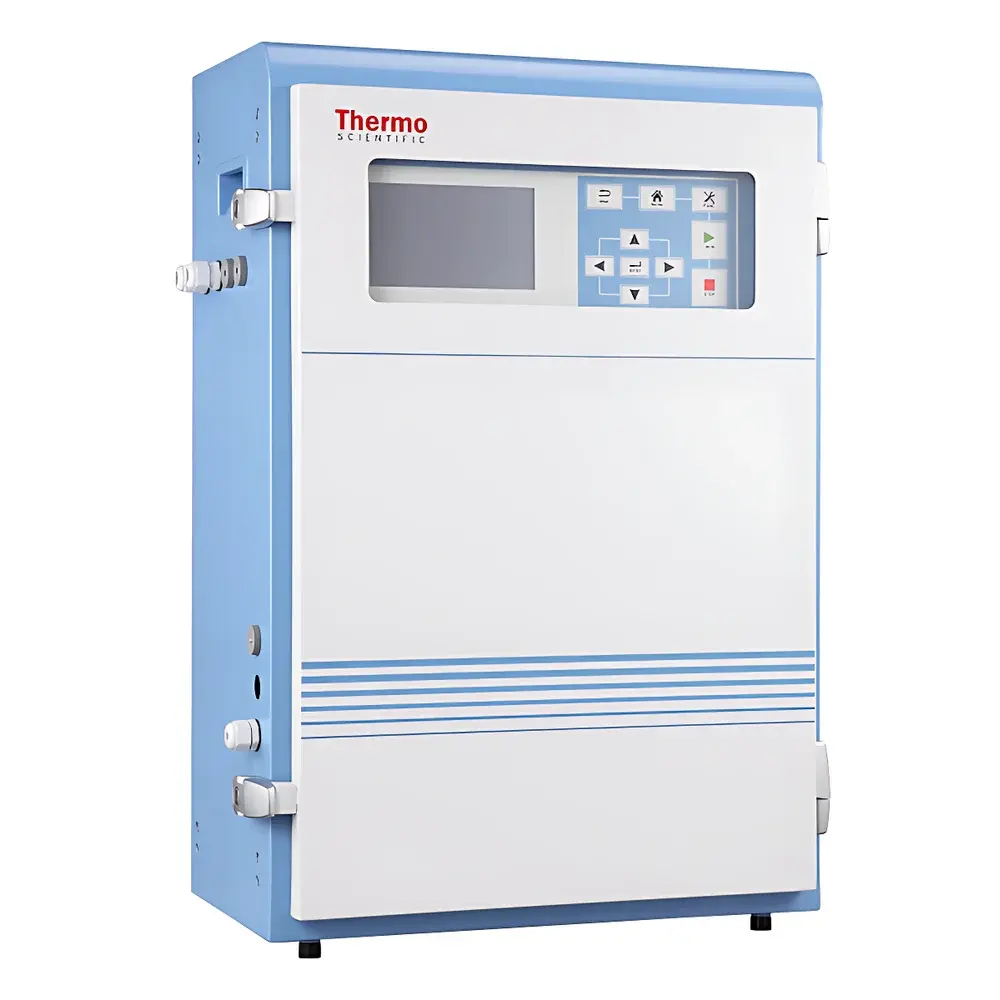
Thermo Scientific AquaEZ 3130 COD Analyzer
| Brand | Thermo Fisher |
|---|---|
| Origin | Shanghai, China |
| Manufacturer Type | Original Equipment Manufacturer (OEM) |
| Regional Classification | Domestic (China) |
| Model | AquaEZ 3130 COD |
| Instrument Type | Online Analyzer |
| Wavelength | 450 nm |
| Measurement Range | 10–4000 mg/L |
| Accuracy | ±10% of reading (for samples >100 mg/L) |
| Repeatability | <5% of reading |
| Limit of Detection | 15 mg/L |
| Analysis Time | 45 minutes per cycle |
| Batch Capacity | 30 samples per 30-minute interval |
| Zero Drift | ≤5 mg/L |
| Protection Rating | IP65 / NEMA 4 |
| Power Supply | 100–240 V AC, 50/60 Hz |
| Dimensions (W×H×D) | 510 × 775 × 330 mm |
| Weight | 40 kg (excluding reagents) |
| Operating Temperature | 5–45 °C |
| Relative Humidity | ≤85% RH (non-condensing) |
| Output Interfaces | Dual 4–20 mA analog outputs, RS232 standard, RS485 optional |
| Digital I/O | 2 digital inputs, 8 digital outputs |
| Calibration Modes | Automatic scheduled, manual, and external-triggered |
| Data Storage | Up to 2 years of time-stamped measurement history with event tagging (M = maintenance, D = fault, C = calibration) |
| Display | Color LCD screen showing real-time results, calibration curves, and historical trends |
| Digestion Conditions | 165 °C, duration adjustable from 10–30 minutes |
| Measurement Modes | Continuous, periodic, timed, or external signal-triggered |
Overview
The Thermo Scientific AquaEZ 3130 COD Analyzer is a fully automated, online spectrophotometric instrument engineered for continuous, unattended monitoring of Chemical Oxygen Demand (COD) in municipal wastewater, industrial effluents, and surface water systems. It operates on the standardized dichromate oxidation method (ISO 6060, ASTM D1252, and EPA Method 410.4), followed by photometric quantification at 450 nm. This principle enables robust, interference-resistant determination of oxidizable organic and inorganic substances—providing a reliable surrogate for biological oxygen demand (BOD) where rapid, regulatory-compliant data are required. Designed for deployment in harsh environmental monitoring stations and wastewater treatment plants (WWTPs), the AquaEZ 3130 integrates thermal digestion, precise fluidic handling, and optical detection into a single compact platform with minimal operator intervention.
Key Features
- Patented non-metallic, corrosion-resistant 8-port rotary valve ensures long-term reagent integrity and eliminates clogging—critical for high-solids or aggressive industrial wastewaters.
- Automated self-diagnostic system continuously monitors critical subsystems (pump status, heater function, optical path clarity, liquid level, and valve positioning), logging fault codes with timestamped event tags (D = diagnostic fault, M = maintenance due, C = calibration performed).
- User-configurable cleaning and calibration schedules reduce manual labor while maintaining metrological traceability across extended operational cycles.
- Bilingual interface (English/Chinese) supports multilingual site personnel without compromising menu logic or parameter navigation depth.
- IP65/NEMA 4-rated enclosure provides protection against dust ingress and low-pressure water jets—suitable for outdoor or semi-outdoor installation without additional sheltering.
- Flexible measurement modes—including continuous, programmable periodic intervals, fixed-time scheduling, and external TTL or relay-triggered analysis—enable synchronization with SCADA or PLC control systems.
Sample Compatibility & Compliance
The AquaEZ 3130 accommodates raw influent, secondary effluent, and tertiary-treated discharge streams with suspended solids up to 100 mg/L (pre-filtered via optional 80-µm inline sieve). Its digestion protocol (165 °C, 10–30 min ramp-adjustable) achieves >95% oxidation efficiency for common organics including alcohols, aldehydes, carboxylic acids, and aromatic compounds—while minimizing chloride interference through mercury sulfate suppression (reagent kit compliant with ISO 6060 Annex A). The analyzer meets functional requirements of ISO/IEC 17025 for in-house verification, supports GLP-aligned audit trails (including user login, parameter changes, and calibration logs), and generates data compatible with regulatory reporting frameworks such as EU Urban Wastewater Treatment Directive (91/271/EEC), China’s GB 18918-2002, and U.S. NPDES permit conditions. All firmware and calibration records retain immutable timestamps and digital signatures per internal system architecture.
Software & Data Management
- Embedded Linux-based controller stores ≥2 years of high-resolution data (timestamp, COD value, temperature, digestion status, error flags) with automatic rollover and CRC-protected backup.
- RS232 serial port enables direct connection to local HMIs or legacy DCS; RS485 (optional) supports Modbus RTU communication for integration into centralized telemetry networks.
- Dual isolated 4–20 mA analog outputs transmit primary COD concentration and secondary status signals (e.g., fault flag or maintenance countdown) to PLCs or chart recorders.
- Eight programmable digital outputs support alarm escalation (e.g., “low reagent”, “digestion timeout”, “out-of-range”) and interlock functions with auxiliary equipment such as sample pumps or emergency shutoff valves.
- Data export via USB flash drive supports CSV-formatted batch retrieval for third-party statistical analysis or LIMS ingestion.
Applications
The AquaEZ 3130 serves as a core compliance tool in municipal wastewater treatment facilities for real-time effluent monitoring prior to discharge—ensuring adherence to daily or monthly COD mass load limits. In industrial settings—including petrochemical refineries, pharmaceutical manufacturing, food processing, and pulp/paper mills—it enables process optimization through feed-forward control of aeration basins and chemical dosing units. Its stability under variable flow and matrix composition makes it suitable for combined sewer overflow (CSO) monitoring, landfill leachate treatment verification, and receiving water quality assessment in riverine or estuarine environments. When deployed alongside NH3-N, TP, and turbidity analyzers, it forms part of a multi-parameter water quality observatory aligned with Smart Water Grid initiatives.
FAQ
What digestion temperature and time does the AquaEZ 3130 use?
The system performs closed-vessel digestion at 165 °C, with dwell time configurable between 10 and 30 minutes to accommodate varying sample matrices and regulatory method requirements.
How often does the system require calibration verification?
Factory-recommended calibration frequency is every 7 days using certified KHP (potassium hydrogen phthalate) standards; however, users may extend this interval based on historical performance data and risk assessment per ISO/IEC 17025 Clause 7.7.
Does the analyzer support remote firmware updates?
Yes—secure over-the-air (OTA) updates are supported via authenticated HTTPS connection to Thermo Fisher’s authorized service portal, preserving cryptographic integrity and rollback capability.
Can the AquaEZ 3130 operate without continuous power?
No—the instrument requires uninterrupted AC supply; internal capacitors provide only sufficient hold-up time (<100 ms) to safely complete an ongoing digestion cycle during brief brownouts.
Is the reagent consumption rate documented per analysis?
Each full analysis consumes approximately 1.8 mL of potassium dichromate/sulfuric acid mixture and 0.9 mL of silver sulfate catalyst solution—enabling accurate reagent inventory forecasting over 30-day operational windows.







