
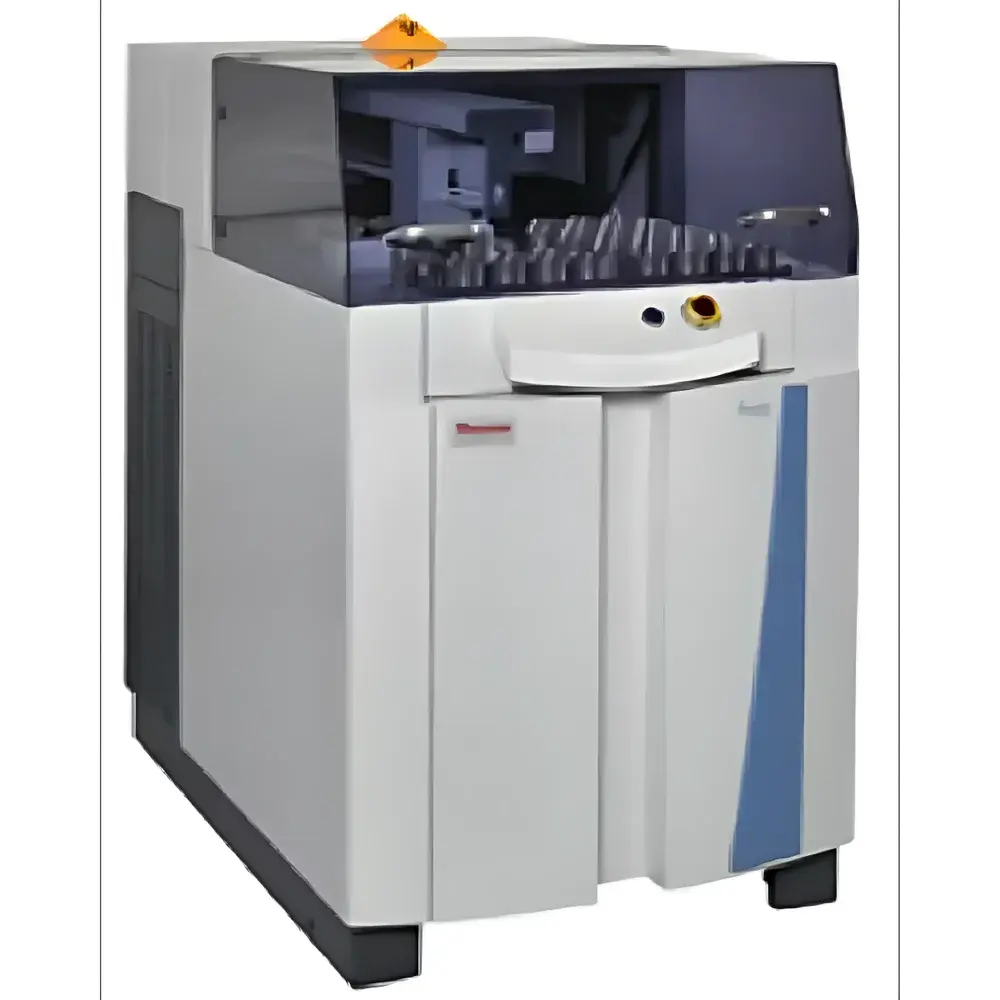
Thermo Scientific ARL PERFORM’X Sequential Wavelength-Dispersive X-ray Fluorescence Spectrometer (WDXRF)
| Brand | Thermo Fisher |
|---|---|
| Origin | Shanghai, China |
| Manufacturer Type | Authorized Distributor |
| Product Origin | Domestic (China-manufactured under Thermo Fisher global quality standards) |
| Model | ARL PERFORM'X |
| Power Options | 1500 W, 2500 W, 4200 W |
| Optical Design | Ultra-Close Coupling Optics (UCCO) |
| Angular Positioning | Gearless digital goniometer with Moiré fringe optical encoder |
| Software Platform | OXSAS v8.x with QuantAS™, UniQuant™, and PetroilQuant™ application packages |
| Compliance | Designed to support GLP/GMP workflows, ASTM E1361, ISO 2936, ISO 8258, USP <233>, and FDA 21 CFR Part 11 audit-trail readiness |
Overview
The Thermo Scientific ARL PERFORM’X Sequential Wavelength-Dispersive X-ray Fluorescence (WDXRF) Spectrometer is an engineered solution for high-precision elemental analysis of solid and liquid samples across diverse industrial and research domains. Based on the fundamental principle of wavelength-dispersive X-ray fluorescence — where characteristic X-rays emitted from a sample upon primary X-ray excitation are separated by diffraction crystals and measured by proportional counters or scintillation detectors — the ARL PERFORM’X delivers exceptional spectral resolution, low background noise, and superior peak-to-background ratios. Its sequential scanning architecture enables rigorous quantification of up to 90 elements (B to U), from trace (sub-ppm) to major (100 wt%) concentrations, without spectral overlap interference. The instrument’s UCCO (Ultra-Close Coupling Optics) design minimizes intensity loss and optimizes sensitivity for light elements — particularly critical for boron, carbon, nitrogen, and oxygen analysis in advanced materials and geological matrices. Unlike energy-dispersive systems (EDXRF), WDXRF provides inherently higher resolution and better detection limits for complex multi-element matrices, making it the preferred technique for regulatory-compliant compositional verification and reference-grade certification.
Key Features
- Gearless digital goniometer with Moiré fringe optical encoders ensures angular reproducibility better than ±0.0005°, enabling long-term stability and minimal drift during extended analytical campaigns.
- Three power configurations (1500 W, 2500 W, 4200 W) accommodate varying throughput and sensitivity requirements — from routine QC labs to high-demand geochemical and metallurgical applications.
- Integrated XY autosampler supports fully automated batch processing of heterogeneous sample types, including pressed pellets, fused beads, liquids in specialized cups, and irregular solids via optional sample holders.
- Small-spot analysis mode (down to 100 µm diameter) enables micro-localized quantification for inclusion mapping, coating thickness evaluation, and contamination source identification.
- No-standard, fundamental parameter-based analysis using QuantAS™ and UniQuant™ software allows rapid screening of unknown samples without prior calibration — validated against CRM libraries and adaptable to novel matrix compositions.
- PetroilQuant™ pre-calibrated method package delivers certified-level quantification for up to 30 elements in fuels, lubricants, and distillates per ASTM D6443 and ISO 8258 protocols — eliminating method development time and reducing operator dependency.
Sample Compatibility & Compliance
The ARL PERFORM’X accepts a broad spectrum of sample forms: powders (pressed or fused), metals, alloys, glasses, ceramics, polymers, soils, sediments, oils, and aqueous solutions. Its robust vacuum and helium purge options enable reliable light-element analysis (B–F) without atmospheric absorption artifacts. All hardware and software components are designed to align with internationally recognized analytical standards: ASTM E1361 (XRF practice for metals), ISO 2936 (XRF terminology), ISO 8258 (control charting), and USP (elemental impurities in pharmaceuticals). The system supports full electronic record retention, user-access controls, and audit-trail generation compliant with FDA 21 CFR Part 11 for regulated environments. IQ/OQ documentation kits and remote diagnostics facilitate rapid installation validation and ongoing performance verification in GLP and GMP laboratories.
Software & Data Management
OXSAS v8.x serves as the unified control, acquisition, and reporting platform. It features modular architecture supporting both routine operation and advanced research workflows. QuantAS™ implements fundamental parameter algorithms with matrix correction models (e.g., alpha coefficients, absorption-enhancement corrections), while UniQuant™ extends this capability to fully unknown matrices using iterative mass absorption coefficient refinement. PetroilQuant™ integrates instrument-specific calibrations with industry-accepted oil matrix corrections (e.g., viscosity-dependent attenuation modeling). All software modules generate PDF/CSV reports with metadata embedding (operator ID, timestamp, instrument parameters, calibration history), and support LIMS integration via ASTM E1482-compliant export formats. Data integrity safeguards include encrypted database storage, version-controlled method files, and role-based access permissions.
Applications
The ARL PERFORM’X is deployed globally in sectors requiring definitive elemental composition data: geological survey laboratories performing whole-rock analysis (SiO₂, Al₂O₃, FeO, MgO, CaO, Na₂O, K₂O, P₂O₅, TiO₂, MnO, LOI); cement and refractory producers monitoring raw mix homogeneity and clinker phase balance; petrochemical QA/QC labs verifying wear metals (Fe, Cu, Pb, Sn) and additives (Ca, Zn, P) in engine oils; metallurgical R&D centers characterizing specialty alloys (Ni-, Co-, Ti-base) and inclusion chemistry; environmental testing facilities quantifying heavy metals (As, Cd, Cr, Hg, Pb) in soils and sludges per EPA Method 6010D; and forensic science units identifying gunshot residue (Sb, Ba, Pb) or glass fragment provenance (Mg, Al, Si, Ca, Sr, Zr).
FAQ
Does the ARL PERFORM’X require external water cooling?
No — all three power variants (1500 W, 2500 W, 4200 W) utilize advanced air-cooled X-ray tube technology and do not require external chillers or tap-water circulation.
Can it analyze light elements such as boron or carbon?
Yes — enabled by UCCO optics, vacuum path, and optimized crystal/detector selection (e.g., LiF(200), PET, TAP), the system achieves reliable detection and quantification of B, C, N, and O in appropriate matrices.
Is method transfer possible between different ARL PERFORM’X units?
Yes — OXSAS supports standardized method export/import, and QuantAS™/UniQuant™ models are portable across instruments when calibrated with identical geometry and detector configurations.
What sample preparation methods are supported?
Standard approaches include pressed powder pellets (with binder), fused borate beads (for silicates and ores), direct metal analysis (polished surfaces), and liquid analysis using Mylar- or polyimide-film sealed cups with internal standardization.
How does the system handle heterogeneous or layered samples?
Via small-spot analysis combined with motorized XYZ stage control, users can perform raster mapping (elemental distribution imaging) or targeted point analysis on inclusions, coatings, or phase-separated regions.





