
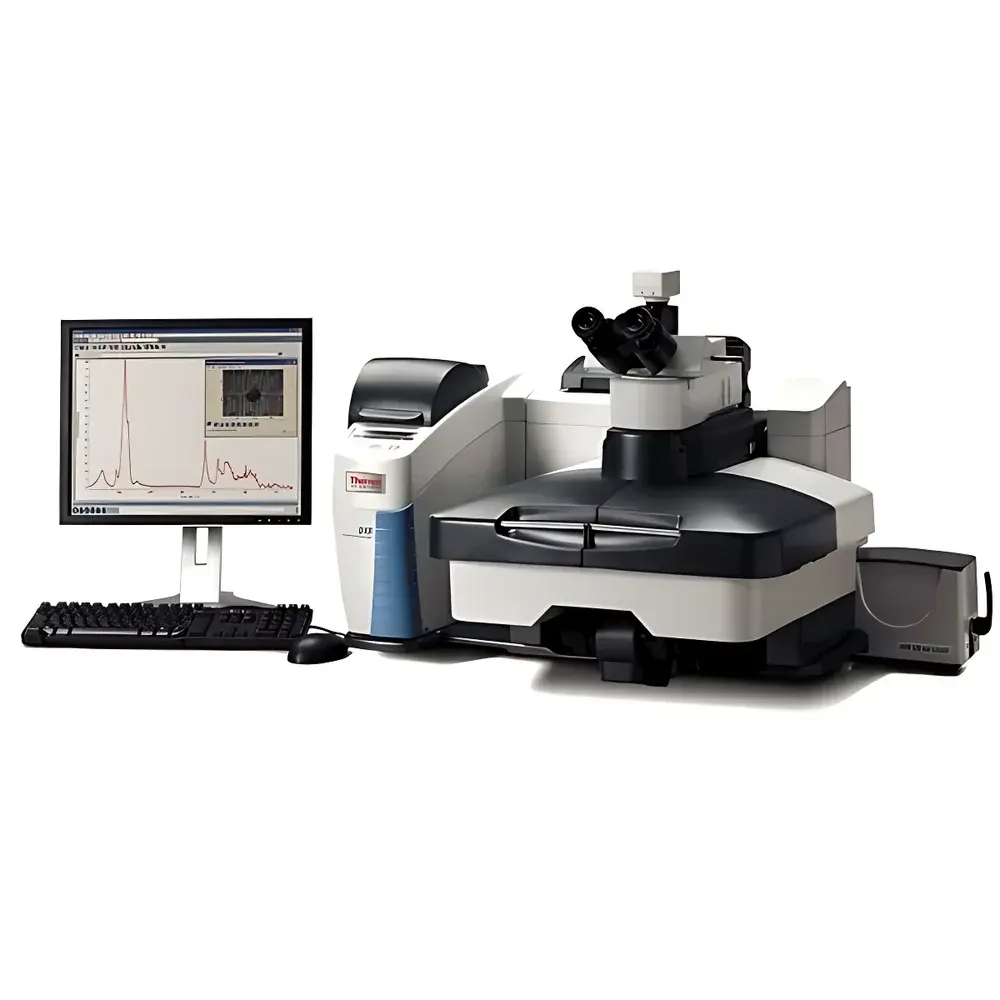
Thermo Scientific DXR3 Raman Microscope
| Brand | Thermo Fisher |
|---|---|
| Origin | Shanghai, China |
| Manufacturer Type | Authorized Distributor |
| Regional Classification | Domestic (China) |
| Model | Thermo Scientific DXR3 Raman Microscope |
| Instrument Type | Benchtop Confocal Raman Microscope |
| Spatial Resolution | 1 µm |
| Spectral Range | 50–3500 cm⁻¹ (standard), up to 6000 cm⁻¹ with 532 nm laser |
| Laser Wavelengths | 455 nm, 532 nm (high-brightness & high-power), 633 nm (high-brightness & high-power), 785 nm (high-brightness & high-power) |
| Laser Safety | Class 1 microscope (fiber-coupled accessories: Class 3B) |
| Compliance | 21 CFR Part 11, ASTM E1840, ISO/IEC 17025 (when validated), GLP/GMP-ready |
| Software | OMNIC™ D/S v10+ |
| Detector | Back-illuminated CCD |
| Optical Platform | Olympus research-grade microscope optics |
| Dimensions (W × H × D) | 94 × 61 × 68 cm |
| Weight | 66.5 kg |
| Operating Temperature | 16–27 °C |
| Electrical Requirements | 100–240 V, 47–63 Hz |
Overview
The Thermo Scientific DXR3 Raman Microscope is a fully integrated, confocal benchtop instrument engineered for high-fidelity, quantitative Raman spectroscopic analysis at the microscale. Based on confocal laser Raman scattering principles, it employs a triple-grating spectrometer architecture with zero-moving-parts optical design to deliver exceptional spectral fidelity, peak shape integrity, and long-term calibration stability across the full Raman shift range (50–3500 cm⁻¹ standard; extended to 6000 cm⁻¹ with 532 nm excitation). Its core measurement capability relies on monochromatic laser excitation—selectable from six wavelengths (455, 532, 633, and 785 nm in both high-brightness and high-power variants)—coupled with diffraction-limited spatial resolution of ≤1 µm and axial (depth) resolution of ≤2 µm under optimal conditions. The system features fully automated alignment, real-time fluorescence background correction, cosmic ray rejection, and intensity-normalized spectral acquisition—enabling reproducible, operator-independent data generation suitable for regulated environments including pharmaceutical QA/QC, forensic casework, and academic materials characterization.
Key Features
- Triple-optical-path spectrometer design ensures uniform spectral response, minimal peak distortion, and high confocality across all excitation wavelengths.
- Tool-free, motorized auto-alignment system maintains daily calibration integrity without manual intervention or service engineer support.
- Three-wavelength laser power regulation (0.1 mW increments) with real-time monitoring guarantees consistent excitation energy over laser lifetime and across instrument swaps.
- Olympus BX53-based microscope platform with motorized XYZ stage, autofocus, and selectable objective magnifications (20×–100×) enables precise micro-area targeting and mapping.
- Single-exposure full-spectrum acquisition (3500–50 cm⁻¹) eliminates stitching artifacts; optional extended-range mode supports 6000 cm⁻¹ coverage with 532 nm laser.
- Class 1 laser safety certification for the microscope body; Class 3B-rated fiber accessories require appropriate laser safety protocols and certified eyewear.
- Automated polarization control module (optional) enables depolarization ratio measurements and orientation-sensitive structural analysis.
- Pre-aligned, snap-in optical components allow reconfiguration—including laser source, grating, and filter modules—in under 60 seconds.
Sample Compatibility & Compliance
The DXR3 accommodates solid, powder, thin-film, and liquid samples mounted on standard microscope slides or specialized holders (e.g., metallurgical mounts, IR-transparent substrates). Its confocal aperture and high numerical aperture objectives permit depth-profiling of layered structures, inclusion analysis in polymers, and sub-surface interrogation of coatings and encapsulants. The instrument meets essential regulatory requirements for analytical instrumentation in GxP environments: OMNIC D/S software includes electronic signatures, audit trails, user role management, and secure data storage compliant with FDA 21 CFR Part 11. Full DQ/IQ/OQ/PQ validation packages—including protocol templates, test scripts, and raw data logs—are provided. It supports ISO/IEC 17025 method validation workflows and aligns with ASTM E1840 (Standard Guide for Raman Microscopy) for spectral acquisition and reporting.
Software & Data Management
OMNIC™ D/S v10+ serves as the unified acquisition, processing, and reporting engine. It provides automated spectral preprocessing (dark current subtraction, cosmic ray removal, fluorescence baseline correction), multivariate analysis (PCA, cluster analysis), particle identification algorithms (for microplastics and contaminants), and hyperspectral image reconstruction. All spectral metadata—including laser power, exposure time, objective, grating, and calibration parameters—is embedded in proprietary .spa files and exportable in JCAMP-DX format. Data integrity is enforced via immutable audit trails, timestamped user actions, and cryptographic hash verification. Batch processing, report generation (PDF/Excel), and LIMS integration via API are supported. Raw spectral data remains unaltered throughout processing, satisfying ALCOA+ (Attributable, Legible, Contemporaneous, Original, Accurate, Complete, Consistent, Enduring, Available) principles.
Applications
- Pharmaceutical: Polymorph identification, API-excipient interaction mapping, crystallinity assessment, contaminant forensics in tablets and lyophilized powders.
- Microplastics Analysis: Automated particle detection, chemical classification (PE, PP, PET, PS), size distribution, and surface oxidation state quantification.
- Forensics: Non-destructive identification of illicit drugs, explosives residues, ink and pigment differentiation, and trace evidence characterization.
- Materials Science: Graphene layer counting, CNT chirality estimation, DLC coating stress analysis, silicon wafer defect mapping, and battery electrode degradation studies.
- Art Conservation: In situ pigment stratigraphy, varnish aging assessment, and identification of restoration materials without sampling.
- Polymer & Petrochemical: Phase separation imaging, filler dispersion homogeneity, crosslink density mapping, and catalyst residue detection.
FAQ
Is the DXR3 suitable for regulated pharmaceutical laboratories?
Yes—the system ships with full 21 CFR Part 11-compliant OMNIC D/S software, pre-validated IQ/OQ protocols, and documentation supporting GMP/GLP audits.
Can multiple lasers be used interchangeably without recalibration?
Yes—each laser module is factory-aligned and recognized automatically; wavelength-specific grating and filter configurations are stored and applied per laser selection.
What is the typical spatial resolution achievable in practice?
Lateral resolution is ≤1 µm (with 100× objective and 532 nm excitation); axial resolution is ≤2 µm under optimized confocal conditions.
Does the system support automated particle analysis for microplastics?
Yes—OMNIC Particle Analysis Module enables batch detection, morphological classification, and Raman-based chemical ID of particles ≥1 µm in diameter.
How is laser safety managed during visual inspection?
The viewing path is physically blocked from the laser beam by an integrated shutter; direct ocular exposure is prevented even during live focusing.





