
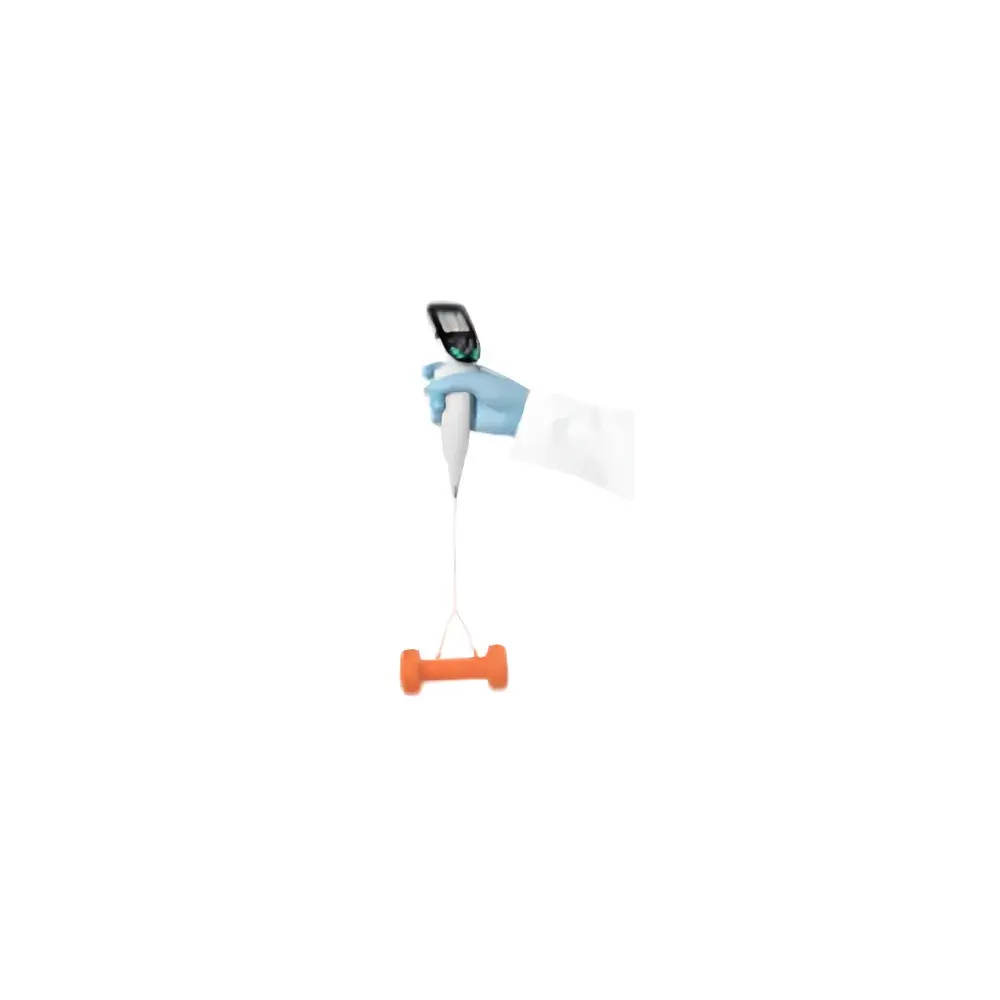
Thermo Scientific E1-ClipTip Electronic Single-Channel Pipette
| Brand | Thermo Fisher Scientific |
|---|---|
| Origin | USA |
| Model | E1-ClipTip Electronic Single-Channel Pipette |
| Volume Range | 0.5–1250 µL |
| Tip Ejection | Motorized ClipTip ejection |
| Operation | Thumb-free finger-actuated pipetting |
| Tip Compatibility | Thermo Scientific ClipTip tips (including E1-ClipTip 12.5 and 384-well formats) |
| Calibration | Liquid-specific calibration supported |
| Memory | 20 programmable protocols |
| Power | Rechargeable Li-ion battery |
| Warranty | 2 years |
| Compliance | Designed for GLP/GMP environments with audit-ready calibration tracking |
Overview
The Thermo Scientific E1-ClipTip Electronic Single-Channel Pipette is an engineered solution for high-precision, ergonomic, and repeatable liquid handling in regulated and research-intensive laboratory environments. Built upon the patented ClipTip interlocking tip attachment mechanism, it eliminates conventional friction-fit tip mounting—replacing it with a positive “snap-and-lip” mechanical engagement that ensures consistent sealing force, zero tip drop during aspiration/dispense cycles, and full volumetric integrity across the entire operating range (0.5–1250 µL). Unlike traditional piston-driven pipettes relying on manual thumb pressure, the E1-ClipTip employs finger-actuated motor control, decoupling thumb fatigue from pipetting accuracy and enabling sustained reproducibility under extended workflow conditions. Its architecture integrates closed-loop motor feedback, real-time plunger position sensing, and programmable acceleration/deceleration profiles to minimize liquid shear and meniscus disturbance—critical for viscous, volatile, or low-surface-tension samples.
Key Features
- Motorized ClipTip ejection: Eliminates mechanical impact stress on tips and pipette shafts; reduces operator-induced variability and tip contamination risk.
- Finger-actuated operation: Shifts actuation load from thumb to index finger—clinically validated to reduce musculoskeletal strain during repetitive pipetting tasks.
- ClipTip interlock technology: Provides uniform sealing pressure across all tip sizes (including low-volume 0.5–10 µL and high-capacity 500–1250 µL formats), ensuring volumetric fidelity per ISO 8655-2 and ASTM E2758 compliance requirements.
- 20-user-programmable protocols: Supports matrix dispensing, multi-step serial dilutions, and custom preset configurations—each assignable with descriptive names and protected by user-defined passwords.
- Liquid-specific calibration mode: Allows storage of up to three calibrated volume curves per liquid class (e.g., aqueous, glycerol-based, ethanol-containing), improving accuracy for non-standard media without recalibration hardware.
- Integrated service tracker: Logs usage cycles and prompts scheduled maintenance alerts based on configurable thresholds—supporting traceability in FDA 21 CFR Part 11–aligned workflows.
- Rechargeable lithium-ion power system: Delivers >10,000 pipetting cycles per charge; supports both cradle charging and USB-C direct charging for lab flexibility.
Sample Compatibility & Compliance
The E1-ClipTip is validated for use with Thermo Scientific ClipTip sterile and filtered tips—including the E1-ClipTip 12.5 series and 384-well-compatible formats—ensuring leak-free performance across microcentrifuge tubes, PCR plates, deep-well blocks, and assay-ready vials. Its mechanical design conforms to ISO 8655-5 (volumetric accuracy verification) and IEC 61000-4-2 (ESD immunity). For regulated QC/QA laboratories, the device supports electronic audit trails via optional Thermo Fisher Connect software integration, enabling GLP-compliant documentation of calibration history, user logins, protocol modifications, and service events. All firmware updates are digitally signed and version-locked to maintain validation state.
Software & Data Management
The E1-ClipTip operates autonomously but interfaces seamlessly with Thermo Fisher Connect—a cloud-enabled platform for centralized pipette fleet management. Users can export protocol logs, calibration certificates, and maintenance records in PDF or CSV format. The embedded MyPipette interface enables drag-and-drop customization of the home screen: frequently used programs appear as touch-optimized icons, while password-protected settings prevent unauthorized parameter changes. Firmware updates preserve user-defined configurations and retain historical calibration data—ensuring continuity during instrument revalidation.
Applications
This pipette is routinely deployed in applications demanding metrological rigor and operational consistency: nucleic acid quantification (qPCR, NGS library prep), cell culture passaging, ELISA plate setup, small-molecule dosing in HTS assays, and reference standard preparation for pharmacopeial testing (USP , EP 2.6.17). Its Equalizer-compatible variants extend functionality to multi-well plate filling with adjustable tip spacing (6–12 channel), supporting seamless transition between tube-based and plate-based workflows without sacrificing accuracy.
FAQ
Does the E1-ClipTip support traceable calibration records required for ISO/IEC 17025 accreditation?
Yes—when paired with Thermo Fisher Connect and a certified calibration station, it generates timestamped, user-attributed calibration reports compliant with ISO/IEC 17025 clause 6.4.3.
Can ClipTip tips be autoclaved?
Standard ClipTip tips are not autoclavable; however, Thermo Fisher offers a dedicated line of autoclavable ClipTip tips (Cat. No. A200001) rated for 121°C, 20 min, 15 psi cycles.
Is firmware update capability available offline?
Yes—firmware packages may be downloaded and installed via USB drive without internet connectivity, preserving operational continuity in air-gapped environments.
What is the recommended recalibration interval under GLP conditions?
Thermo Fisher recommends quarterly verification for routine use; however, intervals must be justified per internal SOPs based on usage frequency, criticality of application, and historical performance data.
How does liquid-specific calibration improve accuracy for DMSO-based compounds?
By compensating for vapor pressure differentials and tip wetting dynamics unique to DMSO, this mode adjusts dispense velocity and dwell time—reducing residual volume error by up to 40% compared to default aqueous calibration.



