
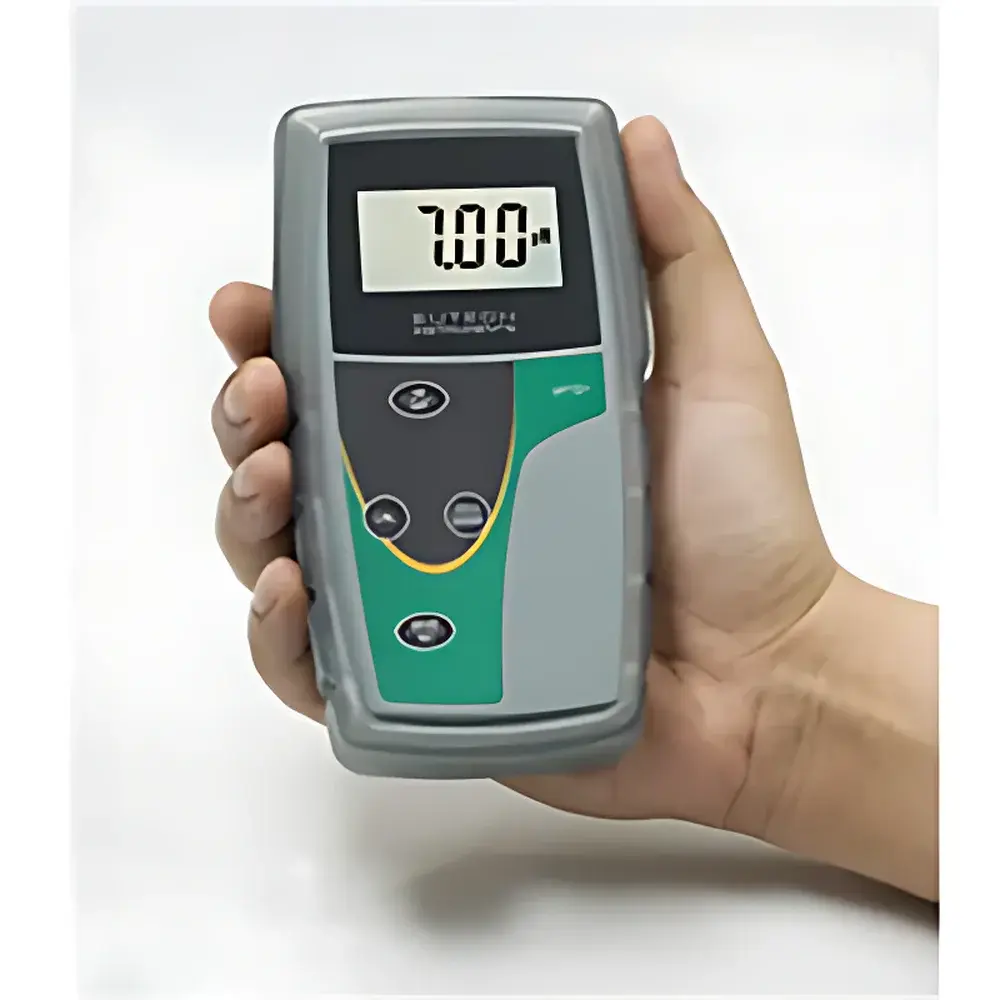
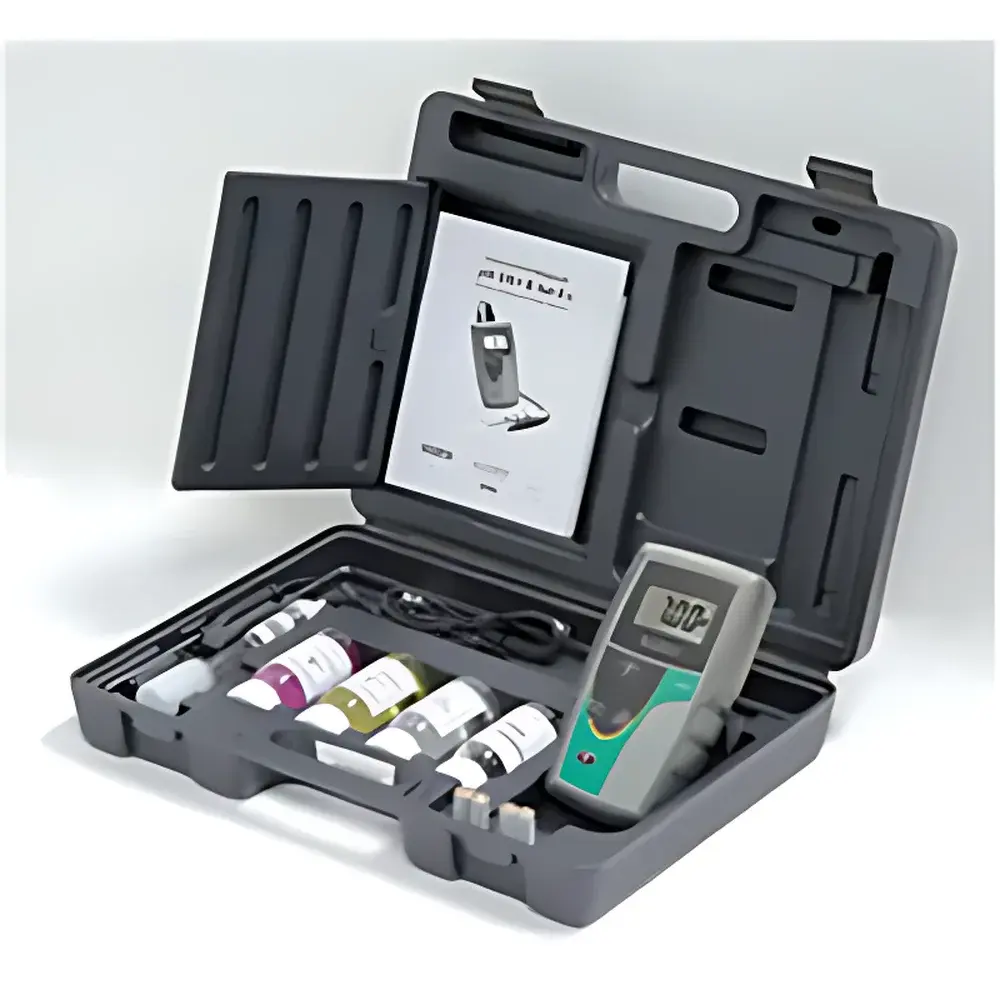
Thermo Scientific Eutech pH 6+ Portable pH/ORP Meter
| Brand | Eutech |
|---|---|
| Origin | USA |
| Model | pH 6+ |
| Instrument Type | Portable |
| Parameter Types | Dual (pH & ORP/mV) |
| pH Range | 0.00–14.00 |
| pH Resolution | 0.01 |
| pH Accuracy | ±0.01 |
| ORP Range | ±1000.0 mV |
| ORP Resolution | 0.1 mV (±199.9 mV), 1 mV (>±199.9 mV) |
| ORP Accuracy | ±0.2 mV (≤±199.9 mV), ±2 mV (>±199.9 mV) |
| Temperature Range | 0.0–100.0 °C |
| Temperature Resolution | 0.1 °C |
| Temperature Accuracy | ±0.5 °C |
| Calibration Points | Up to 3-point |
| Buffer Recognition | Automatic (USA, NIST, PWB) |
| Temperature Compensation | Auto/Manual (0.0–100.0 °C) |
| Display | Dual-line LCD (4.5 × 2.3 cm) |
| Power | 4 × 1.5 V AAA alkaline batteries |
| Battery Life | >500 hours |
| Dimensions (unit) | 15.7 × 8.5 × 4.2 cm |
| Weight (unit) | 255 g |
| Auto-Off | 20 min inactivity |
| Input Connectors | BNC + 2.5 mm phono sockets |
Overview
The Thermo Scientific Eutech pH 6+ is a rugged, field-deployable dual-parameter portable meter engineered for high-fidelity electrochemical measurements in demanding environmental, industrial, and educational settings. Based on potentiometric measurement principles, it determines hydrogen ion activity via a glass pH electrode and quantifies redox potential using a platinum or reference-compatible ORP electrode. Its design adheres to fundamental electrochemical standards—employing high-input-impedance circuitry (>1012 Ω) to minimize loading errors and ensure stable millivolt-level signal acquisition. The instrument supports both standard hydrogen electrode (SHE)-referenced pH reporting and absolute mV output for process validation, making it suitable for applications requiring traceable, repeatable data under variable thermal conditions.
Key Features
- High-precision pH measurement with ±0.01 pH accuracy and 0.01 pH resolution across the full 0.00–14.00 range
- Dual-parameter capability: simultaneous or independent measurement of pH and ORP (±1000.0 mV) with selectable mV resolution (0.1 mV up to ±199.9 mV; 1 mV beyond)
- Intelligent auto-buffer recognition for three widely adopted calibration standards: USA (e.g., pH 4.01, 7.00, 10.01), NIST-traceable (e.g., pH 4.01, 6.86, 9.18), and PWB (Pure Water Buffers) for low-conductivity samples
- Configurable temperature compensation—automatic (using integrated thermistor probe) or manual entry—across 0.0–100.0 °C, with ±0.5 °C sensor accuracy
- Dual-line LCD display (4.5 × 2.3 cm) providing real-time pH/mV and temperature values with clear status icons and error codes
- Robust power management: >500-hour battery life on four AAA alkaline cells; auto-shutdown after 20 minutes of inactivity
- BNC and 2.5 mm phono input sockets accommodate standard pH, ORP, and temperature probes—including interchangeable combination electrodes
- Onboard diagnostics with fault-code display (e.g., “ERR 1” = open circuit, “ERR 2” = shorted electrode) for rapid troubleshooting in remote locations
Sample Compatibility & Compliance
The pH 6+ is validated for use with aqueous solutions across diverse conductivity ranges—from ultrapure water (≥1 µS/cm) to high-ionic-strength industrial effluents. Its automatic PWB buffer recognition enables reliable calibration in low-conductivity media where conventional two-point calibration may drift. While not certified for regulated GMP environments, the instrument’s measurement traceability aligns with ASTM D1293 (Standard Test Method for pH of Water) and ISO 10523 (Water Quality — Determination of pH). Its stable analog front-end and digital filtering support GLP-compliant documentation when paired with external logging tools. No internal memory or audit trail is embedded; users are advised to record calibration events, electrode IDs, and ambient conditions manually per laboratory SOPs.
Software & Data Management
The pH 6+ operates as a standalone field instrument without proprietary software dependencies or USB connectivity. All configuration, calibration, and measurement functions are executed via intuitive front-panel controls. Readings can be manually logged or transferred to external systems using optional analog output adapters (not included). For laboratories requiring electronic records, integration with LIMS or ELN platforms is achieved through third-party RS-232 or Bluetooth-enabled data loggers compatible with standard ASCII serial protocols. No firmware updates or driver installation are required—ensuring long-term operational continuity without IT infrastructure dependency.
Applications
- Field-based water quality monitoring (surface water, groundwater, wastewater treatment influent/effluent)
- Educational labs for teaching electrochemical fundamentals, calibration theory, and Nernst equation applications
- Food & beverage QC checks—including brine pH, fermentation broth monitoring, and rinse-water verification
- Aquaculture and hydroponics system management, where real-time pH and redox stability directly impact biological health
- Environmental remediation site assessments requiring rapid, on-site screening of acidic mine drainage or alkaline leachates
- Maintenance of electroplating baths and cleaning solutions where ORP serves as a proxy for oxidizer concentration (e.g., chlorine, ozone)
FAQ
Does the pH 6+ support GLP/GMP-compliant data integrity?
No—it lacks internal memory, electronic signature capability, or FDA 21 CFR Part 11–compliant audit trails. It is intended for non-regulated or preliminary testing where manual documentation suffices.
Can I use a single electrode for both pH and ORP measurements?
Yes—combination pH/ORP electrodes with integrated reference junctions are fully supported via the BNC input; verify compatibility with your probe’s connector type and impedance rating.
What happens if the temperature probe is disconnected during pH measurement?
The meter defaults to manual temperature mode and retains the last entered value; users must re-enter ambient or sample temperature to maintain accurate compensation.
Is calibration verification possible without recalibrating?
Yes—the instrument allows post-calibration check using a secondary buffer; deviation beyond ±0.02 pH triggers a recommendation to repeat calibration.
How does the auto-buffer recognition algorithm distinguish between USA and NIST standards?
It analyzes measured mV response against stored theoretical Nernstian slopes and intercepts for each buffer set, selecting the closest match based on electrode asymmetry and junction potential estimates.





