
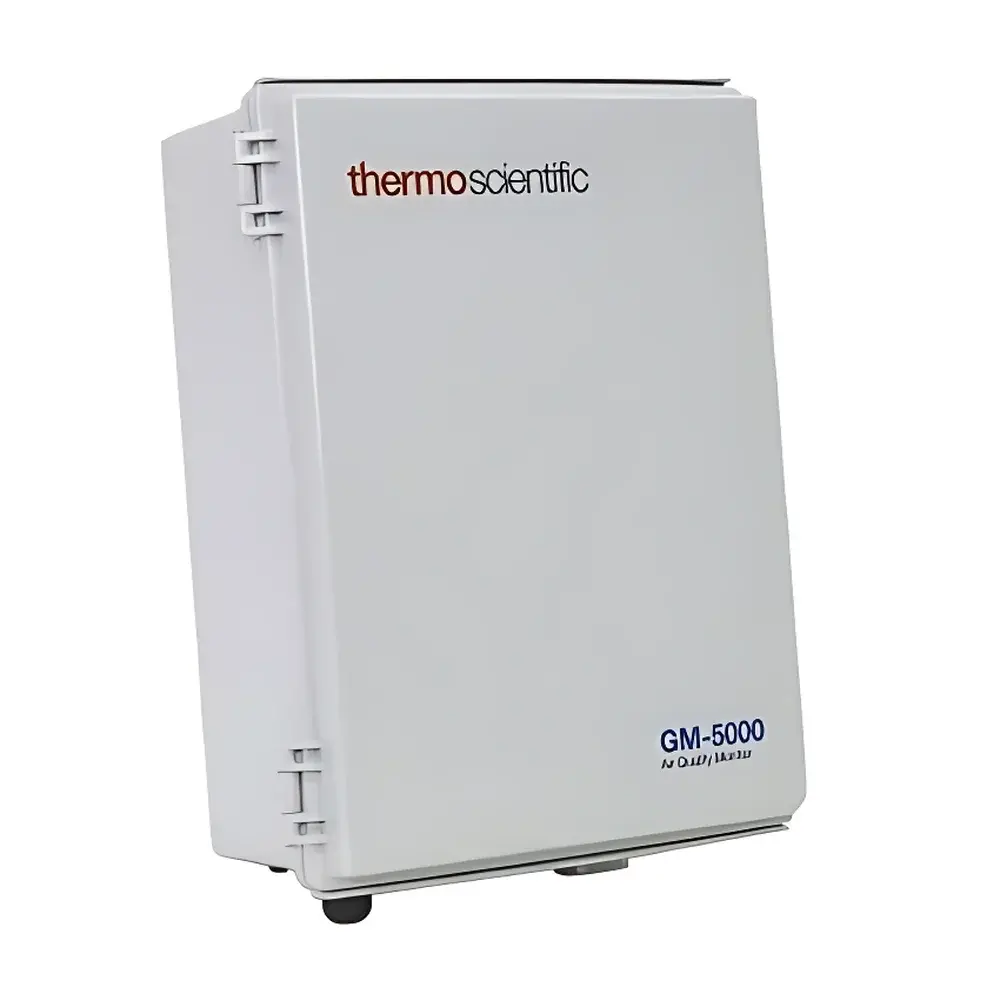
Thermo Scientific GM-5000 Micro Air Quality Continuous Monitor
| Brand | Thermo Fisher |
|---|---|
| Origin | USA |
| Manufacturer Type | Original Equipment Manufacturer (OEM) |
| Product Category | Imported Instrument |
| Model | Thermo Scientific GM-5000 |
| Measurement Principle | Optical Scattering (for PM), Electrochemical (for SO₂, NO₂, NO, CO), Photoionization Detection (for TVOC), UV Absorption (for O₃) |
| Measured Parameters | PM₂.₅, PM₁₀, SO₂, NO₂, NO, O₃, CO, TVOC |
| Measurement Range | PM₂.₅ / PM₁₀: 0–1500 µg/m³ |
| SO₂ / NO₂ / NO / O₃ | 0–500 ppb |
| CO | 0–50 ppm |
| TVOC | 0–40 ppm |
| Sampling Interval | 10 s |
| Sample Flow Rate | >1.5 L/min |
| Detection Limits | PM₂.₅ / PM₁₀ <1.0 µg/m³ |
| SO₂ / NO₂ / NO / O₃ | 5 ppb |
| CO | 0.02 ppm |
| TVOC | 5 ppb |
| Flow Stability | ±2.5% of full scale (all sensors) |
Overview
The Thermo Scientific™ GM-5000 Micro Air Quality Continuous Monitor is a compact, field-deployable, multi-parameter ambient air monitoring system engineered for unattended, long-term operation in outdoor environments. It integrates optical particle counting (OPC) for real-time quantification of PM₂.₅ and PM₁₀ mass concentrations, electrochemical sensors for reactive gases (SO₂, NO₂, NO, CO), pulsed UV absorption for ozone (O₃), and photoionization detection (PID) for total volatile organic compounds (TVOC). The instrument employs active heated sampling with vertical inlet design to minimize moisture condensation and coarse particulate interference—ensuring representative sample intake under diverse climatic conditions. All measurements are thermally compensated using on-board temperature, relative humidity, and barometric pressure sensors, enabling traceable, environmentally corrected concentration outputs compliant with data quality objectives outlined in EPA Guidance for Ambient Air Monitoring Networks and ISO 12103-1 for particulate reference materials.
Key Features
- Simultaneous real-time measurement of eight regulated and emerging air pollutants: PM₂.₅, PM₁₀, SO₂, NO₂, NO, O₃, CO, and TVOC
- Heated vertical inlet and active thermal management system—maintains consistent sensor operating conditions across -30°C to +50°C ambient ranges
- Integrated environmental compensation: concurrent measurement of temperature, relative humidity, and atmospheric pressure for algorithmic correction of gas and particulate responses
- Dual communication architecture: embedded 4G LTE module for secure, encrypted data transmission to central servers; onboard Wi-Fi for local configuration, diagnostics, and firmware updates
- Web-based user interface accessible via standard browser—provides live data visualization, instrument status monitoring, alarm thresholds, and remote calibration logging
- Internal SD card storage supporting ≥12 months of high-resolution (10-second interval) time-series data with full metadata (sensor temperatures, flow rates, diagnostic flags)
- Robust IP65-rated enclosure with integrated mounting options—including pole, wall, and rooftop configurations—designed for permanent outdoor deployment without auxiliary sheltering
- Modular expandability: optional integration of meteorological sensors (wind speed/direction, solar radiation), noise dosimeters, LED display panels, and GPS geotagging modules
Sample Compatibility & Compliance
The GM-5000 is validated for continuous monitoring of ambient air in urban, industrial, roadside, and peri-urban settings per U.S. EPA Reference and Equivalent Method (R&EM) criteria for supplemental monitoring networks. Its OPC-based particulate measurement follows ISO 21501-4 principles for light-scattering particle sizing and counting, with factory calibration traceable to NIST-traceable PSL standards. Gas-phase sensors meet EN 14625 (O₃), EN 14626 (CO), and EN 14627 (NO₂) performance specifications for ambient air quality analyzers. Data integrity is maintained through internal audit trails, timestamped calibration events, and automatic power-loss recovery—supporting compliance with GLP and GMP-aligned QA/QC frameworks. While not certified as a Federal Equivalent Method (FEM) device, the GM-5000 satisfies data quality requirements for trend analysis, hotspot identification, and regulatory gap-filling applications as defined in EPA’s Air Quality System (AQS) Supplemental Monitoring Guidance (2021).
Software & Data Management
Data acquisition and system control are managed by Thermo Scientific’s proprietary embedded firmware, featuring configurable sampling protocols, dynamic range switching, and automated zero/span validation routines. Raw and processed data streams adhere to the SensorML and Observations & Measurements (O&M) standards, enabling seamless ingestion into third-party platforms including EPA’s AirNow, OpenAQ, and custom GIS-based dashboards. Each data packet includes sensor-specific diagnostic codes, flow stability metrics, and environmental compensation coefficients—facilitating post-acquisition uncertainty analysis. Remote access supports role-based authentication, TLS 1.2 encryption, and configurable data retention policies. For laboratory-grade validation, co-location studies with reference-grade monitors (e.g., TEOM, chemiluminescence analyzers) can be executed using built-in synchronization protocols and timestamp alignment tools.
Applications
- High-resolution spatial densification of existing regulatory air monitoring networks—enabling sub-kilometer grid mapping of pollutant gradients
- Targeted monitoring in sensitive receptor zones: schools, hospitals, retirement communities, and low-income neighborhoods
- Roadside and tunnel air quality assessment—capturing transient plume dynamics and fleet-emission signatures
- Construction site perimeter monitoring for fugitive dust (PM₁₀/PM₂.₅) with automated exceedance alerts
- Industrial fence-line monitoring for early detection of process leaks or VOC emissions events
- Academic and governmental research on spatiotemporal pollutant dispersion, source apportionment modeling, and exposure assessment studies
FAQ
Is the GM-5000 certified as a Federal Reference Method (FRM) or Federal Equivalent Method (FEM) device?
No—the GM-5000 is designed as a high-performance supplemental monitor. It does not carry FRM/FEM designation but meets data quality objectives for trend analysis, source attribution, and regulatory support applications.
Can the instrument be calibrated using certified standard gases?
Yes—electrochemical and PID sensors support span calibration with NIST-traceable gas standards. Particulate channels are calibrated against gravimetric reference samplers during factory certification.
What is the expected maintenance interval under continuous outdoor operation?
Optical windows require quarterly cleaning; electrochemical sensors have typical service lives of 18–24 months; annual verification against reference instruments is recommended for regulatory-grade data use.
Does the system support remote firmware updates and configuration changes?
Yes—via secure HTTPS interface over Wi-Fi or 4G; all updates include version rollback capability and integrity checksum validation.
How is data security ensured during wireless transmission?
All telemetry uses TLS 1.2 encryption; device authentication is enforced via X.509 certificates; no credentials are stored in plaintext on the unit.
Related Products







