
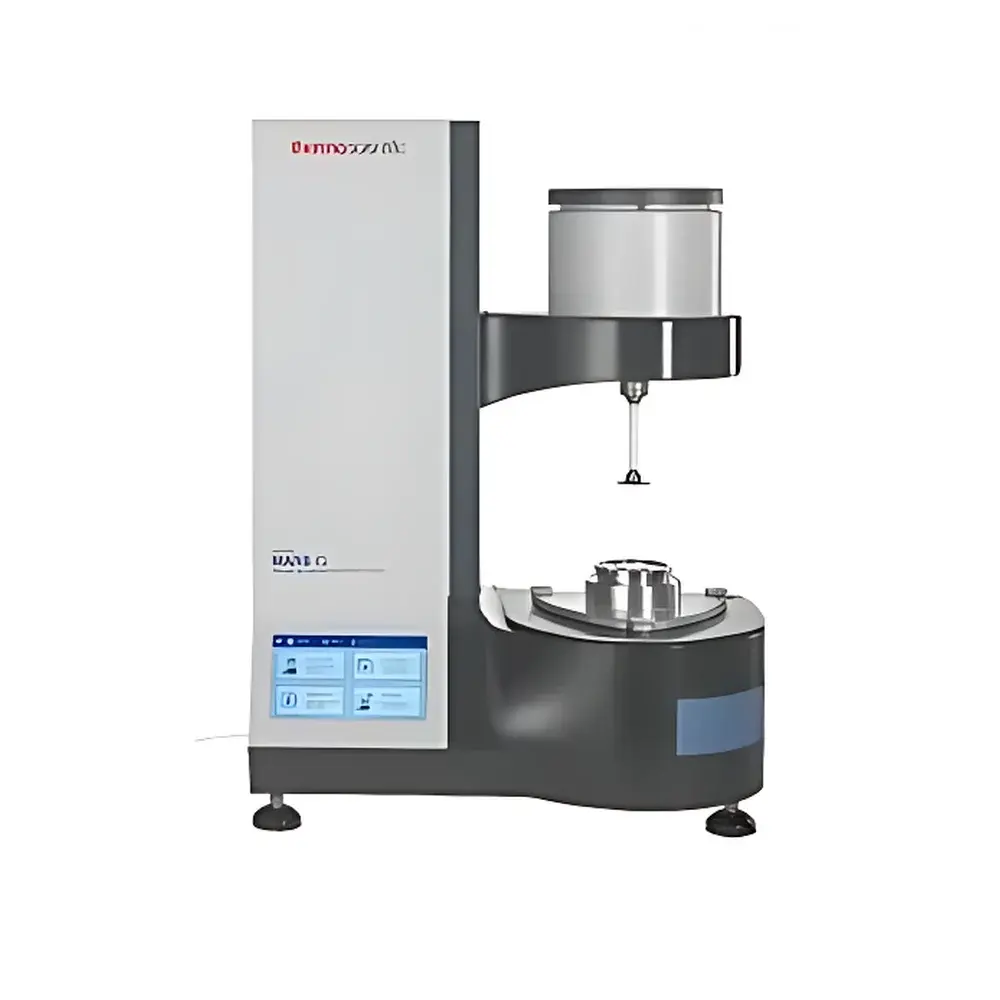
Thermo Scientific HAAKE MARS iQ Rotational Rheometer
| Brand | Thermo Scientific HAAKE |
|---|---|
| Origin | Germany |
| Model | MARS iQ |
| Instrument Type | Rotational Rheometer |
| Motor Bearing | Ball Bearing |
| Minimum Rotational Speed | 0.01 rpm |
| Maximum Rotational Speed | 2000 rpm |
| Torque Range | 0.002–125 mNm |
| Torque Resolution | 2.0 µNm |
| Frequency Range | 0.001–209.4 rad/s |
| Frame Architecture | Folded H-Frame with Mineral Composite Construction |
| Temperature Control Interface | Auto-recognized, Color-Coded Modular System |
| Software Platform | HAAKE RheoWin (with optional 21 CFR Part 11 compliance module) |
Overview
The Thermo Scientific HAAKE MARS iQ Rotational Rheometer is an engineered platform for precision-controlled rheological characterization of complex fluids and soft solids under controlled shear, oscillatory, and extensional deformation regimes. Based on the Couette principle with precise torque-controlled and strain-controlled operation modes, the instrument delivers high reproducibility in dynamic viscoelastic measurements—including storage modulus (G′), loss modulus (G″), complex viscosity (η*), yield stress, thixotropy, and time-dependent structural recovery. Its modular architecture integrates seamlessly into quality control (QC), research and development (R&D), and regulatory-compliant production environments, supporting both routine testing and advanced material science investigations across industries governed by ASTM D4402, ISO 3219, ISO 6721-10, and USP .
Key Features
- High-dynamic EC motor with ball-bearing support ensures mechanical stability, low thermal drift, and long-term torque fidelity across the full frequency range (0.001–209.4 rad/s).
- Folded H-frame design constructed from high-damping mineral composite material minimizes vibration transmission, suppresses thermal expansion effects, and enhances positional repeatability during vertical gap adjustment.
- 7-inch capacitive touchscreen interface enables intuitive SOP-driven workflows; “Connection Assist” automatically detects and validates transducer type, geometry, and temperature module upon attachment.
- Color-coded plug-and-play system for temperature modules (Peltier, liquid-circulated, or convection ovens) reduces setup errors and accelerates method transfer between operators.
- Integrated normal force sensor (optional) supports bidirectional axial force measurement—critical for texture analysis, particle settling studies, and interfacial rheology applications.
- Wide vertical travel range and bottom/edge access accommodate custom fixtures, large-volume cells, and application-specific geometries such as pressure cells, building materials fixtures, and tribology modules.
Sample Compatibility & Compliance
The MARS iQ accommodates a broad spectrum of sample forms—from low-viscosity solvents and polymer melts to highly filled pastes, gels, emulsions, and viscoelastic biomaterials. Standard cone-plate, parallel-plate, and concentric cylinder geometries ensure compatibility with ISO-defined test configurations. Optional accessories extend capability to cementitious slurries (ASTM C1610), asphalt binders (AASHTO T315), food gels (ISO 11036), and pharmaceutical suspensions (USP ). The system meets GLP/GMP operational prerequisites when configured with the optional 21 CFR Part 11-compliant RheoWin software module, providing electronic signatures, audit trails, role-based access control, and secure data archiving.
Software & Data Management
HAAKE RheoWin software serves as the unified control and analysis environment, supporting over 100 standardized test protocols—including creep-recovery, amplitude sweeps, frequency sweeps, temperature ramps, and multi-step time sweeps. All software updates are provided at no additional cost for the instrument’s lifetime. Data export conforms to ASTM E1382 and ISO/IEC 17025 requirements, with native CSV, XML, and HDF5 output formats. Integrated reporting tools generate compliant QC certificates, trend charts, and comparative overlays aligned with internal SOPs or external regulatory templates.
Applications
The MARS iQ delivers validated performance in diverse industrial sectors requiring quantitative structure–property relationships: formulation optimization of architectural coatings and inkjet inks; rheological profiling of yogurt, chocolate, and plant-based dairy alternatives; viscosity and gelation kinetics in injectable hydrogels and topical creams; melt processing behavior of thermoplastics and elastomers; aging and fatigue response of bituminous binders; and flow stability assessment of cement admixtures and self-compacting concrete. Its modularity supports method development for emerging applications including micro-rheology of biofilms and colloidal dispersions under shear.
FAQ
What temperature control options are available for the MARS iQ?
Peltier-based modules (−40 °C to 200 °C), liquid-circulated systems (−40 °C to 200 °C), and forced-convection ovens (up to 600 °C) are supported, all auto-identified via the Connection Assist system.
Is the instrument suitable for GMP-regulated environments?
Yes—when equipped with the optional 21 CFR Part 11 module, RheoWin provides full audit trail logging, user authentication, electronic signatures, and data integrity safeguards required for FDA-submitted documentation.
Can I perform extensional rheology with this system?
While primarily designed for rotational and oscillatory shear measurements, optional filament stretching rheometry (FSR) and Sentmanat extensional rheometer (SER) fixtures enable uniaxial extensional characterization of polymer melts and solutions.
How does the torque resolution translate to measurable viscosity range?
With a torque resolution of 2.0 µNm and minimum speed of 0.01 rpm, the system achieves reliable viscosity detection down to ~0.1 mPa·s for low-shear Newtonian fluids and up to >10⁸ mPa·s for highly structured gels and pastes using appropriate geometry selection.
What maintenance intervals are recommended for the motor and bearing system?
The sealed ball-bearing motor requires no scheduled lubrication; routine verification of torque calibration and geometric alignment is advised every 6 months or per ISO/IEC 17025 internal audit schedule.



