
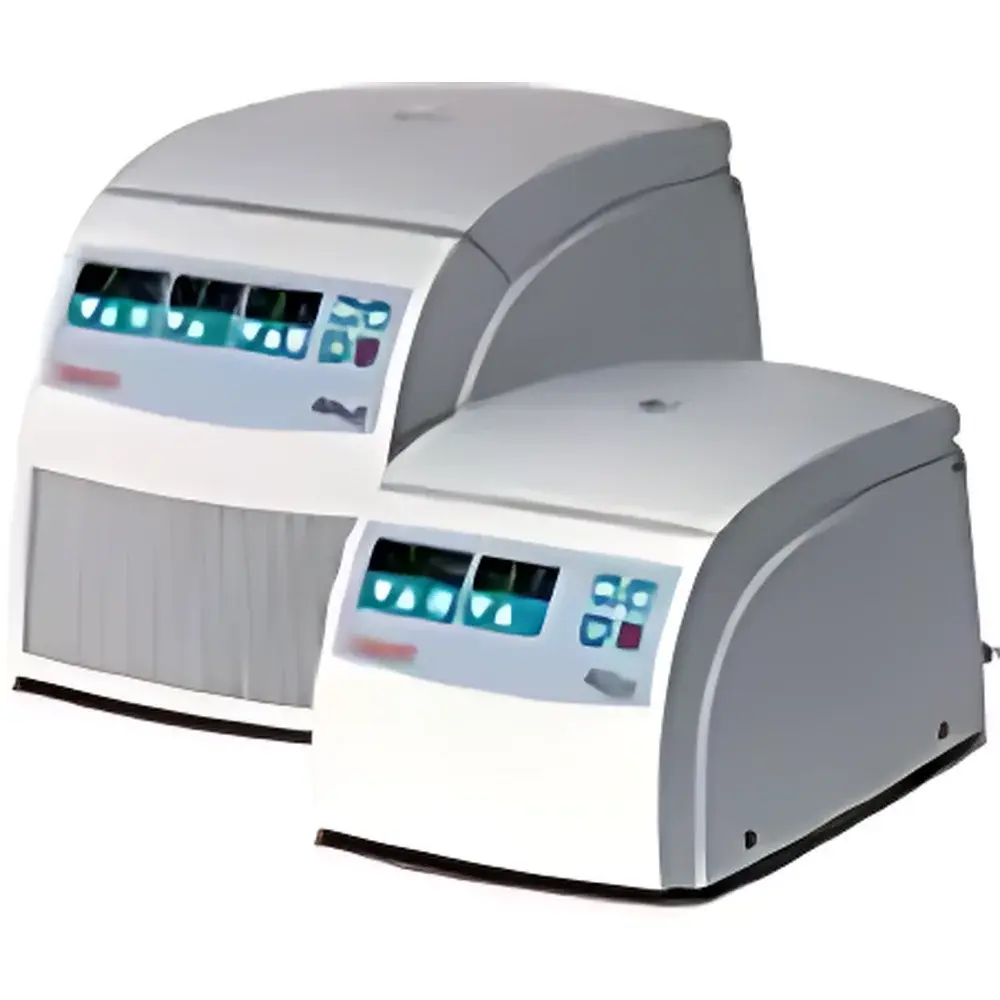
Thermo Scientific Heraeus Pico 17/21 and Fresco 17/21 Microcentrifuges
| Brand | Thermo Fisher Scientific |
|---|---|
| Origin | USA |
| Model | Heraeus Pico 17/21 / Fresco 17/21 |
| Centrifuge Type | Benchtop Microcentrifuge |
| Max Speed | 30,000 rpm |
| Max RCF | 21,000 × g |
| Max Capacity | 24 × 2 mL |
| Acceleration/Deceleration Time | 12 s / 12 s |
| Dimensions (W×D×H) | 310 × 436 × 568 mm |
| Rotor Compatibility | Fixed-angle rotors for 0.2–2.0 mL tubes, including PCR strips, hematocrit capillaries, and filter-based spin columns |
| Safety Certification | CAMR-validated ClickSeal™ biocontainment rotors |
| Cooling Type | Refrigerated (Fresco) and Ventilated (Pico) variants |
Overview
The Thermo Scientific Heraeus Pico 17/21 and Fresco 17/21 microcentrifuges are engineered for precision, reproducibility, and operational efficiency in high-throughput molecular biology and clinical research laboratories. These benchtop instruments operate on the principle of fixed-angle centrifugation, generating controlled radial forces to separate biomolecules—including nucleic acids, proteins, cellular organelles, and precipitated reaction byproducts—based on sedimentation velocity and density differentials. Designed for routine yet demanding applications such as plasmid purification, column-based DNA cleanup, protein pelleting, PCR setup, and hematocrit determination, the Pico and Fresco platforms deliver consistent performance across a broad operational envelope. The Pico series offers ventilated operation ideal for ambient-temperature protocols, while the Fresco variant integrates a precise refrigeration system (typically maintaining 4 °C ± 2 °C at maximum speed), ensuring thermal stability for temperature-sensitive samples like enzymes, RNA, or primary cell lysates.
Key Features
- Two-tier RCF capability: Selectable models delivering either 17,000 × g or 21,000 × g (at 30,000 rpm), enabling optimization for both standard and high-resolution separations.
- Optimized kinetics: Rapid acceleration and deceleration profiles (12 seconds each) minimize cycle time without compromising rotor integrity or sample integrity—critical for labs processing dozens of samples per shift.
- Modular rotor ecosystem: Native compatibility with a full suite of Thermo Scientific fixed-angle rotors, including the 24-position 2.0 mL rotor with integrated ClickSeal™ biocontainment technology (CAMR-certified for biosafety Level 2 containment), an 18-position dual-volume rotor accommodating both 0.5 mL and 2.0 mL tubes without adapters, and specialized rotors for 0.2 mL PCR strips and capillary hematocrit tubes.
- Robust mechanical architecture: Rotors fabricated from high-strength aluminum alloy, validated for repeated autoclaving (121 °C, 20 min) and exposure to common laboratory disinfectants—ensuring long-term sterility assurance and compliance with GLP maintenance schedules.
- Ergonomic human-machine interface: Intuitive LED display with tactile keypad enables direct parameter entry (rpm/RCF, time, temperature for Fresco), real-time status feedback, and programmable recall of up to 9 user-defined methods.
Sample Compatibility & Compliance
The Pico and Fresco systems support standardized microvolume consumables compliant with ISO 8573-1 (compressed air purity) and ASTM D4169 (packaging performance testing) for tube integrity validation. All rotors meet IEC 61010-2-020 safety requirements for laboratory centrifuges. The ClickSeal™ rotor design conforms to CAMR (Centre for Applied Microbiology and Research) biosafety validation protocols for aerosol containment during high-speed operation—making it suitable for use with potentially infectious agents under BSL-2 conditions. Instrument firmware supports audit trail generation per FDA 21 CFR Part 11 requirements when paired with Thermo Scientific Connect software (optional). Routine calibration and verification procedures align with ISO/IEC 17025 competency standards for testing laboratories.
Software & Data Management
While standalone operation requires no software, optional integration with Thermo Scientific Connect platform enables remote monitoring, method synchronization across multiple instruments, electronic logbook generation, and export of run metadata (start/stop timestamps, actual vs. set RCF, temperature drift, rotor ID) in CSV or PDF formats. Audit trails include operator ID, parameter changes, and error events—supporting GMP-aligned documentation workflows. Firmware updates are delivered via USB and maintain backward compatibility with legacy rotor configurations and method libraries.
Applications
- Nucleic acid purification: Efficient pelleting of silica-membrane spin columns during plasmid, genomic DNA, or RNA isolation kits.
- Protein biochemistry: Clarification of bacterial lysates, recovery of inclusion bodies, and desalting prior to MS analysis.
- Diagnostics: Hematocrit measurement using calibrated capillary tubes; rapid serum separation from whole blood microsamples.
- PCR and NGS workflow support: Spin-down of master mixes, cleanup of enzymatic reactions, and removal of unincorporated dNTPs or primers.
- Cellular fractionation: Isolation of mitochondria, nuclei, or membrane vesicles from low-volume tissue homogenates (≤500 µL).
FAQ
What is the difference between the Pico and Fresco models?
The Pico series operates in ventilated (non-refrigerated) mode, optimized for ambient-temperature protocols. The Fresco series incorporates a closed-loop refrigeration system, maintaining sample compartment temperatures at 4 °C ± 2 °C even at maximum speed—critical for thermolabile biomolecules.
Are rotors interchangeable between Pico and Fresco units?
Yes—both platforms share identical rotor interfaces and mechanical specifications; all Heraeus Pico/Fresco-certified rotors are fully compatible across the product line.
Does the ClickSeal™ rotor require special maintenance?
No. ClickSeal™ rotors are designed for routine cleaning with 70% ethanol or 0.5% sodium hypochlorite, followed by air drying. Autoclaving is permitted and does not compromise the sealing mechanism’s integrity.
Can the centrifuge be validated for regulated environments?
Yes. IQ/OQ documentation packages are available from Thermo Fisher Scientific, and the instrument supports electronic signatures, audit trails, and alarm logging required under GxP and ISO 13485 frameworks.
What safety certifications apply to these models?
Compliant with IEC 61010-1 (general safety), IEC 61010-2-020 (centrifuge-specific), and UL 61010-1. ClickSeal™ rotors carry CAMR biosafety certification for aerosol containment during operation at rated speeds.



