
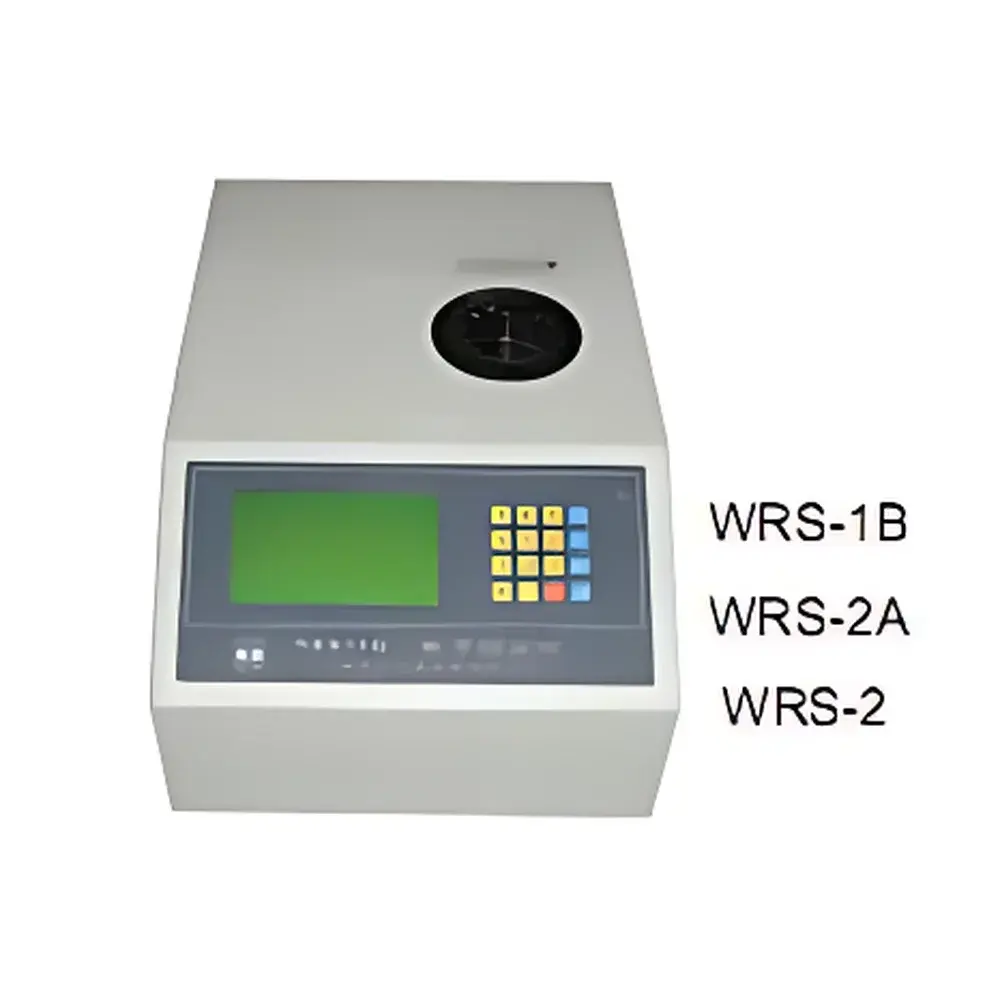
Truelab WRS-1A / WRS-1B / WRS-2 Digital Melting Point Apparatus
| Brand | Truelab |
|---|---|
| Origin | Shanghai, China |
| Model | WRS-1A |
| Melting Point Range | Ambient to 300 °C |
| Temperature Resolution | 0.1 °C |
| Linear Heating Rates | 0.2, 0.5, 1.0, 1.5, 2.0, 3.0, 4.0, 5.0 °C/min (8 selectable) |
| Accuracy | ±0.5 °C below 200 °C |
| Sample Capacity | 3 positions (simultaneous) |
| Display | Backlit LCD with real-time melting curve visualization |
| Interface | RS232 for data export |
| Dimensions | 398 × 280 × 170 mm |
| Weight | 11 kg |
Overview
The Truelab WRS-1A, WRS-1B, and WRS-2 Digital Melting Point Apparatus are precision instruments engineered for the accurate determination of melting point ranges in crystalline organic compounds. Based on the principle of controlled linear heating combined with photometric detection of solid–liquid phase transition, these units provide objective, repeatable results essential for purity assessment and material identification in pharmaceutical, chemical, and academic laboratories. Unlike capillary-based analog systems, the WRS series employs a calibrated platinum resistance temperature sensor (PT100) and synchronized optical monitoring to detect the onset (onset melting) and completion (clear point) of melting—enabling automated calculation of both initial and final melting temperatures across up to three samples per run. Designed for routine QC/QA workflows, the apparatus operates under ambient laboratory conditions without requiring external cooling or inert gas purging.
Key Features
- Triple-sample capability with independent capillary positioning—enables parallel analysis and statistical validation of melting behavior
- Eight programmable linear heating rates (0.2–5.0 °C/min), supporting method flexibility per pharmacopoeial requirements (e.g., USP & EP guidelines)
- High-resolution 0.1 °C temperature display with real-time graphical rendering of the melting curve on a backlit LCD screen
- Photodiode-based optical detection system ensures consistent endpoint recognition regardless of sample color or opacity
- RS232 serial interface compliant with standard laboratory data acquisition protocols—supports direct transfer to LIMS or Excel-compatible software
- Rugged aluminum alloy chassis with thermal shielding minimizes ambient drift and ensures long-term calibration stability
- Self-diagnostic startup sequence and error logging for GLP-compliant operation and audit readiness
Sample Compatibility & Compliance
The WRS series accommodates standard 1.0 mm OD glass capillaries (length ≤ 100 mm), compatible with powdered, granular, or crystalline solids—including APIs, intermediates, dyes, fragrances, and polymer additives. All models meet ISO 11357-3:2013 (Plastics — Differential Scanning Calorimetry — Part 3: Determination of melting temperature and enthalpy of fusion) for comparative reference, and support method development aligned with USP , EP 2.2.17, and JP 14 methods. The instrument’s measurement accuracy (±0.5 °C < 200 °C) satisfies the acceptance criteria for identity testing and purity verification in GMP-regulated environments. While not a DSC instrument, its performance is validated against NIST-traceable reference standards (e.g., indium, caffeine, vanillin) and documented in accordance with ISO/IEC 17025 calibration procedures.
Software & Data Management
Data output via RS232 follows ASCII protocol with timestamped records including sample ID, heating rate, onset temperature, clear point, and calculated mean values. No proprietary software is required—output is natively readable by terminal emulators (e.g., Tera Term), LabVIEW drivers, or custom Python scripts using pySerial. Instrument firmware supports user-defined method storage (up to 10 profiles), automatic pass/fail flagging based on configurable tolerance bands, and full audit trail generation (operator ID, date/time, parameter changes). For regulated labs, optional CSV export templates comply with FDA 21 CFR Part 11 requirements when integrated with validated third-party data management platforms that enforce electronic signatures and change control.
Applications
- Pharmaceutical quality control: Identity confirmation and purity screening of active pharmaceutical ingredients (APIs) and excipients per ICH Q5 and Q6A guidelines
- Organic synthesis validation: Monitoring reaction completion and intermediate purity during multi-step synthesis
- Regulatory submissions: Generating reproducible melting data for DMF, CMC sections, and stability study reports
- Academic research: Teaching fundamental thermal analysis concepts and validating computational crystal structure predictions
- Materials science: Characterizing phase transitions in small-molecule semiconductors, metal–organic frameworks (MOFs), and chiral resolving agents
- Forensic chemistry: Differentiating structurally similar compounds (e.g., isomers, polymorphs) where melting behavior serves as a discriminatory fingerprint
FAQ
What calibration standards are recommended for routine verification?
Indium (mp = 156.60 °C), tin (mp = 231.93 °C), and potassium hydrogen phthalate (mp = 212–214 °C) are commonly used NIST-traceable references. Daily verification at two points across the operating range is advised.
Can the instrument be used for decomposition point determination?
No—the WRS series is optimized for sharp, reversible solid–liquid transitions. Decomposition or charring events may yield ambiguous optical signals and are outside its validated scope.
Is method transfer possible between WRS-1B and WRS-2 models?
Yes—both share identical thermal control architecture, sensor calibration, and optical detection geometry. Method parameters (heating rate, dwell time) are fully interchangeable.
Does the system support GLP-compliant electronic record keeping?
The instrument itself generates raw data with timestamps and operator identifiers. Full GLP compliance requires integration with a validated data management system that enforces audit trails, electronic signatures, and version-controlled method storage.
How often should the capillary holder be cleaned or replaced?
The quartz capillary holder should be wiped with lint-free tissue and ethanol after each batch. Visual inspection for residue buildup or microfractures is recommended weekly; replacement is advised every 6–12 months under continuous use.



