
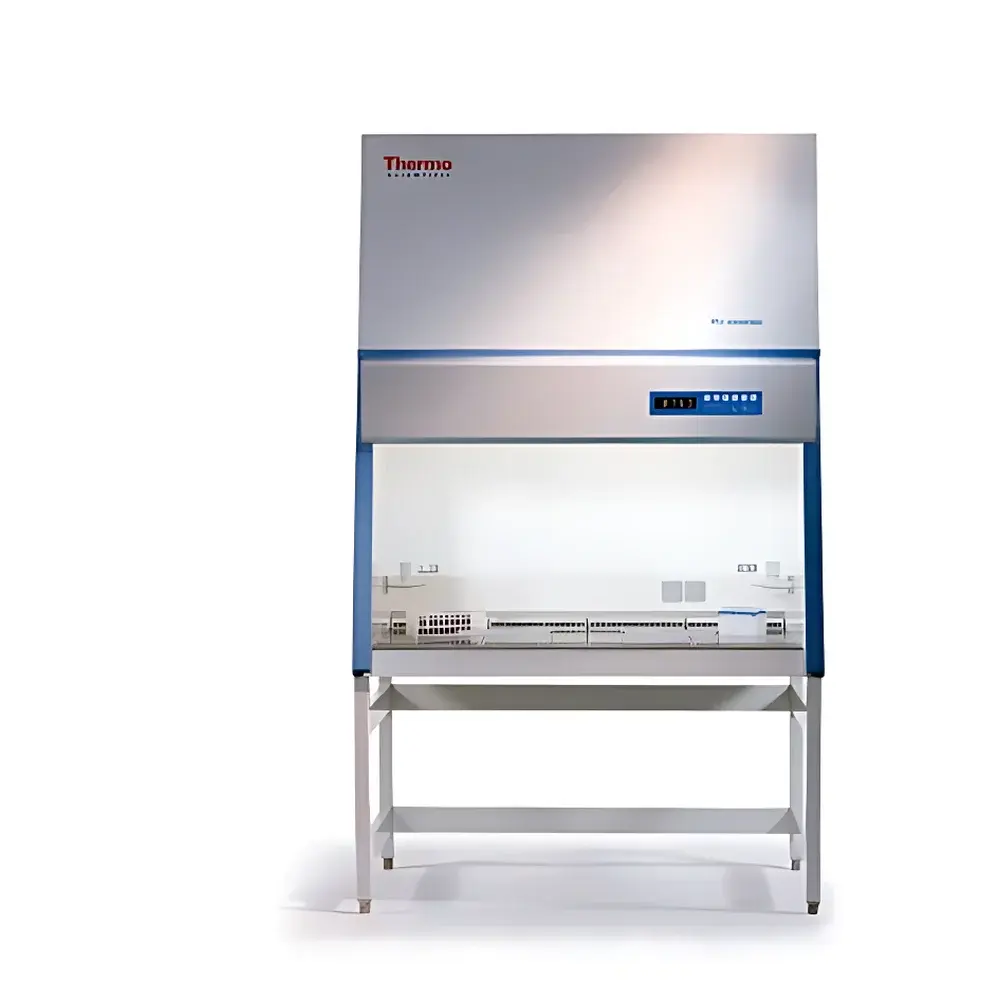
Thermo Scientific MSC-Advantage Class II Biological Safety Cabinet
| Brand | Thermo Fisher |
|---|---|
| Origin | Germany |
| Model | MSC-Advantage |
| Certification | EN 12469:2000, IEC 61010-1:2001, EN 61010-1:2001, NF S 09-500 Rev. 3.2006, DIN EN 61326-1:2004-05 |
| Filter Efficiency | ≥99.999% @ 0.3 µm (HEPA H14 per EN 1822) |
| Airflow Control | Dual independent fan system with real-time active compensation |
| Work Area Construction | Monolithic U-shaped stainless steel chamber with fully sealed side walls |
| Performance Indicator | Real-time Performance Factor (PF) display on control panel |
| Noise Level | <55 dB(A) (MSC-Advantage 1.2) / <57 dB(A) (MSC-Advantage 1.8) |
| Illumination | >1200 lx |
| Power Consumption | 0.4 kW (1.2 m) / 0.8 kW (1.8 m) |
| Compliance | YY 0569–2005, Low Voltage Directive 73/23/EEC, EMC Directive 89/336/EEC |
| External Dimensions (W×H×D, with stand) | 1300×2200×795 mm (1.2 m) / 1900×2200×795 mm (1.8 m) |
| Front Window Opening Height | 535 mm |
| Net Weight | 240 kg / 340 kg |
Overview
The Thermo Scientific MSC-Advantage Class II Biological Safety Cabinet is an engineered solution for containment of biological agents at Biosafety Levels 1, 2, and 3. Designed in accordance with EN 12469:2000—the internationally recognized standard for performance requirements and testing of microbiological safety cabinets—the MSC-Advantage employs a dual-fan airflow architecture to maintain stable inward velocity at the work access opening, consistent downward laminar flow across the work surface, and filtered exhaust air recirculation or external discharge. Its core containment mechanism relies on directional airflow management: inflow air protects the operator, downward laminar air protects the sample, and exhaust air—passing through two certified HEPA H14 filters (EN 1822)—ensures environmental protection. The cabinet supports concurrent handling of biological materials and limited quantities of volatile toxic chemicals, including trace radioactive isotopes, making it suitable for hybrid workflows in molecular biology, vaccine development, and sterile compounding.
Key Features
- Dual independent fan system with real-time active airflow compensation—dynamically adjusts motor speed to maintain setpoint inflow and downflow velocities despite filter loading or ambient pressure fluctuations.
- Monolithic U-shaped stainless steel work chamber with fully sealed vacuum-side walls—eliminates internal seams and crevices that could harbor contaminants, facilitating decontamination and complying with YY 0569–2005 structural integrity requirements.
- Performance Factor (PF) metric displayed continuously on the intuitive front-panel interface—quantifies real-time operational health by integrating inflow velocity, downflow uniformity, filter differential pressure, and lighting intensity into a single normalized index (0–100%).
- Front-accessible service design—all critical components—including fans, filters, UV lamps, and sensors—are reachable without rear or top panel removal, reducing downtime during certification, maintenance, or filter replacement.
- Low-profile ergonomic architecture—total height of 2200 mm enables seamless integration under standard fume hood canopies and improves accessibility for users of diverse anthropometric profiles, particularly in Asia-Pacific laboratory environments.
- Energy-optimized operation—reduced power consumption (0.4 kW for 1.2 m model; 0.8 kW for 1.8 m model) and lower thermal output versus conventional Class II cabinets, contributing to HVAC load reduction in temperature-sensitive facilities.
Sample Compatibility & Compliance
The MSC-Advantage accommodates a broad range of sample types and procedural workflows, including but not limited to: primary cell culture, recombinant protein expression, viral vector production, aseptic pharmaceutical preparation (e.g., IV admixture), and diagnostic assay setup involving low-volatility hazardous reagents. It is validated for use with volatile organic compounds (VOCs) at concentrations below occupational exposure limits, provided appropriate external exhaust ducting and AEF (Auxiliary Exhaust Filter) configuration are implemented. Regulatory compliance includes EN 12469:2000 (microbiological safety cabinet performance), IEC/EN 61010-1:2001 (electrical safety for laboratory equipment), EN 61326-1:2004 (EMC immunity and emissions), and alignment with FDA-recommended practices for aseptic processing environments. While not intrinsically compliant with USP or as a standalone unit, its engineering supports integration into GMP-compliant cleanroom systems when paired with validated environmental monitoring and qualification protocols.
Software & Data Management
The MSC-Advantage features an embedded microcontroller-based control system with non-volatile memory for event logging. All operational parameters—including inflow/downflow velocity measurements, PF index history, UV lamp runtime, filter pressure differentials, and alarm timestamps—are stored locally for up to 12 months. Data export is supported via USB port (CSV format) for audit trail generation and regulatory documentation. The interface supports multilingual display (English, German, French, Chinese) and includes configurable alarm thresholds with visual and audible alerts for deviations exceeding ±10% of nominal inflow (0.50 m/s) or downflow (0.35 m/s). Although not natively 21 CFR Part 11 compliant, the system architecture permits integration with third-party LIMS or electronic lab notebook (ELN) platforms via Modbus RTU protocol for centralized data governance in GLP/GMP environments.
Applications
- Cell culture laboratories requiring BSL-2 containment for human-derived or genetically modified organisms.
- Hospital pharmacy IV compounding centers operating under ISO 14644-1 Class 5 (ISO Class 5) conditions.
- Biopharmaceutical process development labs conducting upstream seed train expansion and transfection studies.
- Virology and immunology research groups handling replication-competent viruses classified under BSL-3.
- Contract development and manufacturing organizations (CDMOs) performing QC release testing of sterile injectables.
- Academic core facilities supporting shared instrumentation access with integrated usage tracking and preventive maintenance scheduling.
FAQ
What biosafety levels does the MSC-Advantage support?
It is certified for use with agents assigned to Biosafety Levels 1, 2, and 3 per CDC/NIH guidelines and EN 12469:2000 classification.
Can it be used for procedures involving volatile chemicals?
Yes—when equipped with the optional Auxiliary Exhaust Filter (AEF) and connected to dedicated ducted exhaust, it safely handles low-concentration VOCs and trace radioisotopes.
Is the cabinet compatible with routine certification and validation protocols?
Fully compatible with EN 12469 Annex D testing procedures, including smoke visualization, airflow velocity mapping, particle challenge (using 0.3 µm PAO/DOP), and microbial containment verification.
Does it meet FDA or EU GMP requirements for aseptic processing?
While the cabinet itself is not a GMP-certified system, its design, documentation, and performance traceability support qualification within GMP-regulated environments when included in a broader facility validation master plan.
How frequently should the HEPA filters be replaced?
Filter service intervals depend on usage intensity and ambient air quality; typical replacement occurs every 3–5 years, guided by real-time differential pressure monitoring and annual third-party certification testing.



