
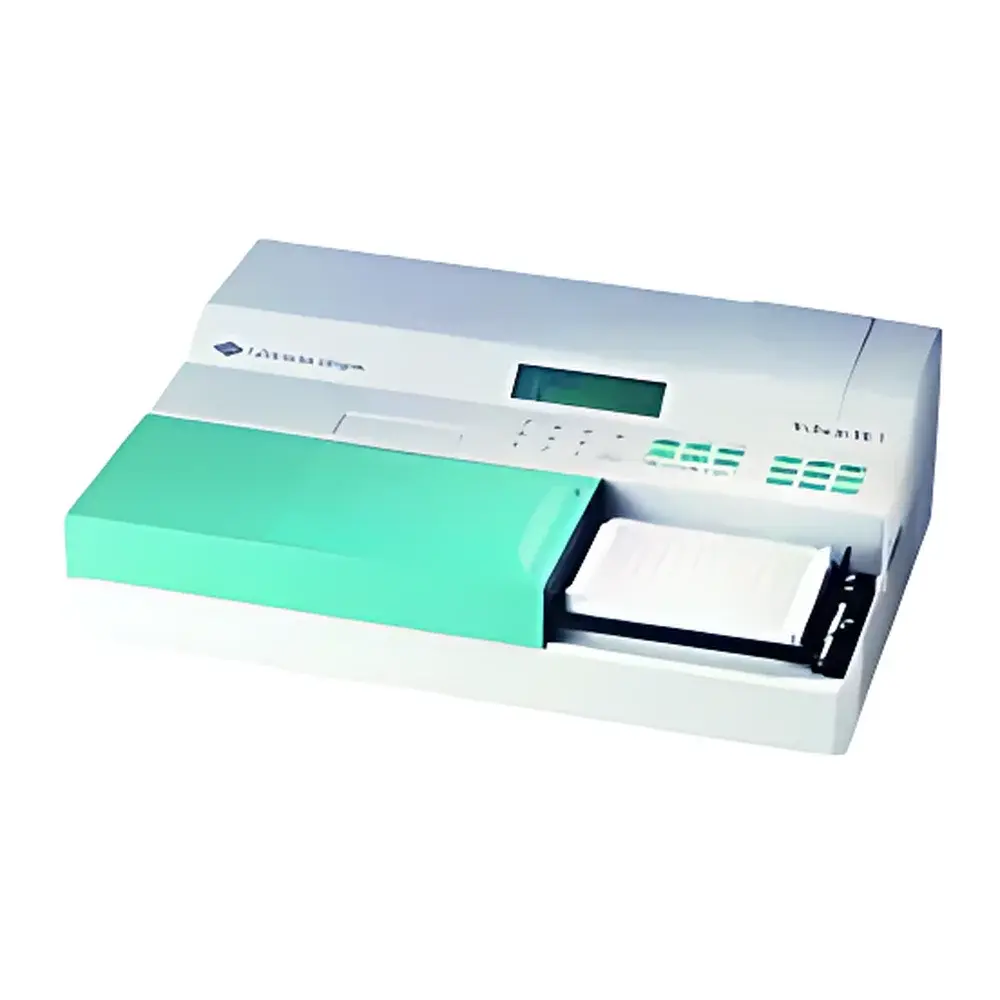
Thermo Scientific Multiscan MK3 Microplate Reader
| [Origin | China |
|---|---|
| Manufacturer Type | Authorized Distributor |
| Model | Multiscan MK3 |
| Optical Range | 340–750 nm (standard configuration: 405, 450, 492, 630 nm) |
| Absorbance Range | 0.000–3.500 A |
| Resolution | 0.001 A |
| Accuracy | ±1% (0–2.0 A) |
| Precision (CV) | <0.2% or ≤0.001 Abs at 0.5 A |
| Read Time | ≤5 seconds per 96-well plate |
| Plate Shaking | Linear vibration, 3 adjustable speeds |
| Dimensions | 140 × 420 × 320 mm (W × D × H) |
| Weight | 11 kg |
| Interface | RS-232 serial port, parallel printer port |
| Light Source | Quartz tungsten halogen lamp |
| Display | 2 × 20-character LCD |
| Keyboard | 30-key membrane keypad |
| Power Supply | 220–240 V, 50/60 Hz] |
Overview
The Thermo Scientific Multiscan MK3 Microplate Reader is a benchtop absorbance-based microplate detection system engineered for routine and research-grade ELISA, kinetic enzyme assays, UV absorbance measurements, and agglutination analysis in life science laboratories. Operating on the principle of photometric absorbance measurement—where sample optical density (OD) is quantified via Beer-Lambert law correlation between light attenuation and analyte concentration—the MK3 delivers robust performance across standard 96-well microplates. Its dual-beam optical architecture with multi-channel fiber-optic detection ensures high reproducibility and minimal well-to-well variation. Designed for compliance-driven environments, the instrument supports audit-ready workflows through timestamped data logging, programmable assay protocols, and full traceability of calibration events and user actions.
Key Features
- Multi-mode detection capability: endpoint (single/dual/multi-wavelength), kinetic (dual-time point), and agglutination assays—enabling flexibility across immunoassay, cell viability, and enzymatic activity studies.
- Integrated linear plate shaker with three programmable vibration intensities and adjustable duration—critical for homogeneous mixing prior to reading in suspension-based assays.
- Automated filter wheel accommodating up to eight interference filters (standard set: 405, 450, 492, 630 nm); optional filters available across 340–750 nm range for expanded spectral compatibility.
- Onboard firmware with 64 programmable method storage slots—including custom curve-fitting algorithms (linear regression, 4-parameter logistic, point-to-point interpolation) and configurable cut-off logic for qualitative interpretation.
- Self-diagnostic startup sequence: automatic lamp intensity verification, optical path calibration, and zero-reference validation prior to each measurement cycle.
- Full-plate statistical reporting: intra-plate coefficient of variation (CV), mean OD, standard deviation, and control group evaluation (blank, negative, weak positive, strong positive)—supporting QC compliance per CLIA, ISO 15189, and internal SOPs.
Sample Compatibility & Compliance
The MK3 is validated for use with standard flat-bottom, U-bottom, and V-bottom 96-well polystyrene and polypropylene microplates. It supports common assay formats including direct, indirect, sandwich, and competitive ELISA; NAD(P)H-dependent dehydrogenase kinetics; and turbidimetric agglutination assays. Instrument operation adheres to IEC 61010-1 safety standards for laboratory equipment. Data integrity features—including operator ID tagging, time/date stamping, and immutable result logs—facilitate alignment with GLP and GMP documentation requirements. While not natively 21 CFR Part 11 compliant, its RS-232 interface enables integration with validated third-party LIMS or ELN systems that enforce electronic signature and audit trail controls.
Software & Data Management
The MK3 operates with embedded firmware and includes Windows-compatible acquisition software for advanced protocol design, real-time visualization, and report generation. Data export is supported in CSV and Excel-compatible formats, preserving spatial mapping between plate layout and printed output. All reports retain full metadata: assay name, filter set, read mode, shaking parameters, calibration history, and operator ID. The software allows batch processing of multiple plates, inter-plate normalization, and customizable pass/fail thresholds based on reference controls. Raw absorbance values are stored with 16-bit resolution, ensuring fidelity for retrospective re-analysis or secondary modeling.
Applications
- Quantitative ELISA for cytokine, hormone, and antibody titer determination in clinical and preclinical research.
- Kinetic monitoring of β-galactosidase, alkaline phosphatase, and horseradish peroxidase activities under variable substrate concentrations.
- Cell proliferation and cytotoxicity assessment using MTT, XTT, and WST-1 colorimetric endpoints.
- Protein quantification via Bradford and BCA assays across biological lysates and purified fractions.
- Quality control of microplate manufacturing—inter- and intra-plate uniformity testing using blank and reference wells.
- High-throughput screening support in academic core facilities where reliability, ease of training, and low maintenance overhead are critical operational criteria.
FAQ
What wavelength filters are included by default?
The standard configuration includes 405 nm, 450 nm, 492 nm, and 630 nm interference filters. Additional filters spanning 340–750 nm are available as optional accessories.
Does the MK3 support kinetic measurements?
Yes—it offers dual-time point kinetic mode (T1/T2) with programmable delay intervals, enabling initial rate approximation for enzyme activity assays.
Can the instrument perform qualitative analysis?
Yes—CUT-OFF threshold logic is fully configurable, supporting binary classification (positive/negative) based on user-defined cutoffs, gray zone definitions, or relative control ratios.
Is the device compatible with modern LIMS or ELN platforms?
Via its RS-232 serial interface, the MK3 can be integrated into validated laboratory informatics ecosystems when paired with middleware that enforces data integrity, electronic signatures, and audit trails.
What maintenance is required for long-term accuracy?
Annual verification using NIST-traceable neutral density filters is recommended. The quartz tungsten lamp has a typical lifetime of 2,000 hours; replacement lamps are supplied with factory calibration coefficients.
Related Products




