
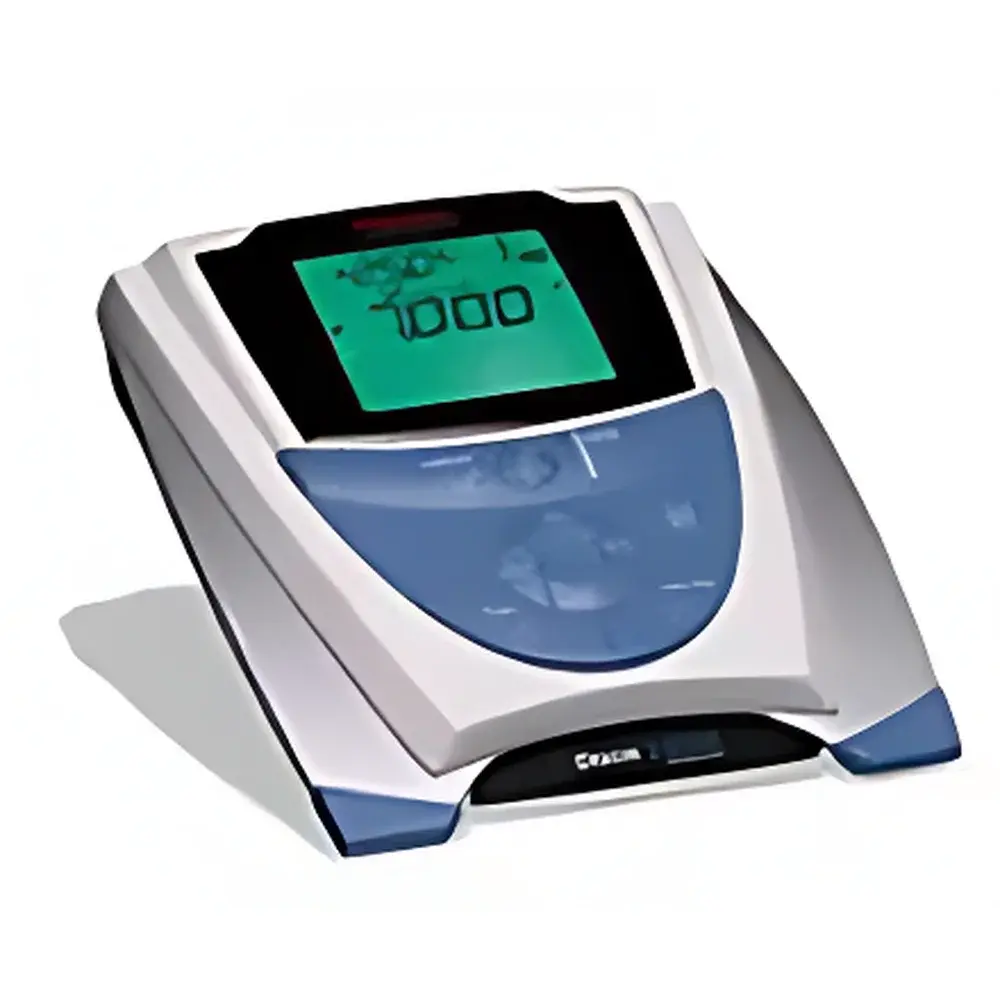
Thermo Scientific Orion 310D-01 Precision Benchtop Dissolved Oxygen Meter
| Origin | USA |
|---|---|
| Manufacturer Type | Authorized Distributor |
| Origin Category | Imported |
| Model | 310D-01 |
| Price | Upon Request |
| DO Range | 0.00–90.0 mg/L |
| DO Resolution | 0.1 / 0.01 mg/L |
| DO Saturation Range | 0.0–600% |
| Saturation Resolution | 1 / 0.1% |
| DO Accuracy | ±0.5% ±1 digit |
| Salinity Compensation Range | 0–45 ppt |
| Atmospheric Pressure Range | 450–850 mmHg |
| Calibration Modes | Water-saturated air, air-saturated water, Winkler titration zero-point |
| Electrode Type | Polarographic membrane sensor |
| Temperature Range | −5 to 105°C |
| Temp Resolution | 0.1°C (−5 to 99.9°C), 1.0°C (>99.9°C) |
| Temp Accuracy | ±0.1°C |
| Temp Compensation | Automatic/manual |
| Display | Backlit LCD |
| Sensor Interfaces | DO-miniDIN, Temp-miniDIN, Stirrer-phone jack (benchtop only) |
| Communication | Bidirectional RS232, optional USB cable |
| GLP Features | Data logging (200 entries), calibration history (last 10), method storage (10), self-test diagnostics, password protection, network-enabled firmware/software updates |
| Power | 4×AA batteries + universal AC adapter (benchtop) |
| Safety Certifications | CE, CSA, UL, TÜV, FCC Class A |
| Operating Environment | 5–45°C, 5–85% RH |
| Enclosure Rating | IP54 (benchtop) |
Overview
The Thermo Scientific Orion 310D-01 Precision Benchtop Dissolved Oxygen Meter is an electrochemical analytical instrument engineered for high-reproducibility measurement of dissolved oxygen (DO) concentration in aqueous solutions using polarographic membrane sensor technology. Based on Clark-type amperometric detection, the system applies a constant polarizing voltage across a gas-permeable membrane–enclosed cathode and silver/silver chloride anode, generating a current proportional to molecular oxygen diffusion rate. This principle enables trace-level quantification (down to 0.01 mg/L resolution) with inherent stability against interferences from redox-active species common in environmental, wastewater, and biological samples. Designed specifically for laboratory-based water quality analysis, the 310D-01 complies with standardized methodologies including U.S. EPA Method 360.1 and ISO 5814:2012 for electrochemical DO determination. Its integrated atmospheric pressure and salinity compensation algorithms ensure metrological rigor across diverse sample matrices—from freshwater streams to estuarine effluents—without manual correction factors.
Key Features
- Polarographic membrane electrode with built-in stirring function ensures rapid equilibration and minimizes boundary layer effects, delivering superior repeatability (RSD < 1.0% under controlled conditions)
- Triple-parameter compensation: automatic temperature, barometric pressure (450–850 mmHg), and salinity (0–45 ppt) applied in real time during measurement
- Smart Stability™ algorithm dynamically adjusts signal filtering to optimize response time without sacrificing endpoint accuracy
- Smart Averaging™ mode computes rolling mean over user-defined intervals (1–60 sec), reducing noise while preserving statistical integrity of reported values
- Self-Test diagnostics validate electrode membrane integrity, electrolyte level, cable continuity, and internal circuitry prior to each measurement cycle
- Benchtop-specific stirrer interface supports synchronized motor control via phone-jack connection, enabling consistent mixing velocity across replicate analyses
- GLP-compliant data management architecture with timestamped, user-annotated records—including full calibration audit trails and method metadata
Sample Compatibility & Compliance
The 310D-01 accommodates standard 12-mm diameter polarographic DO probes compatible with Orion’s Star™ electrode family. It supports direct measurement in deionized water, tap water, surface water, wastewater, fermentation broths, and saline media up to 45 ppt total dissolved solids. Calibration options include water-saturated air (for field reference), air-saturated water (at known temperature/salinity), and Winkler titration-derived zero-point verification—aligning with ASTM D888 and APHA Standard Methods 4500-O. The instrument meets IEC 61010-1 safety requirements and carries CE, CSA, UL, TÜV, and FCC Class A certifications. When configured with optional FDA 21 CFR Part 11 software module, it provides electronic signature support, audit trail logging, and role-based access control—fully satisfying GMP/GLP documentation mandates for regulated laboratories.
Software & Data Management
Data acquisition and reporting are governed by Orion Star™ GLP firmware, which enforces structured recordkeeping per ISO/IEC 17025 and 21 CFR Part 11 Annex 11 expectations. Each stored entry includes sample ID, operator ID, timestamp, DO value (mg/L and % saturation), temperature, pressure, salinity, electrode ID, and calibration status. Up to 200 measurements can be retained onboard; all data export via RS232 or USB to PC-based Orion ComStat™ software for further statistical evaluation, trend visualization, and PDF report generation. Firmware updates and method templates are deployed remotely through secure HTTP-based network protocols, eliminating dependency on physical service visits. Password-protected method libraries (10 slots) allow lab managers to predefine and lock critical parameters—including units, compensation settings, averaging duration, and alarm thresholds—for SOP-driven workflows.
Applications
- Regulatory compliance testing for municipal wastewater discharge permits (e.g., NPDES)
- Biological oxygen demand (BOD5) incubation monitoring per EPA 40 CFR Part 136
- Quality control of pharmaceutical process water (PW, WFI) per USP and
- Aquaculture system health assessment and hypoxia risk modeling
- Research-scale bioreactor dissolved oxygen profiling during microbial cultivation
- Educational laboratory instruction in environmental chemistry and limnology
FAQ
What calibration standards are required for routine operation?
Air-saturated water at ambient temperature and pressure is recommended for daily two-point calibration; water-saturated air serves as a stable secondary reference. Winkler titration may be used for validation or zero-point verification.
Does the instrument support automatic temperature compensation for DO readings?
Yes—NTC thermistor input enables continuous automatic temperature compensation across −5 to 105°C, with selectable linear or non-linear (ASTM D888) compensation curves.
Can the 310D-01 be used outdoors or in humid environments?
The benchtop unit carries IP54 rating (dust-protected, splash-resistant); for extended field deployment, pairing with a portable DO probe and battery power is advised—though primary design intent remains laboratory-based precision analysis.
Is electrode maintenance documented within the GLP log?
Yes—each calibration event logs electrode serial number, membrane replacement date (if entered manually), and post-calibration slope/stability metrics, supporting traceability under ISO 17025 Clause 7.7.
How is data security ensured when using the optional 21 CFR Part 11 software module?
Electronic signatures require dual authentication (user ID + unique PIN), audit trails capture all data modifications with immutable timestamps, and archived records are cryptographically hashed to prevent tampering.







