
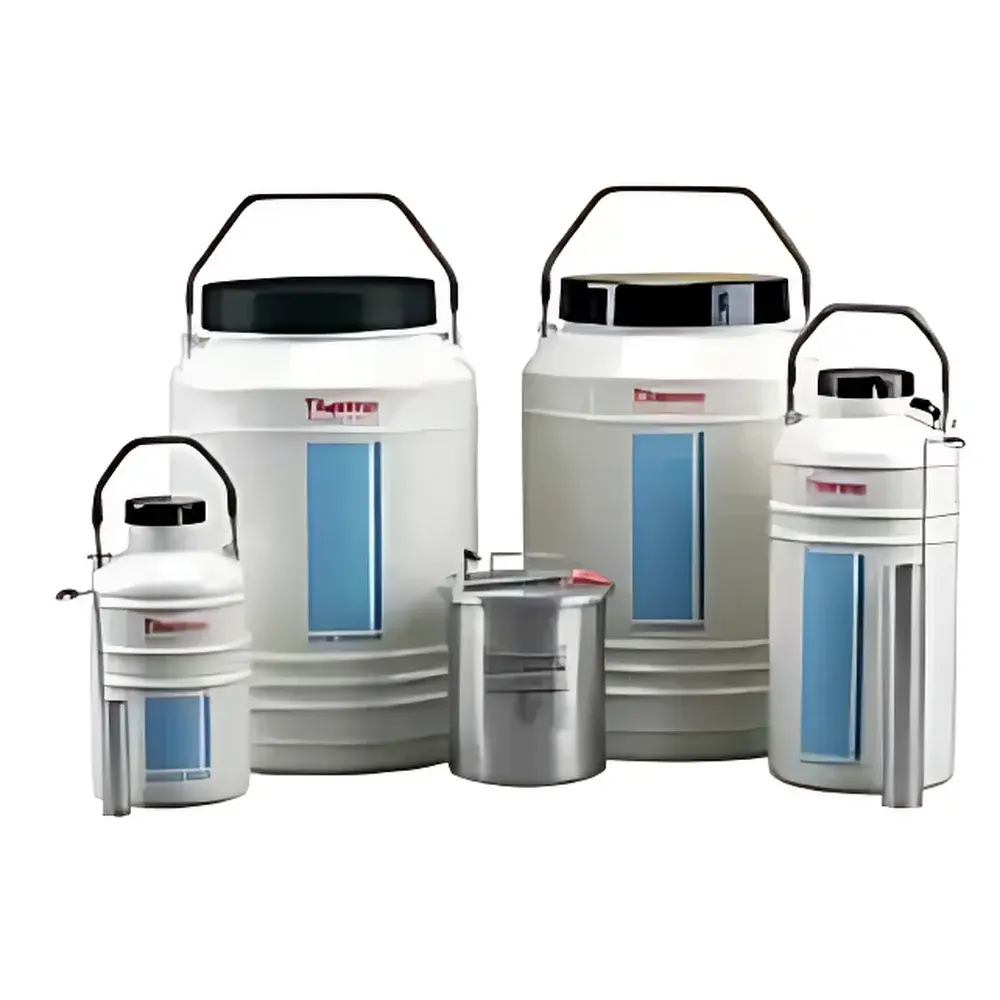
Thermo Scientific Thermo Liquid Nitrogen Transfer Dewar
| Brand | Thermo Fisher Scientific |
|---|---|
| Origin | USA |
| Model | Thermo 5 / Thermo 10 / Thermo 20 / Thermo 30 |
| Material | Anodized Aluminum Alloy |
| Neck Diameter | 5.6 cm / 5.6 cm / 5.0 cm / 6.4 cm |
| Static Evaporation Rate | 0.15 L/day / 0.18 L/day / 0.18 L/day / 0.22 L/day |
| Hold Time (Full Fill) | 33.3 days / 55.6 days / 111 days / 145 days |
| Design Standard | ISO 23779-compliant cryogenic transfer dewar architecture |
| Compliance | Meets ASTM F2163 for portable liquid nitrogen containers |
| Optional Accessory | Lockable stainless-steel transport cart with pneumatic casters |
Overview
The Thermo Scientific™ Thermo Liquid Nitrogen Transfer Dewar is an engineered solution for the safe, efficient, and reproducible handling of small-to-moderate volumes of liquid nitrogen (LN₂) in laboratory environments. Designed according to fundamental principles of cryogenic thermal insulation—featuring high-vacuum double-wall construction with multilayer reflective foil and superinsulating powder fill—the dewar minimizes heat ingress and suppresses static evaporation rates across its four standard capacities (5 L, 10 L, 20 L, and 30 L). Unlike general-purpose storage tanks, this series is purpose-built for *transfer* operations: controlled pouring into cryovials, sample racks, or secondary vessels without splashing, boil-off spikes, or operator exposure. Its lightweight anodized aluminum body provides structural integrity while enabling ergonomic manipulation—a critical requirement in high-throughput cell banking, biobanking, and cryopreservation workflows where repeated LN₂ replenishment is routine.
Key Features
- Optimized neck geometry: Precision-engineered aperture diameters (5.6 cm for Thermo 5/10; 5.0 cm for Thermo 20; 6.4 cm for Thermo 30) balance pour control with minimal vapor loss during dispensing.
- Low static evaporation rate: Ranging from 0.15 L/day (Thermo 5) to 0.22 L/day (Thermo 30), verified under ISO 23779-defined test conditions (ambient 23 °C, relative humidity 50 %, lid fully sealed).
- Ergonomic handling system: Integrated reinforced carry handles with non-slip textured grip surface; center-of-gravity optimized for stable tilt-and-pour motion at angles up to 45°.
- Robust vacuum integrity: Factory-sealed high-vacuum interstitial space maintained for ≥15 years under normal use; vacuum status indicator port available on request for preventive maintenance verification.
- Modular mobility: Compatible with optional CE-certified transport cart (stainless steel frame, dual-locking 100 mm pneumatic wheels, integrated LN₂ spill containment tray).
Sample Compatibility & Compliance
The Thermo Liquid Nitrogen Transfer Dewar supports direct transfer of LN₂ into all standard cryogenic receptacles—including 2 mL cryovials (Nunc, Corning), 50 mL conical tubes, cryoboxes (e.g., Micronic 96-well format), and vapor-phase storage racks. It complies with ASTM F2163–22 “Standard Specification for Portable Liquid Nitrogen Containers Used in Biomedical Applications”, ensuring mechanical stability, pressure relief performance, and thermal safety margins under routine lab handling. The anodized aluminum shell meets ISO 10993-5 cytotoxicity requirements for incidental contact with biological materials. No internal coatings or polymers are used—eliminating leachables risk during long-term storage or repeated thermal cycling. All models undergo 100% factory leak testing and vacuum hold-down validation prior to shipment.
Software & Data Management
While inherently a passive cryogenic device, the Thermo Transfer Dewar integrates seamlessly into digitally governed cold chain protocols. When paired with Thermo Fisher’s SampleManager LIMS or third-party systems (e.g., LabVantage, STARLIMS), users may log transfer events—including timestamp, operator ID, destination vessel ID, and volume dispensed (via calibrated dipstick or integrated mass-based flow sensor kits)—to satisfy GLP/GMP audit trails. Optional RFID-enabled lid tags (sold separately) support automated asset tracking and usage history reporting. All documentation—including Certificate of Conformance, vacuum integrity test report, and ASTM F2163 compliance statement—is provided in electronic format compliant with FDA 21 CFR Part 11 requirements for electronic records.
Applications
- Cryopreservation workflows: Routine refilling of vapor-phase freezers (e.g., Thermo Scientific CryoMed™) and liquid-phase cryostorage units during cell line expansion or primary tissue processing.
- IVF and reproductive labs: Controlled LN₂ delivery to vitrification workstations, minimizing thermal shock to oocytes and embryos during loading/unloading procedures.
- Biorepository operations: Batch-wise replenishment of cryoboxes and rack-based storage systems in accordance with ISBER Best Practices for specimen integrity.
- QC/QA laboratories: Standardized LN₂ dosing for thermal validation studies (e.g., mapping of ultra-low temperature zones per ISO/IEC 17025 Annex A.3).
- Research core facilities: Shared-resource deployment with usage metering and access logging for cost allocation and equipment utilization analytics.
FAQ
What is the recommended maximum fill level for optimal static hold time?
Fill to the shoulder of the inner vessel—approximately 95% capacity—to avoid excessive pressure buildup during thermal equilibration and ensure rated hold time performance.
Can the dewar be used for long-term storage of biological samples directly inside?
No. This is a transfer-only dewar. Biological specimens must be stored in dedicated vapor-phase or liquid-phase storage tanks (e.g., Thermo Scientific MVE series) meeting ISO 23779 Category II requirements.
Is the anodized aluminum surface compatible with ethanol or isopropanol decontamination?
Yes. The Type II anodized finish resists corrosion from common laboratory disinfectants when used per manufacturer-recommended concentration and dwell time.
How often should vacuum integrity be verified?
Annual verification is recommended using a calibrated vacuum gauge connected via the optional test port; more frequent checks are advised in high-cycle environments (>10 transfers/day).
Does the transport cart require electrical power or assembly?
No. The cart is manually operated and ships fully assembled with pre-torqued hardware and factory-calibrated wheel alignment.




