
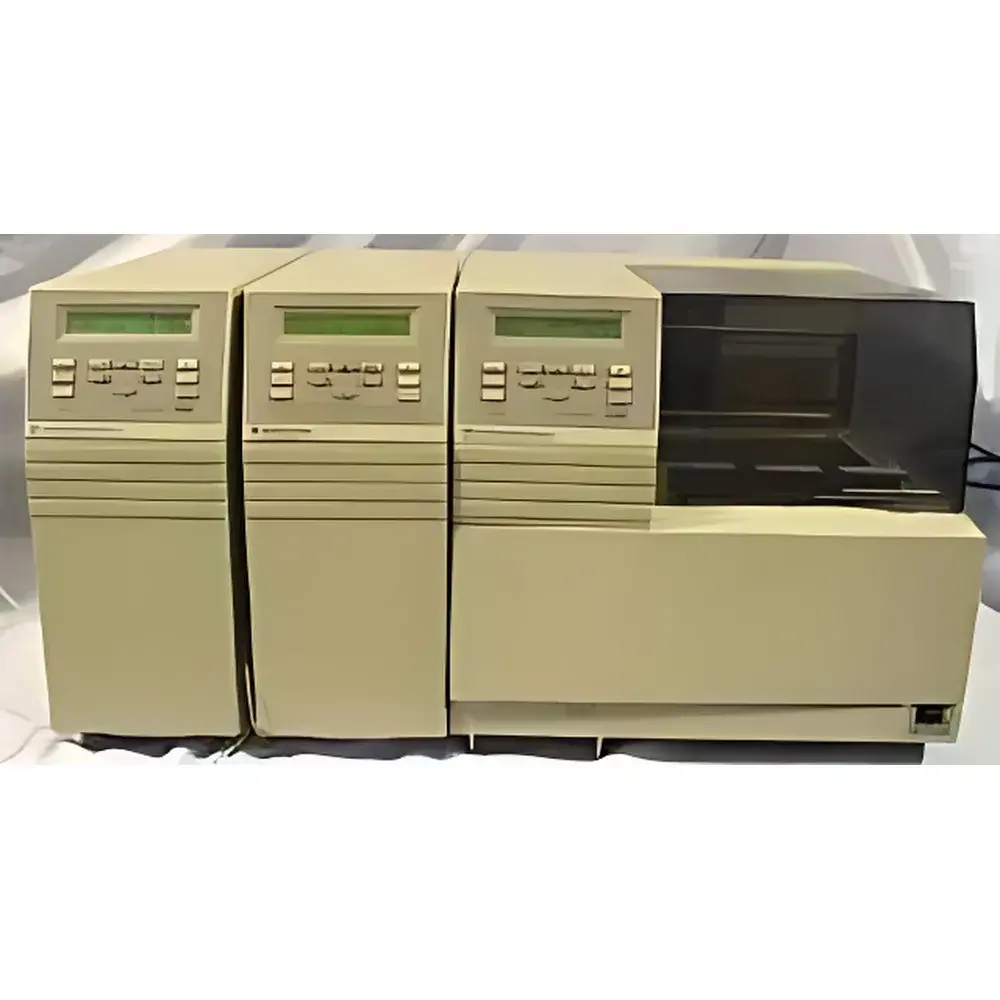
Thermo Scientific TSP P4000 Gradient Pump
| Origin | Imported |
|---|---|
| Manufacturer Type | Authorized Distributor |
| Model Series | P4000, AS 3000, UV 1000 |
| Compliance | CE, UL, RoHS |
| Flow Rate Range | 0.001–10.000 mL/min |
| Pressure Rating | Up to 400 bar |
| Gradient Accuracy | ≤0.2% RSD |
| Pulse Dampening | Active electronic compensation |
| Solvent Compatibility | HPLC-grade aqueous/organic solvents (including THF, DCM, DMF) |
| Communication Interface | RS-232, CAN bus, optional Ethernet (via TSP Control Hub) |
Overview
The Thermo Scientific TSP P4000 Gradient Pump is a high-precision, dual-plunger reciprocating solvent delivery system engineered for robust performance in analytical and preparative liquid chromatography applications. Operating on the principle of positive displacement via synchronized ceramic-coated stainless-steel plungers, the P4000 delivers exceptional flow stability and gradient reproducibility across a wide operational range—from trace-level method development to high-throughput QC workflows. Its architecture integrates real-time pressure monitoring, adaptive pulse dampening, and low-dead-volume fluidic pathways to minimize baseline noise and ensure compliance with ISO 9001-certified manufacturing standards. Designed as a core module within the broader Thermo Separation Products (TSP) ecosystem—including the AS 3000 autosampler and UV 1000 UV-Vis detector—the P4000 supports both isocratic and multi-step binary or quaternary gradient elution protocols.
Key Features
- High-pressure capability up to 400 bar (5800 psi), suitable for UHPLC-compatible columns and sub-2 µm particle packings
- Flow accuracy of ±0.1% and precision ≤0.06% RSD at 1 mL/min, validated per ASTM E2672-20 guidelines for LC pump performance
- Gradient composition accuracy ≤0.2% RSD over 0–100% B solvent range, achieved via digitally controlled proportional valve actuation
- Integrated degassing module (compatible with TSP Degasser units) reduces dissolved gas interference and improves retention time stability
- Self-diagnostic firmware with event logging, including pressure fault detection, seal wear alerts, and solvent level monitoring
- Modular front-panel interface with tactile keypad and backlit LCD; supports remote operation via RS-232 or CAN bus integration into centralized chromatography data systems (CDS)
Sample Compatibility & Compliance
The TSP P4000 is validated for use with standard HPLC and UHPLC mobile phases, including water/acetonitrile, water/methanol, and buffered systems (e.g., ammonium acetate, phosphate buffers pH 2–8). It exhibits chemical resistance to common organic solvents (THF, chloroform, DMF) and low-volatility additives when operated within specified temperature and pressure limits. All wetted materials—plunger seals, check valves, and pump heads—are constructed from chemically inert sapphire, ruby, and PEEK composites to prevent metal leaching and ensure compatibility with ICH Q5A biopharmaceutical purity testing. The instrument meets CE marking requirements under Directive 2014/30/EU (EMC) and 2014/35/EU (LVD), complies with UL 61010-1 safety standards, and adheres to RoHS 2011/65/EU restrictions on hazardous substances. Audit trails, user access controls, and electronic signature support are available when integrated with Thermo Chromeleon CDS v7.3+ under FDA 21 CFR Part 11 and EU Annex 11 regulatory frameworks.
Software & Data Management
Native control is enabled through Thermo Chromeleon Chromatography Data System (CDS), which provides method-driven pump configuration, real-time pressure/flow trending, and automated calibration report generation. The P4000 supports bidirectional communication for sequence synchronization with AS 3000 autosamplers and UV 1000 detectors, enabling fully automated run execution with inter-device error propagation handling. All operational parameters—including gradient profiles, flow ramps, and pressure limits—are stored as encrypted XML method files compliant with ASTM E1949-22 metadata standards. Raw diagnostic logs (e.g., plunger position traces, valve timing events) are timestamped and exportable in CSV format for GLP/GMP audit review. Optional Ethernet gateway modules enable secure TLS 1.2 connectivity for cloud-based fleet monitoring in multi-instrument laboratories.
Applications
- Pharmaceutical impurity profiling per USP and ICH Q2(R2) validation requirements
- Environmental analysis of PAHs, pesticides, and pharmaceutical residues in wastewater per EPA Method 8330B and ISO 17993
- Food safety testing for mycotoxins and veterinary drug residues under EU Regulation (EC) No 401/2006
- Biopolymer characterization using SEC-MALS coupling with low-shear flow delivery
- Method transfer between HPLC and UHPLC platforms via scalable flow/pressure parameter mapping
FAQ
Is the TSP P4000 compatible with third-party CDS platforms such as Agilent OpenLab or Waters Empower?
Yes—via standard RS-232 or CAN bus ASCII command sets defined in the Thermo TSP Communication Protocol Specification Rev. 4.2. Driver packages are available for OpenLab CDS 2.8+ and Empower 3 FR5.
What maintenance intervals are recommended for plunger seals and check valves?
Under typical use (8 hrs/day, aqueous/organic mobile phases), plunger seals require replacement every 6–12 months; check valves every 18–24 months. A full preventive maintenance kit (P/N TSP-PMK-P4000) includes calibrated replacement parts and torque specifications aligned with ISO/IEC 17025 calibration procedures.
Does the P4000 support gradient delay volume minimization for fast LC methods?
Yes—the system dead volume is factory-optimized to ≤120 µL from mixer outlet to column inlet. Optional low-volume mixer kits (P/N TSP-LVM-40) reduce delay volume to <60 µL for sub-minute gradients.





