
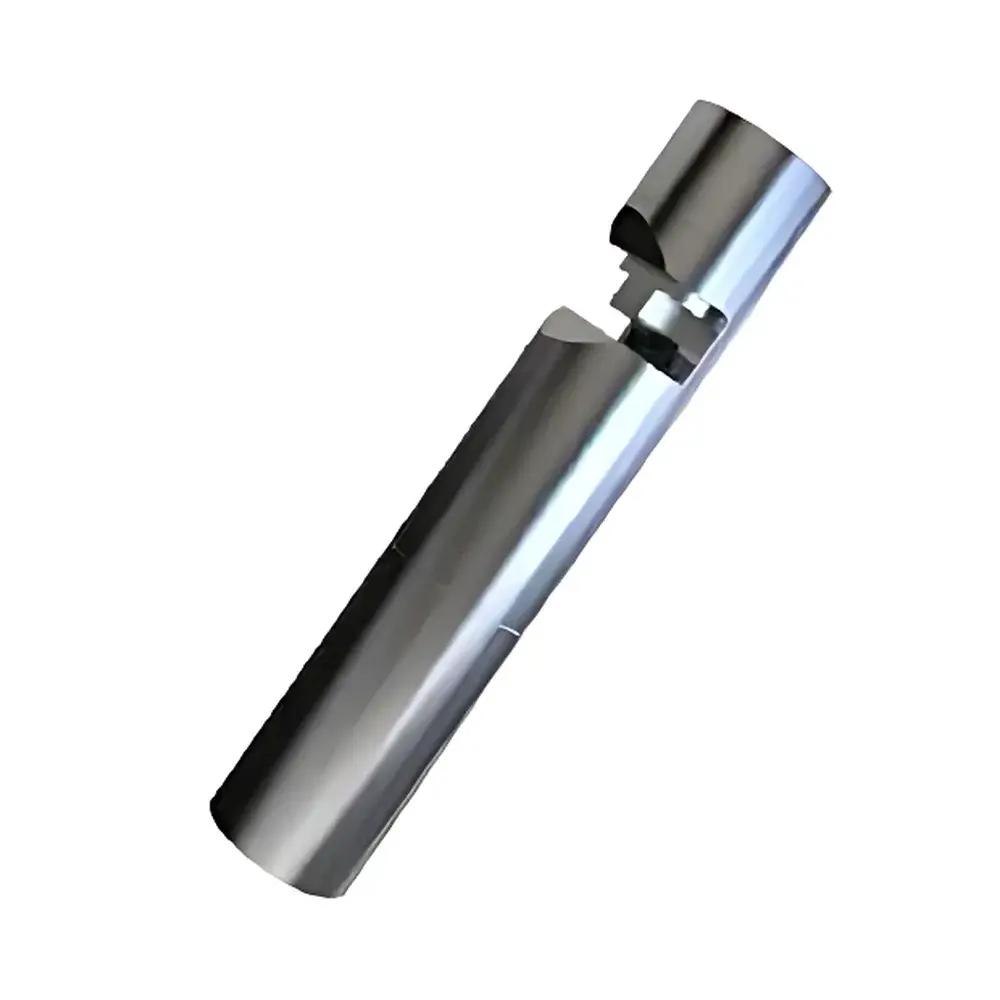
Thermo Scientific TSSEPC510 Full-Spectrum UV-Vis Immersion Sensor
| Brand | Thermo Fisher |
|---|---|
| Origin | USA |
| Manufacturer Type | Original Equipment Manufacturer (OEM) |
| Product Category | Imported Instrument |
| Model | Thermo Scientific TSSEPC510 |
| Pricing | Available Upon Request |
Overview
The Thermo Scientific TSSEPC510 Full-Spectrum UV-Vis Immersion Sensor is an advanced optical sensing platform engineered for continuous, reagent-free water quality monitoring in demanding environmental and municipal applications. Operating across a broad spectral range of 200–800 nm, the sensor employs high-resolution ultraviolet–visible (UV-Vis) absorbance spectroscopy combined with multivariate chemometric modeling to quantify multiple water quality parameters simultaneously. Unlike conventional dual-wavelength or fixed-band sensors, the TSSEPC510 captures full spectral fingerprints—enabling robust quantification of chemical and physical constituents even in complex, variable matrices such as raw sewage, surface water, and industrial effluents. Its immersion-based optical architecture utilizes precision-aligned quartz cuvettes and thermally stabilized LED light sources with matched photodiode detection, ensuring long-term baseline stability and minimal drift under fluctuating temperature and flow conditions.
Key Features
- Full-spectrum acquisition from 200 nm to 800 nm with 1 nm spectral resolution, supporting multi-parameter regression models for COD, BOD5 surrogate, UV254, nitrate-nitrogen (NO3-N), TOC, DOC, turbidity, TSS, color, and temperature.
- Integrated mechanical self-cleaning system: configurable between pulsed compressed-air jet cleaning (for low-sediment environments) and motor-driven rotating brush assembly (for high-fouling applications such as wastewater influent).
- Reagent-free operation eliminates consumables, hazardous waste generation, and associated regulatory reporting—fully compliant with ISO 15839 and EPA Method 1600-series guidelines for unattended monitoring.
- Sub-2-second optical response time enables real-time process control integration, including dynamic dosing feedback loops for UV disinfection or coagulant optimization.
- Chloride ion immunity achieved via spectral deconvolution algorithms that isolate nitrate absorption bands (200–220 nm) from overlapping chloride interference peaks—validated per ASTM D7573-22 for high-salinity wastewater streams.
- Designed for seamless integration with Thermo Scientific 3150 and 3300 Series multiparameter controllers, supporting Modbus RTU/TCP and HART 7.0 protocols for centralized SCADA deployment.
Sample Compatibility & Compliance
The TSSEPC510 is rated IP68 and constructed with 316L stainless steel housing, PTFE-coated optical windows, and FDA-compliant wetted materials (USP Class VI). It operates continuously in temperatures from 0 °C to 50 °C and pressures up to 6 bar, making it suitable for submerged installation in open channels, pipe spools, and pressurized distribution networks. The sensor meets IEC 61326-1 (EMC), IEC 61000-6-2/6-4, and ATEX Zone 1/21 certification requirements when used with approved barrier systems. Data integrity complies with FDA 21 CFR Part 11 through audit-trail-enabled firmware (v3.2+), including electronic signatures, user access controls, and immutable event logging for GLP/GMP-regulated monitoring sites.
Software & Data Management
Raw spectral data (absorbance vs. wavelength) is streamed at 1 Hz to compatible Thermo Scientific controllers or third-party SCADA platforms via standardized protocol stacks. Onboard chemometric models are field-upgradable using Thermo’s AquaSoft™ Calibration Manager—a secure, version-controlled desktop application supporting PCA, PLS, and MLR model validation per ISO/IEC 17025:2017 Annex A.3. All calibration certificates include uncertainty budgets traceable to NIST SRM 2036 (UV-Vis absorbance standards) and documented matrix-matched validation across >200 real-world samples per parameter.
Applications
- Real-time compliance monitoring at NPDES and EU WFD discharge points
- Early-warning detection of organic loading shocks in activated sludge basins
- UV transmittance (UVT) and dose tracking for UV disinfection systems
- Source water quality trending in reservoirs and river intakes
- Industrial pretreatment verification for food & beverage, pharmaceutical, and semiconductor facilities
- Research-grade dissolved organic matter (DOM) characterization in limnological studies
FAQ
Does the TSSEPC510 require annual recalibration?
No—field validation is recommended every 6 months using matrix-matched reference standards; full recalibration is only required after optical window replacement or firmware upgrade.
Can it be deployed in seawater or brackish environments?
Yes, provided the optional titanium housing variant (TSSEPC510-Ti) is selected and the cleaning cycle is increased to mitigate biofouling; chloride interference is algorithmically compensated.
Is spectral data export supported?
Yes—raw absorbance spectra (CSV), processed parameter outputs (JSON/XML), and diagnostic logs are accessible via controller USB port or Ethernet API endpoint.
What maintenance intervals apply to the brush cleaning mechanism?
Brush motor lifetime exceeds 20,000 cycles; brush bristles are rated for ≥12 months in typical municipal wastewater; replacement kits include torque-calibrated drive shafts and wear-compensating bearings.
How does it handle air bubbles or suspended solids during measurement?
Optical path length compensation algorithms detect and correct for transient scattering events; dual-beam referencing minimizes impact from particulate obscuration within ±5% error margin (per ISO 7027-1:2016).







