
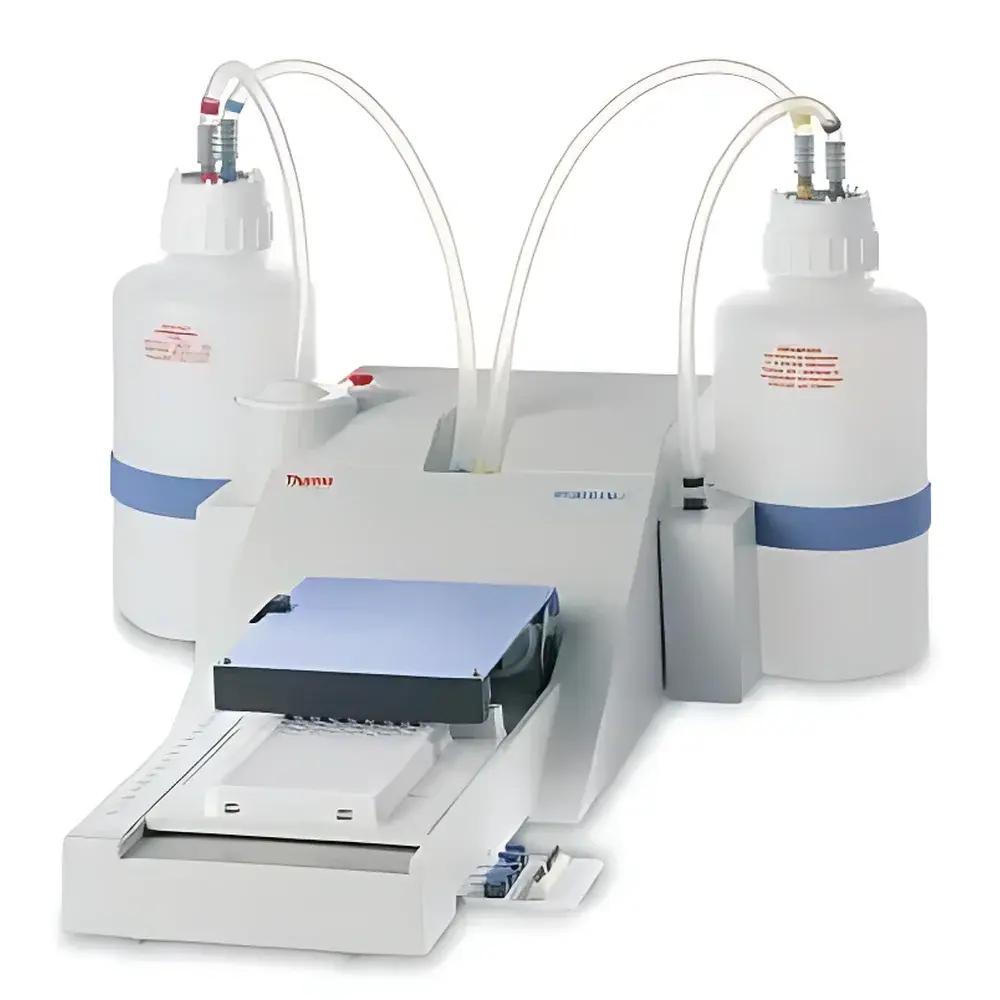
Thermo Scientific WellWash 4 MK2 Plate Washer
| Origin | Imported |
|---|---|
| Manufacturer Type | Authorized Distributor |
| Weight | 10 kg |
| Wash/ Waste Bottle Capacity | 2 L + 2 L |
| Optional Auxiliary Wash Bottle | 2 L |
| Pre-wash Volume | 15–20 mL |
| Max Operating Pressure (Self-limiting) | 0.5 bar |
| Residual Liquid per Well | < 5 µL (avg.) |
| Accuracy | ±5% |
| Operation Mode | Continuous |
| Adjustable Wash Cycles | 1–15 |
| Dispense Volume Range | 0–750 µL |
| Soak Time | 0–10 min |
| Pause Duration | 0–60 s |
| Wash Head Configurations | Interchangeable 8-channel and 12-channel coaxial cannula tips |
| Auto Pump Shut-off Delay | 30 s idle timeout |
Overview
The Thermo Scientific WellWash 4 MK2 Plate Washer is a benchtop microplate washing system engineered for precision, reproducibility, and operational robustness in ELISA, cell-based assays, and other high-throughput immunoassay workflows. It employs a dual-channel coaxial cannula design—where an outer stainless-steel suction ring surrounds an inner dispensing needle—to achieve simultaneous, spatially decoupled fluid delivery and aspiration. This architecture minimizes cross-contamination by eliminating contact between the dispensing tip and well bottom or sidewalls, while ensuring complete aspiration via continuous peripheral vacuum draw. The system operates under self-limiting pneumatic pressure (0.5 bar), delivering consistent wash performance across 96-well and 384-well microplates without requiring external compressed air sources. Its modular hardware platform supports both standard and custom assay protocols, making it suitable for regulated environments where traceability and repeatability are essential.
Key Features
- Coaxial dual-cannula wash head: Outer suction ring removes residual liquid from well walls and corners; inner non-contact dispensing needle delivers wash buffer at a fixed 2 mm above well bottom—preventing carryover and surface adhesion.
- Interchangeable 8-channel and 12-channel wash heads: Tool-free switching completed in under 5 seconds, enabling rapid adaptation between plate formats and assay volumes.
- Magnetic tray docking system: Eliminates mechanical alignment wear, reduces vibration-induced misalignment, and enhances long-term positional accuracy during repeated plate loading cycles.
- Self-regulating pump control: Automatic shut-off after 30 seconds of inactivity reduces mechanical stress on diaphragm pumps, extends service life, and lowers acoustic emissions in shared laboratory spaces.
- Dual independent fluid reservoirs: Standard 2 L wash and 2 L waste bottles; optional auxiliary 2 L rinse bottle allows on-the-fly buffer exchange or post-wash needle purging without manual disassembly.
- Precision fluid handling: Dispense range 0–750 µL per well with ±5% volumetric accuracy; residual volume consistently maintained below 5 µL per well under validated operating conditions.
Sample Compatibility & Compliance
The WellWash 4 MK2 accommodates ANSI/SLAS-standard microplates (96-well and 384-well), including flat-bottom, U-bottom, V-bottom, and tissue-culture-treated formats. Its non-contact dispensing geometry ensures compatibility with coated, hydrophobic, or low-binding surfaces without compromising antibody binding integrity. The system supports protocols compliant with CLSI EP15-A3, ISO 15197:2013 (for assay validation prerequisites), and FDA-recommended ELISA washing practices outlined in guidance documents for diagnostic kit development. While the instrument itself does not embed electronic audit trails, its programmable operation supports GLP/GMP-aligned documentation when integrated into SOP-controlled workflows using external logbook systems or LIMS interfaces.
Software & Data Management
Operation is controlled via front-panel membrane keypad with intuitive icon-driven navigation. Four pre-programmed protocol cards are factory-installed for common ELISA, streptavidin-biotin, and blocking buffer removal applications. A fifth fully adjustable card enables user-defined configuration of wash cycles (1–15), dispense volume (0–750 µL), soak duration (0–10 min), pause intervals (0–60 s), and aspiration dwell time. Protocol parameters are stored in non-volatile memory and recalled without software installation. For laboratories requiring digital record retention, Thermo Fisher Scientific offers optional integration with Thermo Scientific Connect software (v3.2+), which logs operator ID, timestamp, protocol version, and cycle completion status—supporting 21 CFR Part 11 compliance when deployed with appropriate access controls and electronic signature modules.
Applications
- ELISA and multiplex immunoassays requiring stringent wash stringency to reduce background and improve signal-to-noise ratios.
- Cell-based assays involving adherent or suspension cultures where gentle yet thorough buffer exchange is critical for viability and receptor integrity.
- Western blot strip washing prior to secondary antibody incubation.
- High-sensitivity cytokine or phosphorylation profiling where residual detergent or blocking agent must be minimized.
- QC release testing of diagnostic reagents under ISO 13485 or IVD regulatory frameworks.
- Research-scale antibody purification workflows involving affinity plate capture and sequential pH-elution steps.
FAQ
What microplate formats are supported by the WellWash 4 MK2?
Standard 96-well and 384-well plates conforming to ANSI/SLAS dimensional specifications, including flat-bottom, U-bottom, V-bottom, and TC-treated variants.
Can the wash head be sterilized or autoclaved?
No—the coaxial cannula assembly is not autoclavable; however, it is compatible with 70% ethanol, 0.5% sodium hypochlorite, and 0.1 M NaOH for decontamination between runs.
Is the system compatible with viscous buffers such as 10% BSA or 5% skim milk?
Yes—within the specified 0–750 µL range and at ambient temperature; viscosity effects are compensated by the self-limiting pressure regulation and optimized aspiration timing.
How is calibration verified?
Gravimetric verification is performed using calibrated analytical balance and standardized test plates; Thermo Fisher recommends annual verification per ISO/IEC 17025-aligned internal procedures.
Does the instrument support remote monitoring or network connectivity?
Not natively—the WellWash 4 MK2 operates as a standalone unit; however, optional USB-to-serial adapters enable basic command-line control via third-party scripting environments for semi-automated batch processing.



