
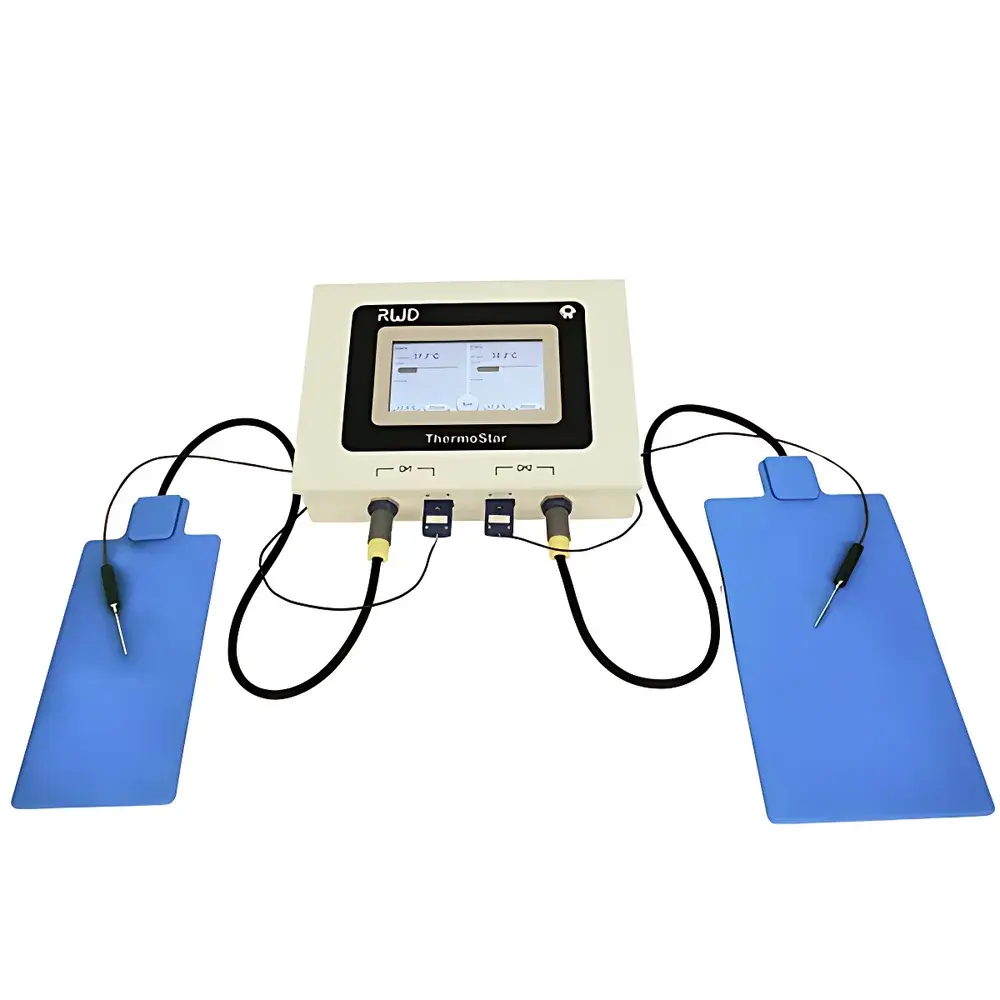
ThermoStar Animal Temperature Maintenance System by RWD
| Brand | RWD |
|---|---|
| Model | 69020 |
| Display | 4.3-inch color LCD touchscreen |
| Temperature setting range | 20–45 °C (±0.1 °C resolution) |
| Unit toggle | °C / °F |
| Power supply | 100–240 V AC, 50/60 Hz |
| Control unit dimensions | 205 × 148 × 80 mm |
| Control unit weight | 1.3 kg |
| Safety architecture | Separate circuit control for heating pad and rectal probe |
| Operating states displayed | IDLE, WARNING, STANDBY, WORKING |
| Included in base system | One 69023 heating pad (12.0 × 20.5 cm), one 69022 rectal probe (1.5 mm Ø, 30 mm insertion length, 150 cm cable) |
Overview
The ThermoStar Animal Temperature Maintenance System (Model 69020) is an engineered thermal regulation platform designed specifically for rodent surgical and anesthesia protocols in preclinical research environments. Maintaining normothermia during experimental procedures is not merely a welfare requirement—it is a critical experimental variable that directly impacts physiological stability, anesthetic depth, metabolic rate, cerebral blood flow, and postoperative recovery outcomes. Hypothermia, even mild (≥1 °C below baseline), induces vasoconstriction, reduces tissue oxygenation, delays drug metabolism, and increases surgical site infection risk—factors that compromise data reproducibility and statistical power. The ThermoStar system employs closed-loop proportional-integral (PI) temperature control to actively regulate surface heating and core body temperature via real-time feedback from a calibrated rectal thermistor probe. Its dual-channel architecture allows concurrent, independent thermal management of two subjects—enabling comparative studies or paired experimental designs without cross-interference.
Key Features
- 4.3-inch high-contrast color LCD touchscreen interface with intuitive icon-based navigation and real-time graphical status indicators
- Dual independent control channels: one for the heating pad surface, one for rectal temperature feedback—each with dedicated circuitry for fail-safe redundancy
- Four-state operational visualization: IDLE (standby), WARNING (out-of-range deviation >0.5 °C), STANDBY (pre-heating), and WORKING (active regulation)
- Precision temperature control: 0.1 °C resolution across 20–45 °C range; configurable display in both Celsius and Fahrenheit
- Compliance-ready design: meets IEC 61010-1 safety standards for laboratory electrical equipment; includes overtemperature cutoff and open-circuit detection for probe and pad
- Modular accessory ecosystem: compatible with three standardized heating pad sizes (69023: 12.0 × 20.5 cm; 69024: 9.0 × 17.0 cm; 69025: 7.0 × 10.0 cm) and a validated rectal probe (69022, 1.5 mm diameter, 30 mm active tip, 150 cm PTFE-insulated cable)
Sample Compatibility & Compliance
The ThermoStar system is optimized for use with mice (18–35 g) and rats (150–500 g) under ISO 10993-compliant biocompatible materials. The 69022 rectal probe features a smooth, tapered stainless-steel tip with medical-grade epoxy encapsulation, minimizing mucosal trauma during insertion. All heating pads utilize low-voltage resistive elements embedded in silicone rubber—providing uniform thermal distribution, chemical resistance to common disinfectants (e.g., 70% ethanol, sodium hypochlorite), and mechanical durability for repeated autoclaving (up to 121 °C, 20 min). The system supports adherence to ARRIVE 2.0 guidelines, NIH Office of Laboratory Animal Welfare (OLAW) standards, and EU Directive 2010/63/EU requirements for perioperative thermal support. It is routinely deployed in GLP-compliant toxicology studies where temperature documentation must be traceable and auditable.
Software & Data Management
While the ThermoStar 69020 operates as a standalone hardware-controlled device without external software dependency, its interface logs timestamped operational events—including setpoint changes, state transitions, and fault triggers—to internal non-volatile memory (retention ≥10 years). This audit trail satisfies basic FDA 21 CFR Part 11 requirements for electronic records when paired with institutional SOPs governing instrument calibration and maintenance. Optional RS-232 or USB-to-serial interfaces (available upon request) enable integration with third-party data acquisition systems (e.g., LabChart, Spike2) for synchronized recording of temperature alongside electrophysiological, respiratory, or hemodynamic parameters. Calibration certificates per ISO/IEC 17025 are available through RWD’s accredited service network.
Applications
- Intracranial stereotaxic surgery requiring stable core temperature for accurate electrode placement and neural signal fidelity
- Long-duration fMRI or PET imaging sessions where thermoregulatory drift affects BOLD contrast or tracer kinetics
- Cardiovascular interventions (e.g., carotid occlusion, myocardial ischemia-reperfusion) where hypothermia confounds infarct size quantification
- Developmental neurobiology studies involving neonatal or aged rodents with impaired thermoregulatory capacity
- Pharmacokinetic/pharmacodynamic (PK/PD) experiments assessing drug clearance rates sensitive to hepatic perfusion temperature
- Behavioral assays conducted immediately post-surgery (e.g., Morris water maze, rotarod) where thermal stress alters motor coordination and learning retention
FAQ
What is the maximum number of animals the ThermoStar 69020 can support simultaneously?
It supports two animals concurrently, each with fully independent temperature setpoints and real-time monitoring.
Is the rectal probe reusable? What is its sterilization protocol?
Yes—the 69022 probe is autoclavable at 121 °C for 20 minutes; repeated sterilization does not affect thermistor accuracy within ±0.1 °C over 200 cycles.
Can the system interface with external data loggers or animal monitoring platforms?
Yes—via optional serial communication modules (RS-232 or USB-CDC), enabling time-synchronized export of temperature setpoints, measured values, and operational states.
How often does the system require recalibration?
Annual calibration is recommended; however, daily verification using a NIST-traceable reference thermometer (e.g., Fluke 1523) is advised before critical experiments.
Does the ThermoStar comply with GLP or GCP regulatory frameworks?
The hardware design and documentation package meet foundational GLP requirements for equipment qualification (IQ/OQ); full compliance depends on site-specific validation protocols and record-keeping practices.




