
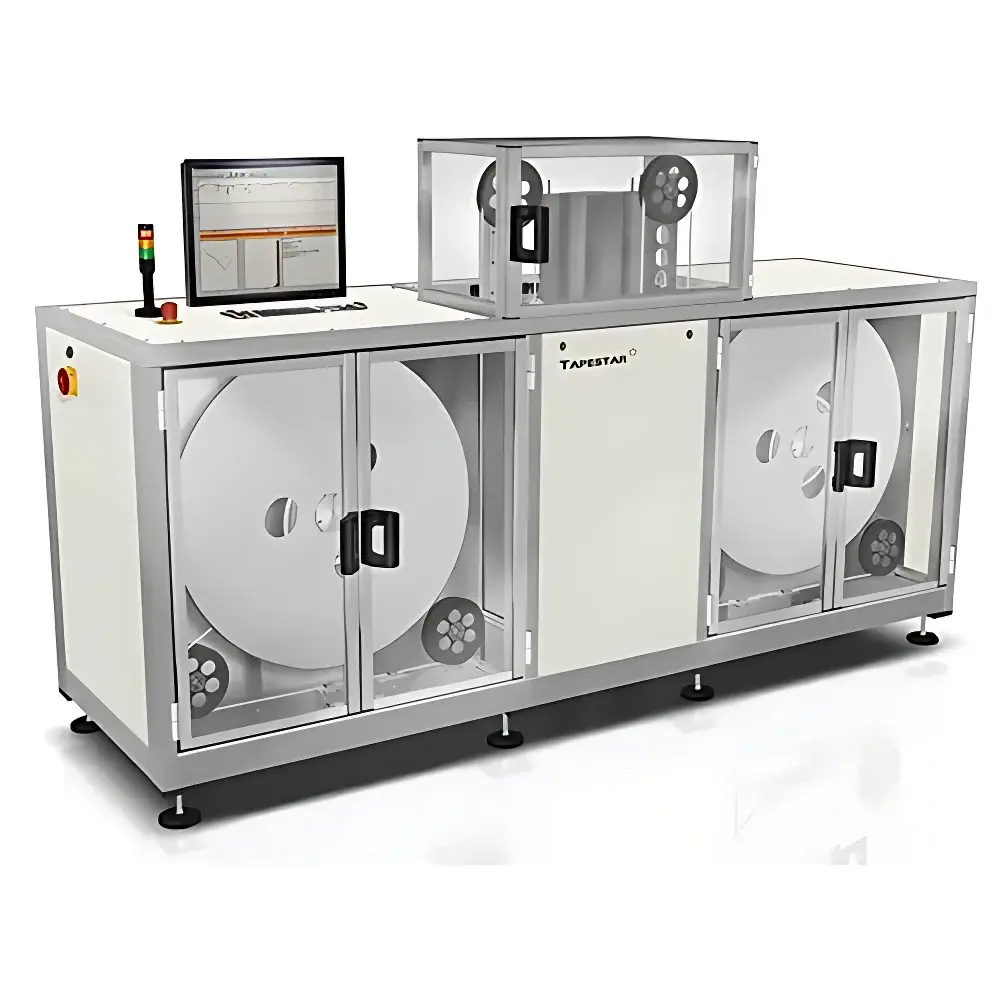
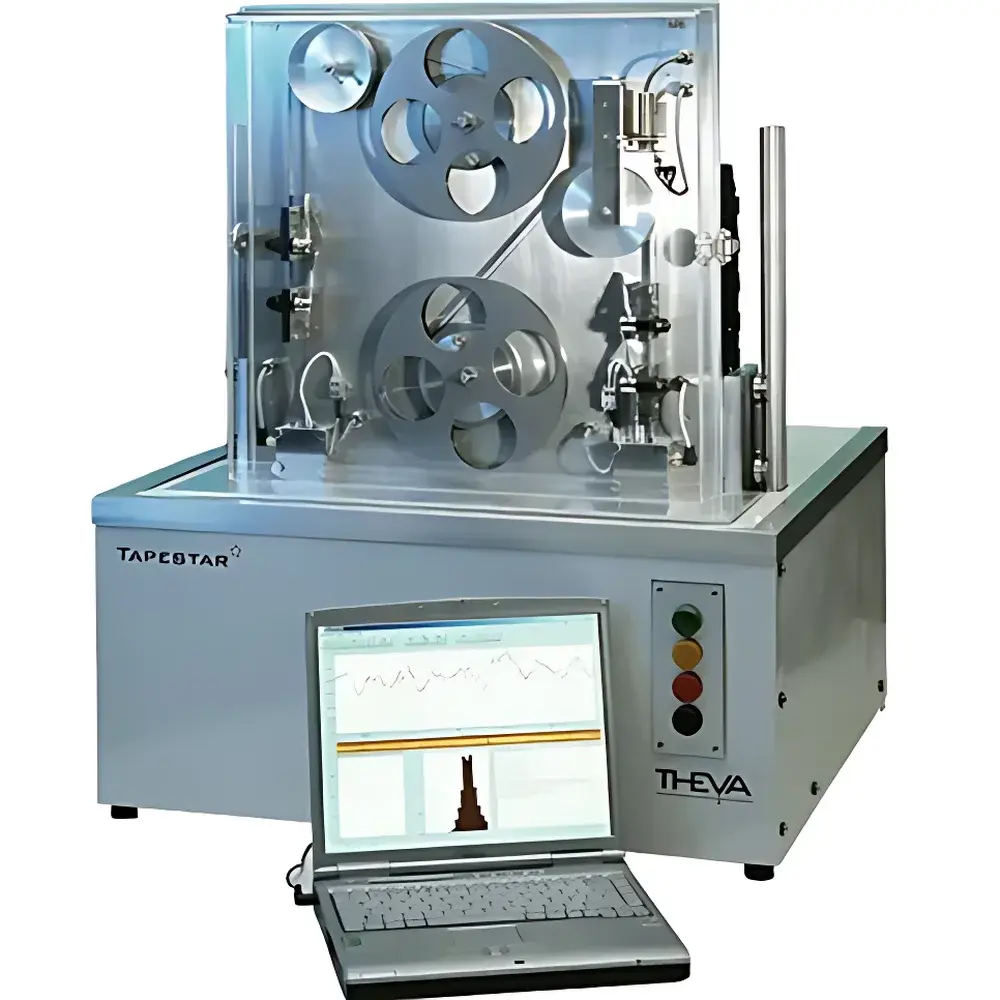
Theva TAPESTAR™ Critical Current Measurement System for HTS Tapes
| Brand | Theva |
|---|---|
| Origin | Germany |
| Model | TAPESTAR™ |
| Critical Current Range | 50–400 A (TAPESTAR™), 50–1000 A (TAPESTAR™ XL) |
| Measurement Principle | Non-contact magnetic induction (perpendicular field scanning with multi-channel Hall sensor array) |
| Operating Temperature | Liquid nitrogen (77 K) |
| Tape Speed | 0–55 m/h (TAPESTAR™), 0–200 m/h (TAPESTAR™ XL) |
| Axial Resolution | 0.5 mm @ 55 m/h (TAPESTAR™), 1 mm @ 55 m/h (TAPESTAR™ XL) |
| Transverse Resolution | 0.6 mm (4 mm tape), 1.5 mm (10 mm tape) |
| Magnetic Field Range | 0–40 mT (TAPESTAR™), 0–120 mT (TAPESTAR™ XL) |
| Sensor Channels | 7 (TAPESTAR™), 21 (TAPESTAR™ XL) |
| Accuracy | ±3% (≥15 A, calibrated reference sample) |
| Tape Width Customization | Up to 12.4 mm |
| Max. Tape Thickness | 200 µm |
| Tape Tension Control | 5 N (TAPESTAR™), 5–11 N (TAPESTAR™ XL) |
| Power Supply | 220 V / 50 Hz / 250 W (TAPESTAR™), 400 V / 3-phase / 50 Hz / 3 kW (TAPESTAR™ XL) |
| Dimensions (L×W×H) | 750 × 710 × 860 mm (TAPESTAR™), 2630 × 880 × 1550 mm (TAPESTAR™ XL) |
| Weight | 98 kg (TAPESTAR™), 475 kg (TAPESTAR™ XL) |
| Environmental Requirements | 5–35 °C, 10–90% RH (non-condensing), vibration-isolated installation |
Overview
The Theva TAPESTAR™ Critical Current Measurement System is an engineered solution for non-contact, high-resolution, in-line characterization of high-temperature superconducting (HTS) tapes under liquid nitrogen conditions (77 K). Based on the principle of magnetic induction—specifically, the detection of local magnetic field perturbations generated by critical current flow under applied perpendicular DC bias fields—the system enables rapid, quantitative mapping of Ic (critical current) along the full length of coated conductor tapes. Unlike contact-based four-probe methods, TAPESTAR™ eliminates electrode interface resistance, thermal load inconsistencies, and mechanical damage risks—making it uniquely suited for quality assurance of brittle, multi-layered architectures including YBCO (2G) and BSCCO (1G) tapes, as well as edge-defined or laminated configurations where electrical contact is impractical or destructive. The system operates by translating the tape at controlled velocity through a uniform magnetic field while a linear array of cryogenically stabilized Hall sensors records localized flux exclusion profiles; these are converted into spatially resolved Ic values using calibrated transfer functions traceable to NIST-traceable reference standards.
Key Features
- Non-contact, cryogenic Ic mapping at 77 K using integrated liquid nitrogen Dewar—no electrical contacts, no tape heating, no surface degradation
- Two platform variants: compact benchtop TAPESTAR™ for R&D and lab-scale validation; industrial-grade TAPESTAR™ XL for production-line QC and incoming inspection
- Precision tape handling subsystem with active tension control (5 N standard, up to 11 N optional), constant-speed drive (0–55 m/h or 0–200 m/h), and low-stress bending radius (≥100 mm)
- Multi-channel Hall sensor arrays (7-channel for TAPESTAR™, 21-channel for TAPESTAR™ XL) enabling sub-millimeter axial resolution and tape-width-adaptive transverse resolution (0.6 mm for 4 mm tapes, 1.5 mm for 10 mm tapes)
- Onboard digital signal processing (DSP) module with real-time data acquisition and noise suppression algorithms optimized for low-SNR cryogenic environments
- Integrated anti-condensation tape heater (controlled temperature ramp) preventing moisture-induced surface icing during LN2 operation
- Modular mechanical design supporting custom tape widths up to 12.4 mm and thicknesses up to 200 µm—compatible with standard spool geometries (core diameters from 10 mm to 3 inches)
Sample Compatibility & Compliance
TAPESTAR™ supports both first-generation (Bi-2223/Ag-sheathed) and second-generation (REBCO/YBCO on metallic substrates) HTS tapes, including those with buffer layers, cap layers, or edge-defined geometries that preclude conventional contact probing. The system accommodates tapes wound on standard storage reels (max. 5 kg for TAPESTAR™, 50 kg for TAPESTAR™ XL) and integrates mechanical guides to ensure centric alignment during translation. All measurement protocols adhere to ASTM F2629-21 (“Standard Test Method for Critical Current of Coated Conductors Using Magnetic Induction”) and ISO/IEC 17025-compliant calibration practices. Traceable calibration is performed using certified reference tapes with documented Ic homogeneity and uncertainty budgets (<±1.5% k=2). The system architecture satisfies requirements for GLP-compliant documentation: audit trails, user access controls, and electronic signature support are implemented via the embedded software framework.
Software & Data Management
Control and analysis are executed via Theva’s proprietary Windows-based application, TAPESTAR™ Control Suite v4.x. The software provides real-time visualization of Ic profiles, defect localization overlays, statistical process control (SPC) charts (X-bar/R, Cpk), and batch-level reporting compliant with FDA 21 CFR Part 11 Annex 11 requirements—including electronic signatures, change history logs, and immutable raw-data archiving. Data export formats include CSV, HDF5, and XML for integration with LIMS or MES platforms. Optional remote monitoring via Ethernet/IP allows centralized supervision across multi-site manufacturing facilities. Firmware updates and calibration certificate management are handled through secure, role-based web interfaces accessible only to authorized personnel.
Applications
- In-process quality control during reel-to-reel HTS tape manufacturing (e.g., MOCVD, PLD, or MOD deposition lines)
- Receiving inspection of supplier tapes prior to coil winding or magnet fabrication
- R&D evaluation of new substrate architectures, buffer layer stacks, or annealing processes
- Failure analysis of localized Ic degradation due to microcracks, interfacial delamination, or impurity segregation
- Correlation studies between magnetic Ic maps and transport measurements (e.g., 4-probe DC or AC loss)
- Validation of tape uniformity specifications per IEC 61788-13 and CIGRE TB 728
FAQ
What is the minimum measurable critical current, and what uncertainty applies below 15 A?
The specified accuracy of ±3% applies only above 15 A. Below this threshold, measurement repeatability is limited by sensor noise floor and magnetic background stability; users requiring sub-15 A quantification should perform site-specific validation using matched reference samples.
Can TAPESTAR™ measure tapes with non-uniform width or tapered edges?
Yes—transverse resolution is dynamically adjusted based on nominal tape width input; however, edge detection accuracy degrades beyond ±0.2 mm width variation per 10 cm segment.
Is the system compatible with helium-cooled operation (4 K)?
No. TAPESTAR™ is engineered exclusively for liquid nitrogen (77 K) operation. Cryostat geometry, sensor thermal anchoring, and magnetic field coil design are optimized for this temperature regime.
How often does the system require recalibration?
Annual calibration is recommended, or after any mechanical impact, Dewar refill procedure modification, or firmware update affecting sensor gain coefficients. Calibration certificates include drift assessment over 72-hour thermal soak cycles.
Does TAPESTAR™ XL support automated integration into factory SCADA systems?
Yes—via OPC UA server implementation (IEC 62541), enabling real-time Ic mean, min, and standard deviation streaming to enterprise-level manufacturing execution systems (MES).



