
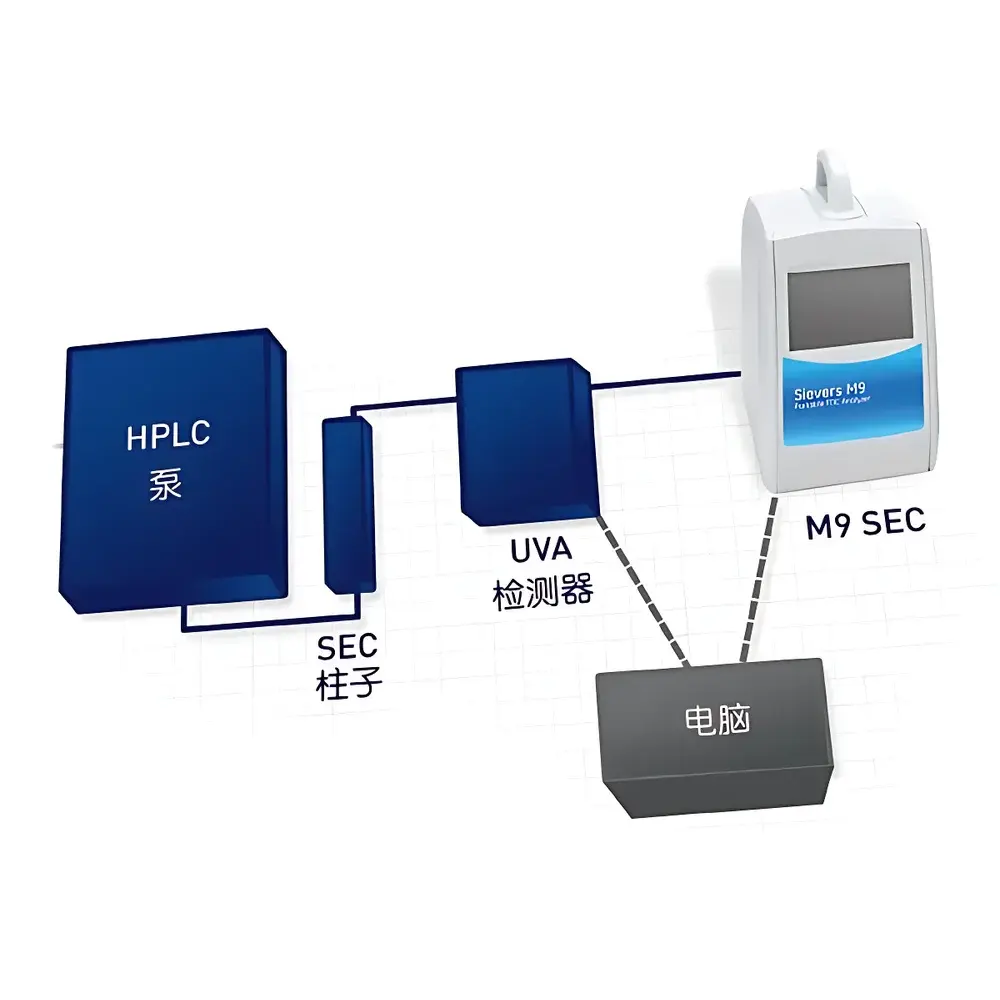
Sievers M9 SEC Portable Total Organic Carbon Analyzer
| Brand | Sievers (Veolia) |
|---|---|
| Origin | USA |
| Model | Sievers M9 SEC Portable |
| Instrument Type | Portable TOC Analyzer |
| Detection Principle | Membrane Conductivity Detection |
| Oxidation Method | UV/Persulfate Oxidation |
| Measurement Range | 0.03 ppb – 50 ppm |
| Accuracy | ±2% |
| Resolution | 0.01 ppb |
| Detection Limit | 0.03 ppb |
| Repeatability | ≤1% RSD |
Overview
The Sievers M9 SEC Portable Total Organic Carbon (TOC) Analyzer is a purpose-engineered, field-deployable analytical instrument designed for high-sensitivity, on-site quantification of dissolved organic carbon (DOC) in conjunction with high-performance liquid chromatography–size exclusion chromatography (HPLC-SEC) systems. Unlike conventional standalone TOC analyzers, the M9 SEC integrates directly into SEC workflows to enable molecular-weight-resolved organic carbon profiling—providing not only total or non-purgeable organic carbon (NPOC/TC) values but also size-distribution data across the full macromolecular range. Its core detection methodology relies on membrane conductivity measurement following UV/persulfate oxidation, a technique standardized under ASTM D5907 and ISO 8245 for aqueous organic carbon quantification. The system removes inorganic carbon (IC) via an integrated Inorganic Carbon Remover (ICR), ensuring accurate NPOC determination in complex matrices such as natural waters, wastewater effluents, pharmaceutical process streams, and bioprocessing intermediates.
Key Features
- Portable architecture optimized for mobile laboratory use and field deployment—compact footprint (W × D × H: 35 × 40 × 25 cm), IP21-rated enclosure, and 9.4 kg mass for transportability.
- Dual-mode operation: supports both offline batch analysis and online turbo-mode acquisition (one reading every 4 hours) synchronized with HPLC-SEC elution profiles.
- High-fidelity detection with 0.01 ppb resolution and sub-ppb detection limit (0.03 ppb), validated per USP and EP 2.2.44 requirements for ultrapure water monitoring.
- Integrated ICR module ensures complete IC removal prior to oxidation, eliminating carbonate/bicarbonate interference and enabling robust NPOC measurement in variable pH samples.
- Modular connectivity suite: three 4–20 mA analog outputs, four amplitude outputs, one binary input, one USB device port, two USB host ports, and native Modbus TCP/IP support for seamless integration into SCADA or LIMS environments.
- 7-inch WGA (800 × 480) color LCOS display with intuitive touch-enabled interface for real-time chromatogram viewing, calibration status, and diagnostic alerts.
Sample Compatibility & Compliance
The M9 SEC analyzer accepts liquid samples delivered at 1 mL/min flow rate from compatible HPLC-SEC systems—including isocratic pumps, vacuum degassers, and columns such as the Toth Biocontrol 44782 SEC column. Sample introduction requires pre-filtration through 0.45 µm membranes to prevent particulate fouling. Compatible mobile phases include phosphate buffer (0.004 M, pH 6.8) and sodium sulfate (0.025 M), selected to minimize organic background and avoid column contamination. The instrument operates within ambient conditions of 5–40 °C and relative humidity up to 95% non-condensing. It complies with ETL Listed safety certification (ETL CE), meets IEC 61000-6-2/6-3 EMC standards, and supports audit-trail-enabled operation aligned with FDA 21 CFR Part 11 and EU Annex 11 requirements when paired with validated HPLC software platforms.
Software & Data Management
Data acquisition and reporting are managed through vendor-supplied HPLC control software, which synchronizes detector output (TC/NPOC) with retention time and molecular weight calibration curves generated using PEG or PSS standards. Calibration protocols follow traceable KHP (potassium hydrogen phthalate) standards across five concentration levels. All raw signals, calibration logs, method parameters, and user actions are timestamped and stored locally with optional export to CSV or XML formats. The USB host interfaces allow direct connection to external storage or network gateways, facilitating automated upload to centralized QA/QC databases. For regulated environments, the system supports electronic signatures, role-based access control, and secure data archiving compliant with GLP and GMP documentation practices.
Applications
- Environmental monitoring of DOC speciation in surface water, groundwater, and drinking water treatment plants.
- Pharmaceutical water system validation (PW, WFI) per USP , EP 2.2.44, and JP 17 guidelines.
- Biopharmaceutical process development—tracking organic carbon leachables from chromatographic resins, filters, and single-use systems.
- Research applications in aquatic biogeochemistry, including humic substance characterization and polymer degradation kinetics.
- Regulatory compliance testing for wastewater discharge permits requiring molecular-weight-distributed organic load reporting.
FAQ
What sample preparation is required before analysis?
Samples must be filtered through a 0.45 µm membrane to protect the SEC column and detector flow path. No acidification or sparging is needed due to the integrated ICR module.
Can the M9 SEC operate independently of an HPLC system?
No—it is specifically configured as an SEC-coupled detector and lacks standalone sample introduction hardware; it requires external HPLC delivery at 1 mL/min.
How is molecular weight calibration performed?
Using certified PEG or PSS standards injected under identical SEC conditions; retention times are mapped to known molecular weights to generate calibration curves.
Does the instrument support regulatory audit trails?
Yes—when operated with validated HPLC software, all calibration events, method changes, and result exports are logged with user ID, timestamp, and digital signature capability.
What maintenance intervals are recommended?
UV lamp replacement every 12 months; membrane conductivity cell cleaning every 200 injections; annual performance verification using KHP and PEG standards per ISO/IEC 17025 protocols.
Related Products







