
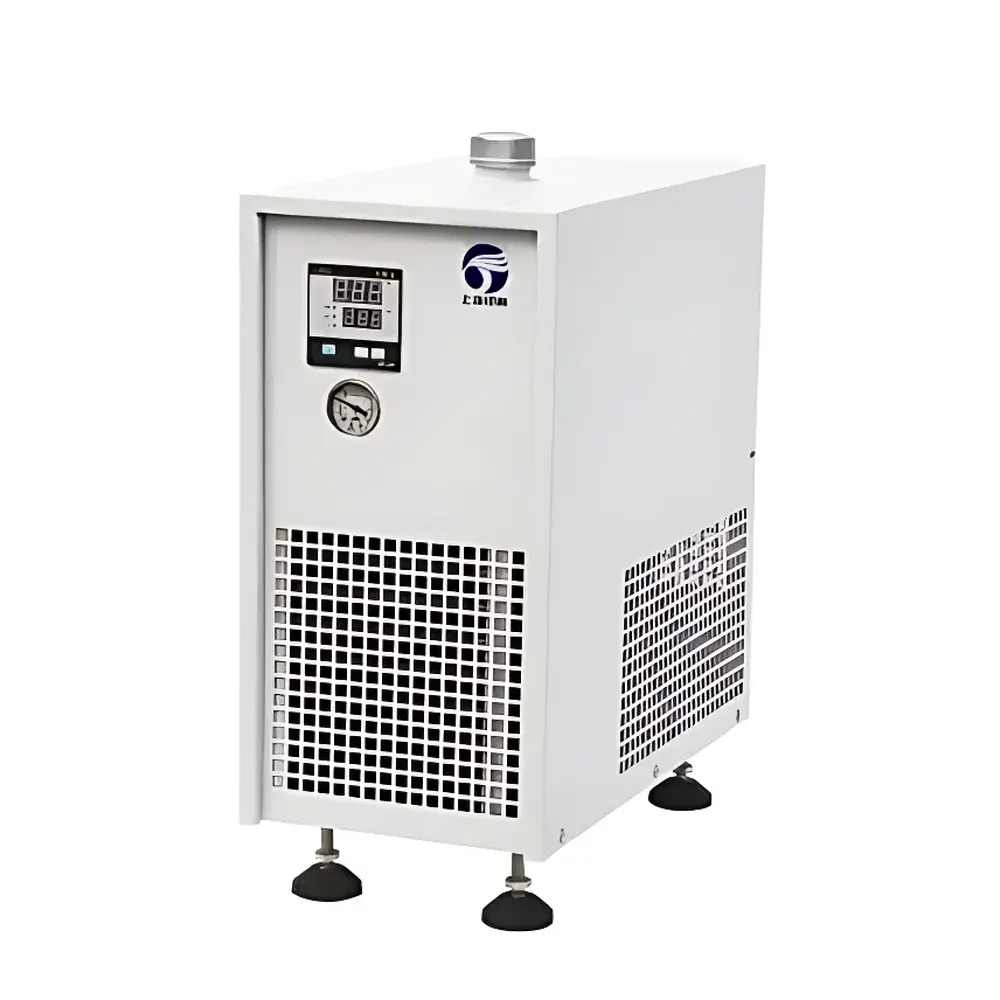
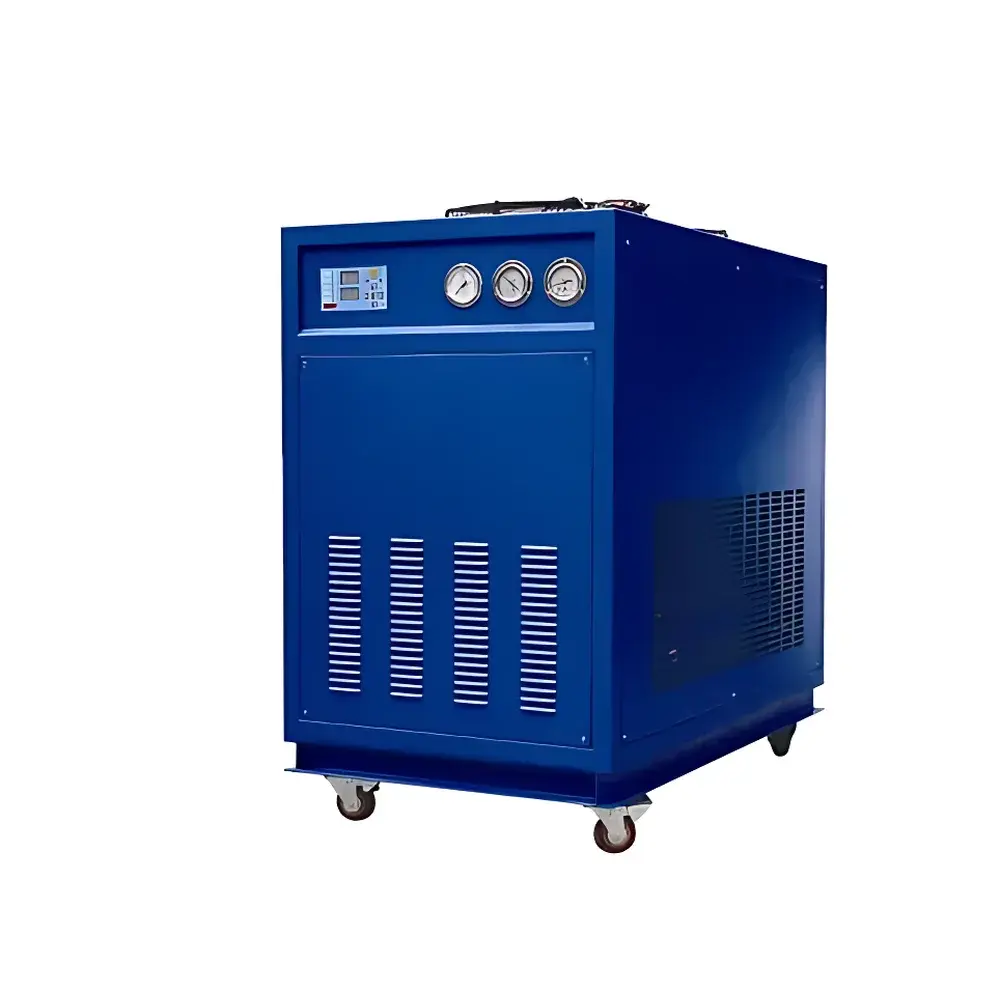
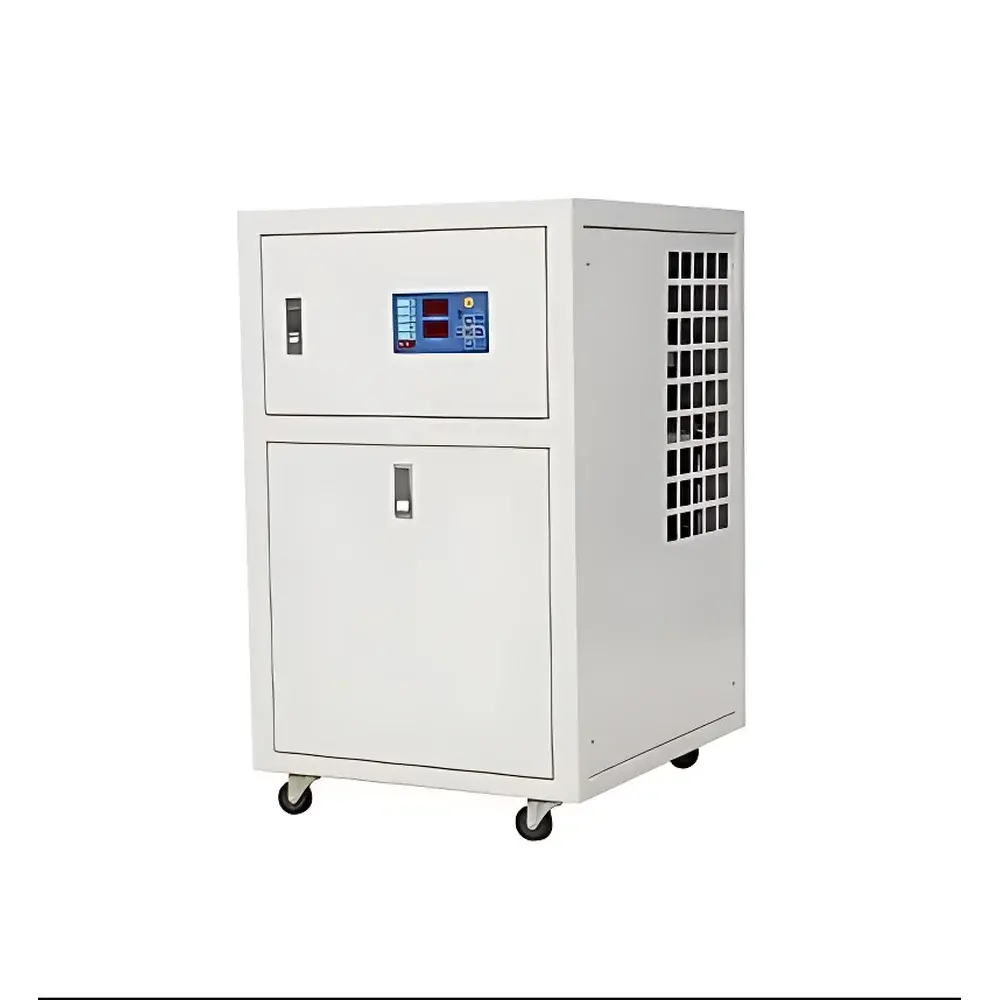
Tianfeng LS-1.5HP Integrated Circulating Chiller
| Brand | Tianfeng |
|---|---|
| Origin | Shanghai, China |
| Manufacturer Type | Direct Manufacturer |
| Equipment Type | Integrated Circulating Chiller |
| Cooling Method | Water-Cooled |
| Temperature Control Range | 0–10 °C |
| Refrigeration Capacity | 4 kW |
| Temperature Stability | ±0.1 °C |
| Circulation Pump Pressure | 2.0 bar |
| Circulation Flow Rate | 2 L/min |
| Reservoir Volume | 45 L |
| Operating Mode | Continuous Duty |
| Power Supply | 220 V, 50 Hz |
| Compressor Type | Scroll Compressor |
| Safety Protections | Compressor Overheat Protection, Overcurrent Protection, High/Low Pressure Switches, Overtemperature Alarm |
| Enclosure Material | Stainless Steel Reservoir & Pump |
| Dimensions (L×W×H) | 800 × 600 × 1065 mm |
| Noise Level | Low-Noise Design |
| Controller | Digital PID Temperature Controller (Optional RKC Japan Unit) |
| Compliance | ISO 9001:2000 Certified Manufacturing |
Overview
The Tianfeng LS-1.5HP Integrated Circulating Chiller is a precision-engineered, water-cooled thermal management system designed for stable, continuous-duty cooling of heat-generating components in laboratory and industrial instrumentation. It operates on the vapor-compression refrigeration cycle, utilizing a high-efficiency scroll compressor, imported expansion valves (Italy/Germany), and a stainless-steel circulation loop to deliver tightly regulated coolant at temperatures between 0 °C and 10 °C. With a nominal refrigeration capacity of 4 kW at standard operating conditions (inlet water 12 °C, outlet water 7 °C; ambient air 30 °C → 40 °C), the unit maintains temperature stability within ±0.1 °C—critical for applications demanding thermal consistency across extended operational cycles. Its compact footprint (800 × 600 × 1065 mm), integrated reservoir (45 L), and sealed circulation architecture eliminate external plumbing complexity, making it ideal for benchtop integration with sensitive analytical platforms where spatial constraints and vibration isolation are paramount.
Key Features
- High-precision digital PID temperature controller with real-time display and programmable setpoint adjustment (standard unit; optional RKC Japan controller available for enhanced repeatability)
- Stainless-steel water tank and circulation pump—corrosion-resistant, non-reactive, and compliant with GLP-relevant material compatibility requirements
- Dual-mode operation: fixed-temperature mode for steady-state cooling and intelligent adaptive mode that dynamically modulates compressor output and flow rate in response to thermal load variation
- Comprehensive safety architecture including compressor overheat protection, high/low refrigerant pressure cutoffs, overcurrent circuit interruption, and independent overtemperature alarm with relay output
- Low-noise scroll compressor (European-sourced) coupled with vibration-damping mounting—acoustic emission < 62 dB(A) at 1 m distance
- Adjustable flow rate (0–6 L/min) and pressure (0–2 bar) via calibrated bypass valve and integrated pressure gauge
- Continuous-duty rated motor and refrigeration circuit—validated for 24/7 operation under nominal load without derating
- Full electrical compliance with IEC 61000-6-2 (immunity) and IEC 61000-6-4 (emission); CE-marked power distribution using Siemens/Schneider/Omron contactors and relays
Sample Compatibility & Compliance
The LS-1.5HP chiller is engineered for direct integration with instruments requiring closed-loop coolant circulation at low-to-moderate thermal loads. It is routinely deployed with graphite furnace atomic absorption spectrometers (GFAAS), inductively coupled plasma optical emission spectrometers (ICP-OES), ICP-mass spectrometers (ICP-MS), X-ray fluorescence (XRF) and X-ray diffraction (XRD) systems, scanning electron microscopes (SEM), and transmission electron microscopes (TEM)—all of which rely on stable cold-water jackets for detector cooling, X-ray tube thermal management, or vacuum chamber temperature stabilization. The unit complies with ISO 9001:2000 quality management standards throughout design, manufacturing, and testing. While not intrinsically certified for hazardous locations, its stainless-steel wetted parts meet USP Class VI biocompatibility criteria for incidental fluid contact, and its control firmware supports audit-trail-capable logging when interfaced with validated LIMS environments per FDA 21 CFR Part 11 requirements.
Software & Data Management
The chiller features a standalone embedded controller with no proprietary software dependency. All operational parameters—including setpoint, actual temperature, flow rate, pressure, compressor status, and fault codes—are accessible via the front-panel LCD and retained in non-volatile memory for post-event diagnostics. Optional RS-485 Modbus RTU interface enables integration into centralized building management systems (BMS) or laboratory automation platforms for remote monitoring, scheduled start/stop, and alarm forwarding. Data logging interval is configurable (1–60 min); logged records include timestamp, temperature deviation, and cumulative compressor runtime—supporting preventive maintenance scheduling aligned with ISO/IEC 17025 clause 6.4.6 (equipment monitoring). No cloud connectivity or vendor-hosted services are implemented, ensuring full data sovereignty and alignment with institutional IT security policies.
Applications
- Laboratory Instrument Cooling: Thermal stabilization of X-ray tubes (XRF/XRD), CCD/CMOS detectors (ICP-OES/MS), RF generators (plasma sources), and electron optics (SEM/TEM)
- Materials Analysis: Maintaining consistent graphite furnace temperature profiles during GFAAS analysis; preventing thermal drift in high-resolution mass spectrometry
- Pharmaceutical QC: Supporting controlled-temperature dissolution testing apparatus and HPLC column ovens per USP & EP monographs
- Electronics & Metrology: Cooling high-speed spindles, laser diodes, and coordinate measuring machine (CMM) granite bases to minimize thermal expansion errors
- Industrial Process Support: Mold temperature control in analytical-scale injection molding rigs; coolant supply for vacuum deposition chambers requiring sub-ambient substrate conditioning
FAQ
What is the maximum recommended return water temperature for continuous operation?
The unit is rated for continuous duty with return water temperatures ≤ 40 °C. Sustained inlet temperatures above this threshold increase condensing pressure, accelerate oil degradation, and reduce compressor service life—consistent with AHRI Standard 550/590 guidance for liquid-cooled chillers.
Can the chiller be integrated into a facility’s SCADA system?
Yes—via optional RS-485 Modbus RTU interface (addressable slave device). Register maps and communication protocols are supplied in English-language technical documentation upon request.
Is the reservoir fluid path compatible with deionized water or glycol-water mixtures?
The stainless-steel circulation loop and pump are compatible with DI water and aqueous glycol solutions up to 30% v/v. Use of corrosion inhibitors is recommended for long-term glycol operation; pH must be maintained between 6.5–8.5.
Does the unit support validation documentation (DQ/IQ/OQ)?
Factory test reports (including refrigerant charge verification, pressure decay test, temperature uniformity mapping, and safety interlock verification) are provided with each unit. Custom DQ/IQ/OQ protocol development and execution can be arranged under separate service agreement.



