
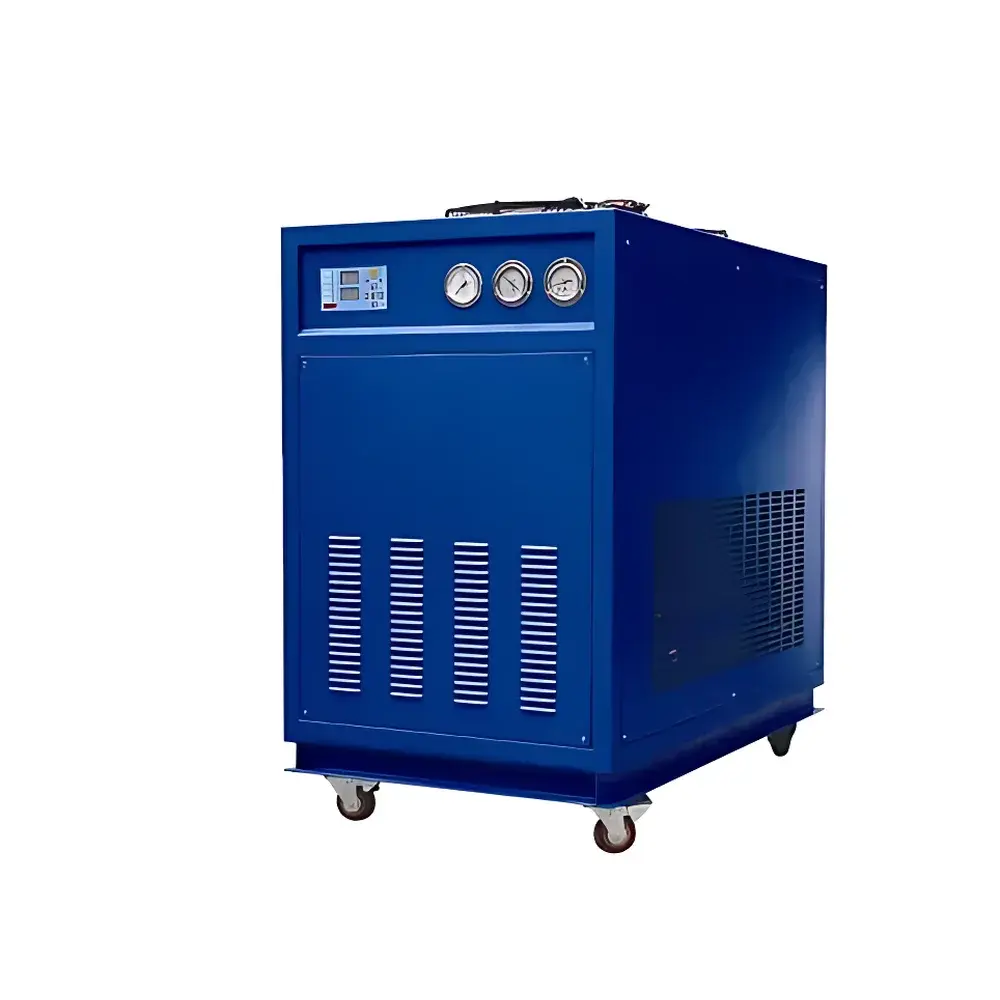
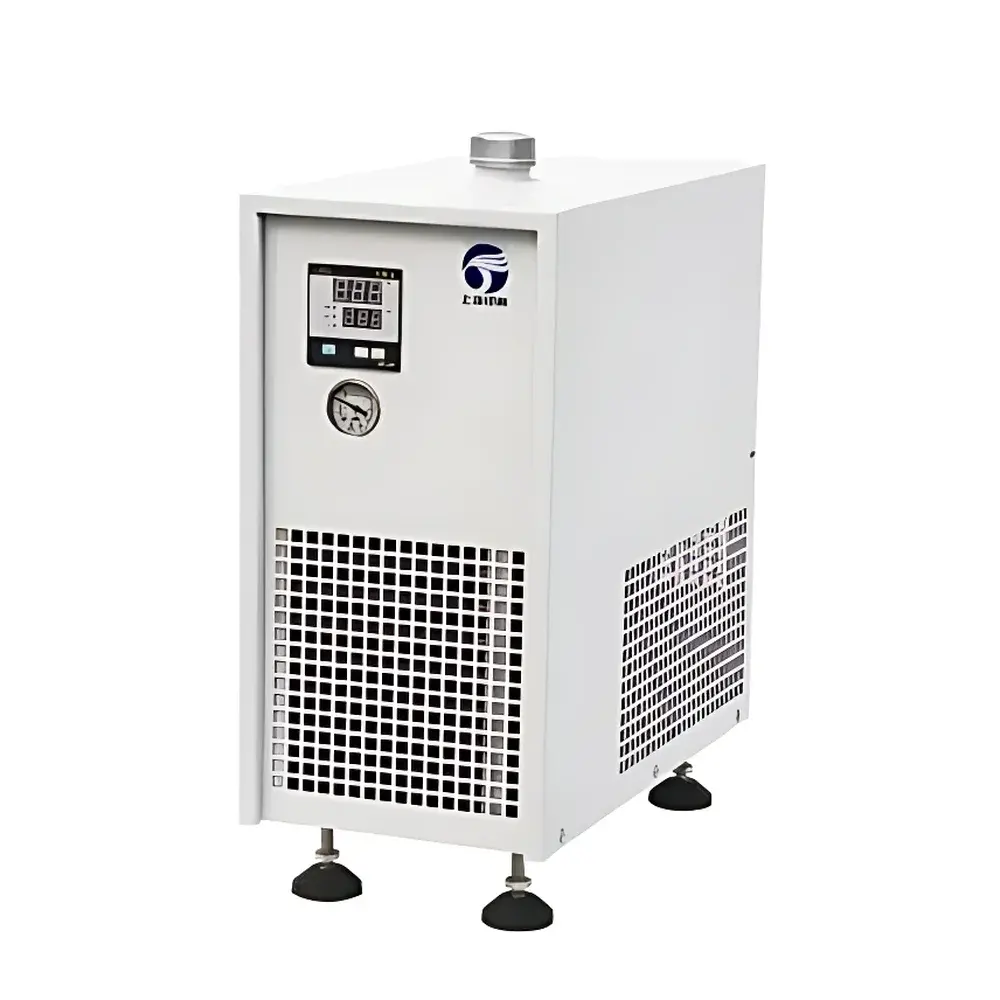
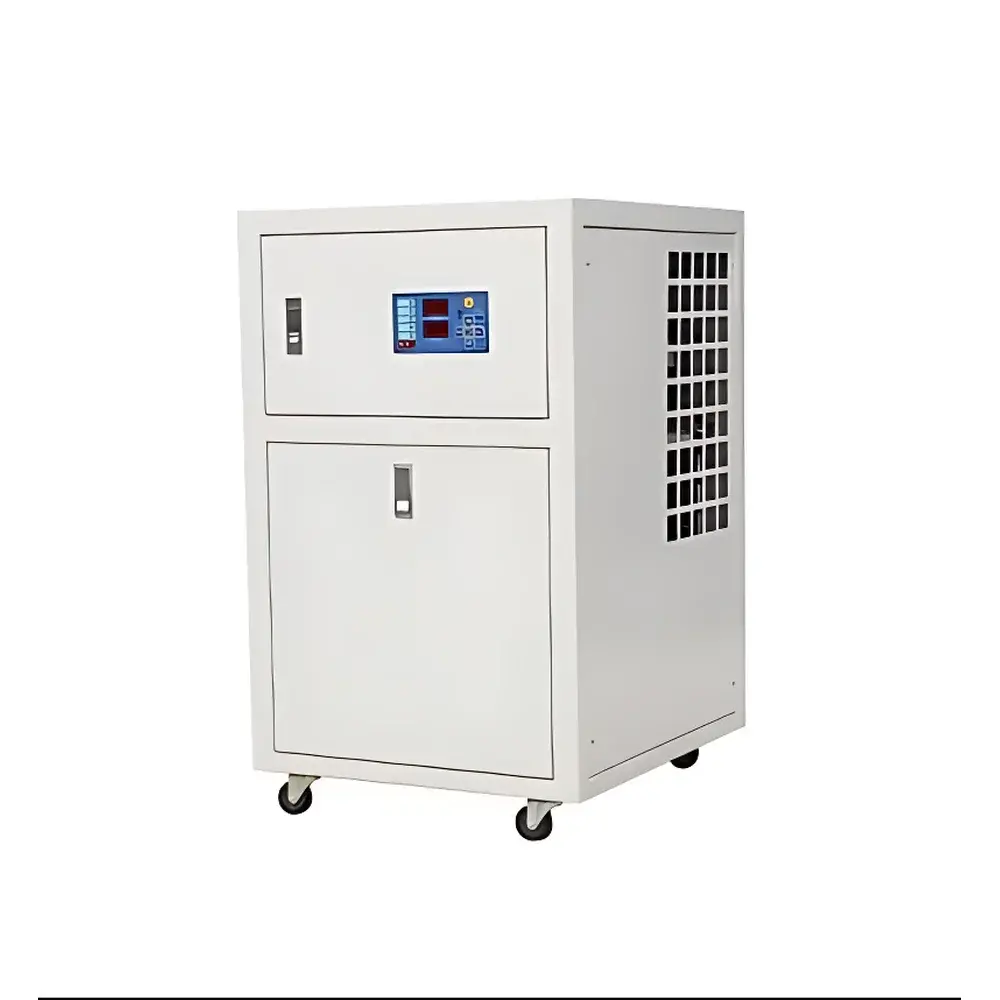
Tianfeng LS-12HP Air-Cooled Industrial Circulating Chiller
| Brand | Tianfeng |
|---|---|
| Origin | Shanghai, China |
| Manufacturer Type | Direct Manufacturer |
| Instrument Type | Integrated Unit |
| Cooling Method | Air-Cooled |
| Temperature Stability Range | 0–10 °C |
| Refrigeration Capacity | 37.2 kW |
| Temperature Stability | ±0.1 °C |
| Circulation Pump Pressure | 2.0 bar |
| Circulation Flow Rate | 2 L/min |
| Reservoir Volume | 260 L |
| Operating Mode | Continuous Duty |
| Compressor Type | Scroll Compressor |
| Safety Protections | Compressor Overheat Protection, Overcurrent Protection, High/Low Pressure Switches, Overshoot Temperature Cut-off |
| Power Supply | 220 V, 50 Hz |
| Dimensions (L×W×H) | 1610 × 900 × 1850 mm |
| Noise Level | Low-Noise Design |
| Construction | Stainless Steel Reservoir & Pump |
| Control System | Digital PID Temperature Controller (Optional RKC Controller Available) |
| Electrical Components | Siemens / Schneider / Omron |
| Expansion Valve & Solenoid Valve | Imported from Italy and Germany |
| Certifications | ISO 9001:2000 Certified |
Overview
The Tianfeng LS-12HP Air-Cooled Industrial Circulating Chiller is a precision-engineered thermal management system designed for continuous-duty operation in demanding laboratory and industrial environments. It employs a closed-loop refrigeration cycle based on vapor-compression thermodynamics, utilizing a high-efficiency scroll compressor, imported thermostatic expansion valves, and optimized condenser airflow design to deliver stable cooling performance without external water infrastructure. Unlike water-cooled chillers requiring municipal or tower-based cooling water, this unit relies solely on ambient air for heat rejection—making it ideal for laboratories with limited plumbing access or where water conservation is mandated. Its core function is to maintain precise coolant temperature (0–10 °C) within ±0.1 °C stability while delivering consistent flow (2 L/min at 2.0 bar) to external equipment. The chiller’s stainless steel reservoir (260 L) minimizes corrosion risk and supports long-term fluid integrity, critical for applications involving deionized or inhibited glycol-water mixtures.
Key Features
- Integrated air-cooled architecture eliminates dependency on external cooling water circuits, reducing installation complexity and operational overhead.
- High-stability PID digital temperature controller with real-time display ensures reproducible setpoint adherence across extended runtimes.
- Scroll-type compressor delivers low-vibration, low-noise operation (<65 dB(A) at 1 m) and enhanced reliability over reciprocating alternatives.
- Multi-layer safety architecture includes compressor overheat protection, high/low refrigerant pressure cutoffs, overcurrent detection, and thermal runaway prevention.
- Full stainless steel wetted components—including reservoir, pump housing, and internal piping—resist corrosion from aggressive coolants and extend service life.
- Modular electrical cabinet integrates globally certified components (Siemens, Schneider, Omron) compliant with IEC 61000-6-2/6-4 EMC standards.
- Continuous-duty rating validated per ISO 5149-2:2014 for industrial refrigeration systems operating >8,000 hours/year.
Sample Compatibility & Compliance
The LS-12HP is engineered to interface with a broad spectrum of analytical and processing instruments requiring stable low-temperature coolant supply—including graphite furnace atomic absorption spectrometers (GFAAS), inductively coupled plasma optical emission spectrometers (ICP-OES), inductively coupled plasma mass spectrometers (ICP-MS), X-ray fluorescence (XRF) and X-ray diffraction (XRD) systems, scanning electron microscopes (SEM), and transmission electron microscopes (TEM). Its flow and pressure specifications meet the inlet requirements of most OEM instrument cooling manifolds. All materials in contact with coolant comply with USP Class VI and FDA 21 CFR Part 117 (for indirect food contact applications). The unit conforms to ISO 9001:2000 quality management system requirements and meets CE marking directives for electromagnetic compatibility (2014/30/EU) and low voltage safety (2014/35/EU).
Software & Data Management
While the standard configuration features a standalone digital controller with local setpoint adjustment and real-time temperature readout, optional RS485 Modbus RTU or Ethernet TCP/IP interfaces enable integration into centralized lab monitoring platforms (e.g., LabVantage, Thermo Fisher SampleManager, or custom SCADA systems). Audit-trail-capable controllers (RKC RP950 series, optional) support GLP/GMP environments by logging temperature deviations, alarm events, and operator actions with time stamps—fully traceable and exportable as CSV files. Remote parameter adjustment, alarm notification via email/SMS, and historical trend analysis are available through compatible supervisory software.
Applications
This chiller serves mission-critical thermal regulation across multiple domains: In analytical laboratories, it stabilizes detector temperatures in high-resolution spectrometers and prevents thermal drift in electron-optical columns. In materials science, it maintains consistent mold temperatures during polymer characterization workflows, improving repeatability in dynamic mechanical analysis (DMA) and differential scanning calorimetry (DSC) sample preparation. In semiconductor metrology, it cools laser interferometers and stage positioning systems to sub-micron thermal expansion control. In pharmaceutical QC labs, it supports controlled-temperature dissolution testing per USP and maintains chromatographic column ovens within tight tolerances. Its robust construction also supports industrial use cases—including CNC spindle cooling per ISO 230-3 thermal distortion testing protocols and vacuum deposition chamber temperature stabilization.
FAQ
What is the recommended maximum return coolant temperature?
For optimal compressor longevity and refrigeration efficiency, the return coolant temperature should not exceed 40 °C. Sustained inlet temperatures above this threshold increase discharge pressure and reduce system COP.
Can the chiller operate with glycol-water mixtures?
Yes—the stainless steel circulation path and compatible seals support aqueous solutions containing up to 35% propylene glycol for freeze protection down to –15 °C.
Is remote monitoring supported out of the box?
Standard units include analog 4–20 mA output for temperature and digital dry-contact alarms. Full Modbus or Ethernet connectivity requires optional communication module installation.
How often does the system require preventive maintenance?
Compressor oil analysis and refrigerant circuit inspection are recommended annually; air-side condenser coil cleaning every 3–6 months depending on ambient particulate load.
Does the unit comply with environmental refrigerant regulations?
It uses R410A refrigerant, which complies with current EU F-Gas Regulation (EU) No 517/2014 phase-down schedules and carries zero ozone depletion potential (ODP = 0).
Related Products



