
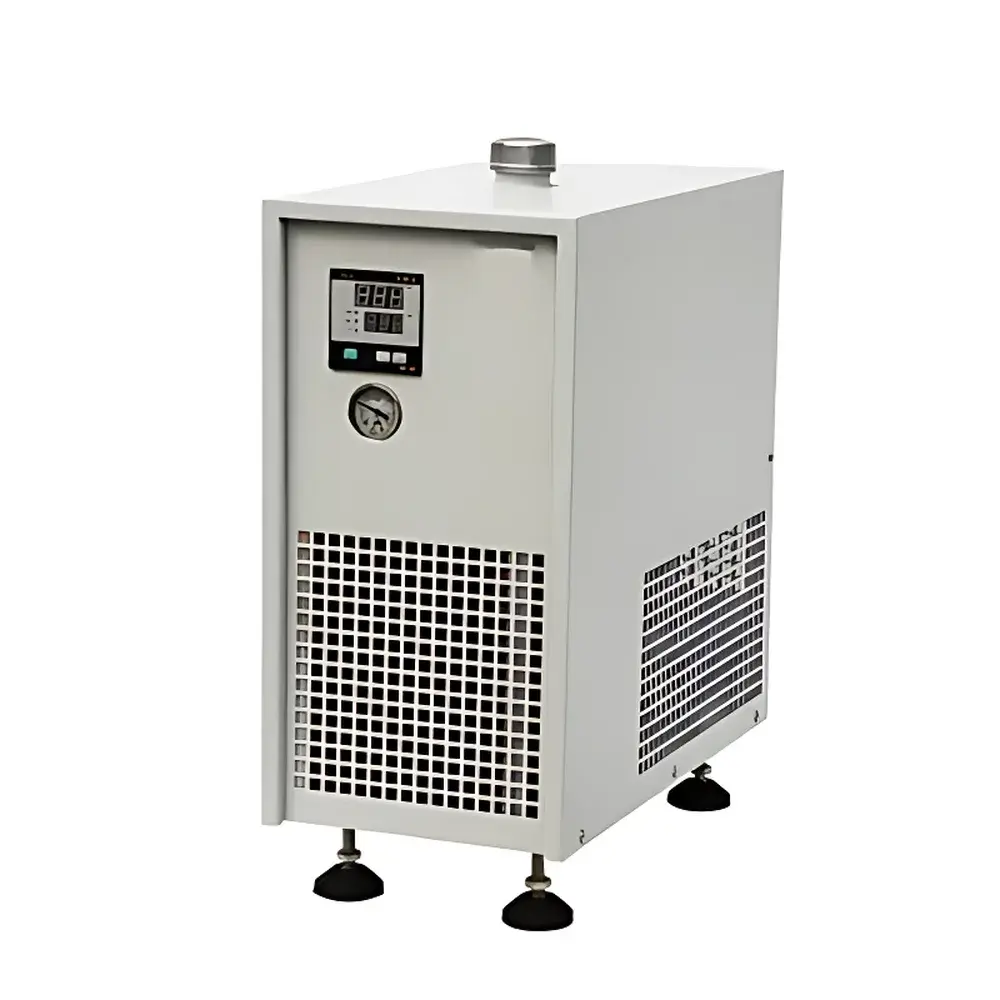
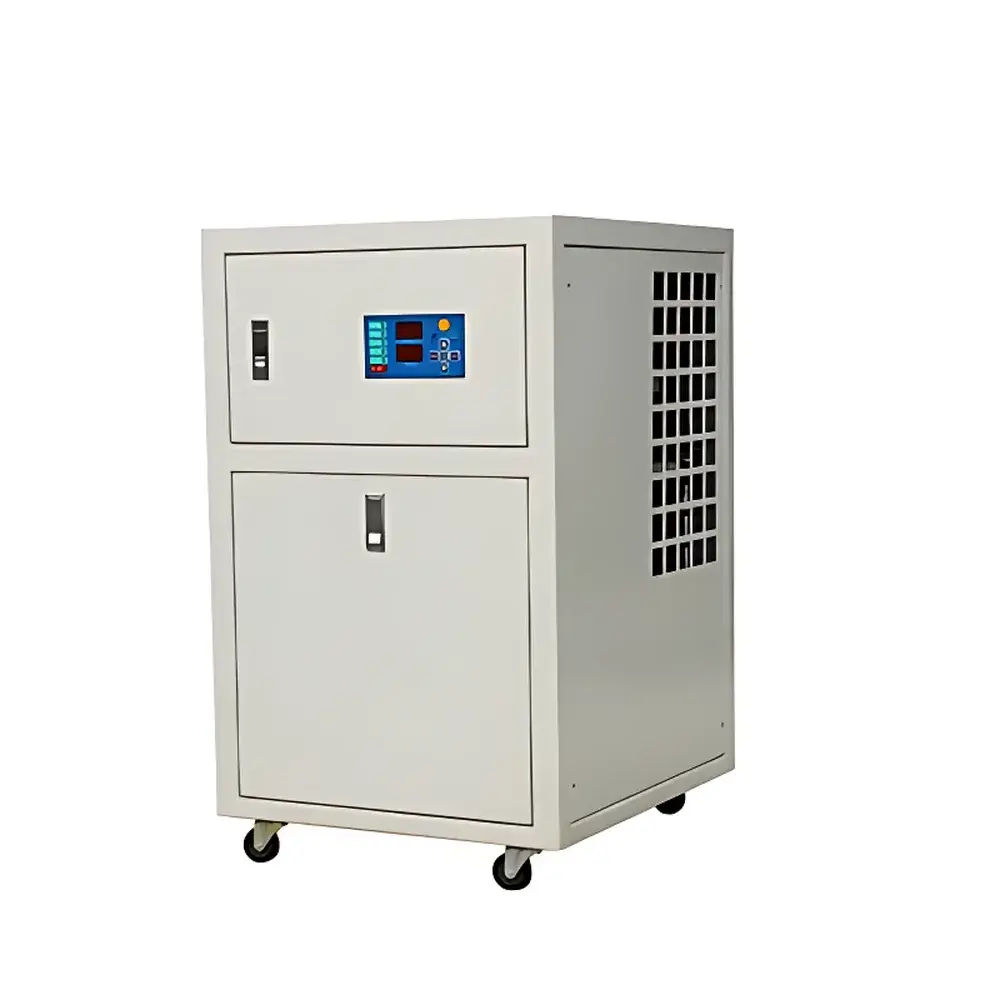
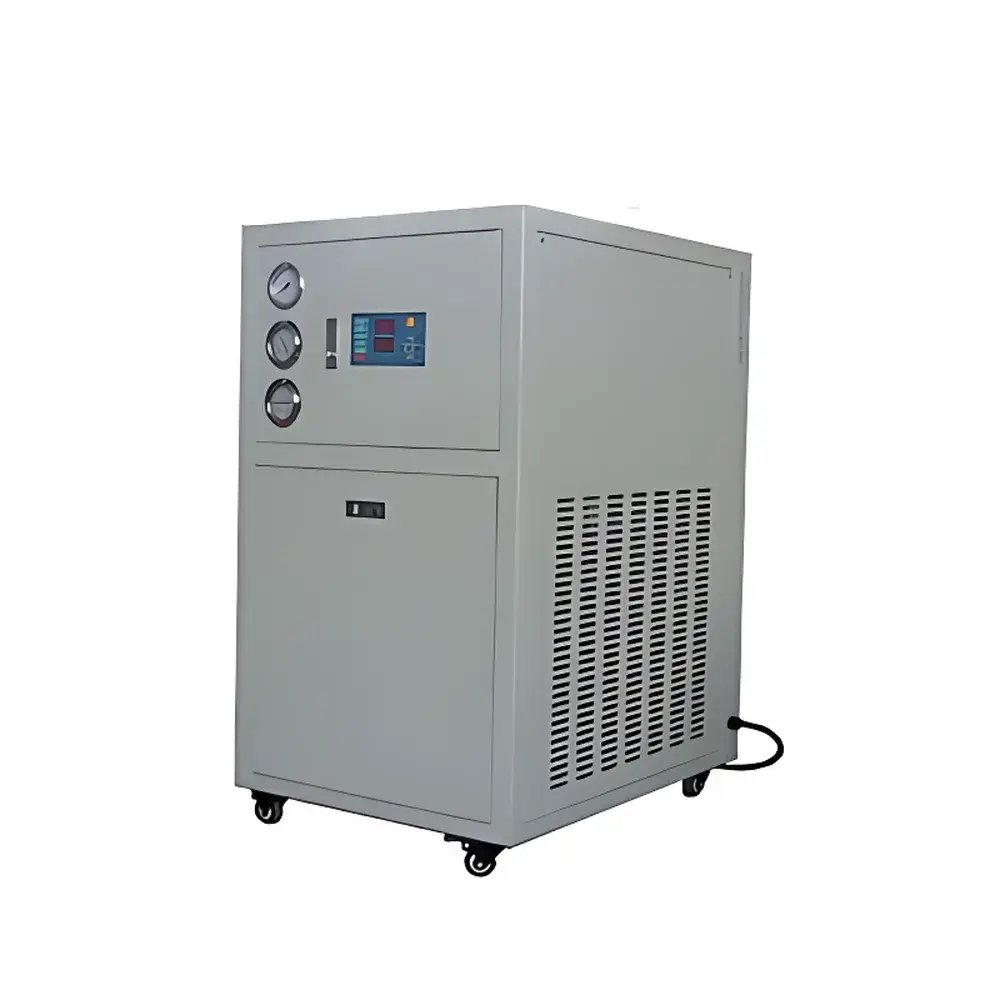
Tianfeng LS-300 Industrial Oil Chiller
| Brand | Tianfeng |
|---|---|
| Origin | Shanghai, China |
| Manufacturer Type | Direct Manufacturer |
| Instrument Type | Integrated Circulating Chiller |
| Cooling Method | Water-Cooled |
| Temperature Stability Range | 5–30 °C (adjustable) |
| Refrigeration Capacity | 0.3 kW (258 kcal/h) |
| Temperature Fluctuation | ±0.1 °C |
| Circulating Pump Pressure | 0–0.6 kgf/cm² |
| Circulating Flow Rate | 0–20 L/min |
| Reservoir Volume | 5 L |
| Power Input | 260 W |
| Dimensions (L×W×H) | 505×230×500 mm |
| Power Supply | 220 V, 50 Hz |
| Safety Protections | Compressor overheat protection, overcurrent protection, high/low pressure cutoff, overtemperature alarm |
Overview
The Tianfeng LS-300 Industrial Oil Chiller is a compact, integrated circulating chiller engineered for precision thermal management of oil-cooled industrial and laboratory equipment. Unlike generic water chillers, this unit is specifically optimized for dielectric oil circulation—delivering stable, low-temperature coolant to high-heat-load components such as laser diodes, RF amplifiers, vacuum pump oil sumps, and high-speed spindles. Its thermodynamic architecture employs a hermetic scroll compressor, copper-aluminum microchannel condenser, and imported thermostatic expansion valve (TXV) to ensure consistent refrigerant flow and minimal thermal hysteresis. Designed for continuous-duty operation under ambient conditions up to 35 °C, the LS-300 maintains setpoint accuracy within ±0.1 °C across its operational range of 5–30 °C—critical for applications demanding strict thermal drift control, including electron microscopy sample stages and plasma source cooling.
Key Features
- Integrated all-in-one design with stainless steel reservoir and centrifugal circulation pump—no external plumbing or auxiliary tanks required.
- Digital PID temperature controller with real-time display of outlet fluid temperature; optional RKC (Japan) controller available for enhanced repeatability and ramp-soak programming.
- Low-noise operation (<58 dB(A)) achieved via vibration-dampened compressor mounting and acoustic insulation of refrigerant lines.
- Comprehensive safety suite: dual-stage high/low pressure switches, compressor winding overtemperature sensor, electronic overcurrent protection, and independent overtemperature cutout on outlet line.
- Full stainless steel wetted parts (reservoir, pump housing, heat exchanger tubes) compatible with synthetic and mineral-based dielectric oils—including ISO VG 32, VG 46, and polyalphaolefin (PAO) formulations.
- Modular electrical architecture using certified components from Siemens, Schneider Electric, and Omron—compliant with IEC 61000-6-2 (EMC immunity) and IEC 61000-6-4 (EMC emissions).
Sample Compatibility & Compliance
The LS-300 is validated for use with non-corrosive, non-flammable dielectric oils meeting ASTM D6920 (Standard Specification for Electrical Insulating Oils) and IEC 60296 (Mineral insulating oils for electrical equipment). It supports closed-loop circulation in systems requiring oil viscosity stability at temperatures between −10 °C and +60 °C. The unit conforms to ISO 9001:2015 quality management requirements and meets CE marking criteria for machinery (2006/42/EC) and electromagnetic compatibility (2014/30/EU). While not FDA 21 CFR Part 11–certified out-of-the-box, its digital controller supports audit trail configuration (via optional RS485/Modbus RTU interface), enabling integration into GLP/GMP environments where traceable temperature logging is mandated.
Software & Data Management
The standard controller provides local setpoint adjustment, real-time temperature readout, and status LED indicators for fault conditions (e.g., low flow, high discharge temp). For laboratory integration, an optional Modbus RTU interface enables remote monitoring and parameter setting via SCADA or LabVIEW. Data logging (min/max/average temperature, runtime hours, alarm events) is supported when paired with a third-party PLC or data acquisition system. No proprietary software is required—configuration uses industry-standard Modbus function codes (03h, 06h, 10h). All firmware updates are performed via USB port using signed binary files, ensuring integrity and version traceability.
Applications
- Laser Systems: Thermal stabilization of CO₂, fiber, and diode-pumped solid-state (DPSS) lasers—preventing wavelength drift and optical misalignment caused by thermal lensing.
- Analytical Instrumentation: Cooling of X-ray tube anodes (XRF, XRD), ICP-MS torch interfaces, and SEM/TEM column cold traps—maintaining vacuum integrity and detector signal-to-noise ratio.
- Machining & Manufacturing: Temperature regulation of hydraulic oil in CNC machining centers and electro-spark erosion (EDM) dielectric circuits to minimize thermal expansion-induced dimensional error.
- Electronics Testing: Controlled cooling of power amplifier modules during burn-in testing, ensuring junction temperature remains within JEDEC JESD51-1 limits.
- Research Infrastructure: Support for cryogenic pre-cooling loops in superconducting magnet systems and RF cavity thermal management in particle accelerator test stands.
FAQ
What types of oil are compatible with the LS-300?
The chiller is compatible with mineral, synthetic, and silicone-based dielectric oils having flash points above 150 °C and viscosity grades between ISO VG 10 and VG 100. Avoid chlorinated or phosphate-ester fluids.
Can the unit operate continuously at 5 °C outlet temperature?
Yes—continuous operation is rated for outlet temperatures down to 5 °C when ambient air temperature does not exceed 35 °C and cooling water inlet temperature remains ≤25 °C.
Is the pump flow rate adjustable?
Flow is continuously variable from 0 to 20 L/min via integrated bypass valve; no external flow restrictors are needed.
Does the LS-300 support external temperature feedback control?
Yes—optional PT100 input allows closed-loop control based on user-defined process temperature (e.g., spindle bearing surface), overriding internal sensor readings.
What maintenance intervals are recommended?
Compressor oil inspection every 12 months; refrigerant circuit leak check annually; stainless steel reservoir cleaning every 6 months if used with hygroscopic oils.



