
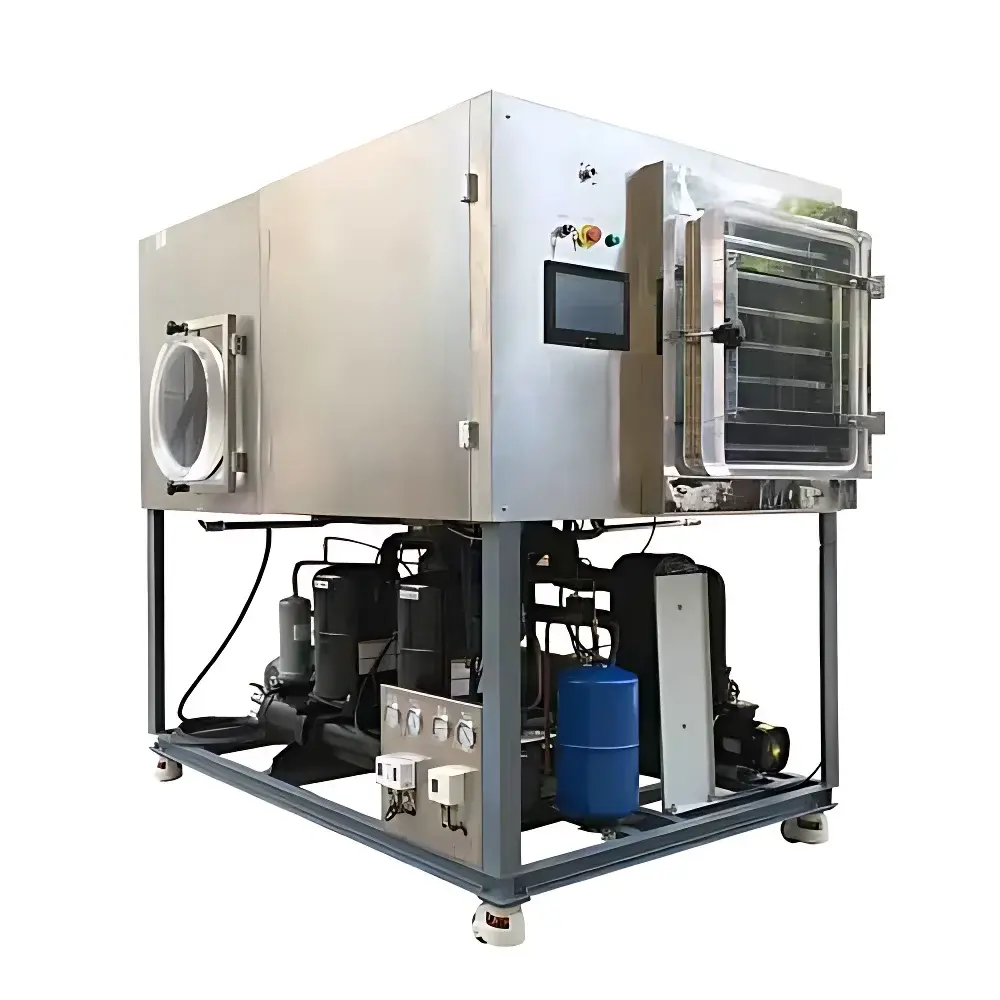
Tianfeng SFD-20m² Pilot-Scale Freeze Dryer with In-Situ Pre-Freezing and PID-Controlled Shelf Heating
| Brand | Tianfeng |
|---|---|
| Origin | Shanghai, China |
| Manufacturer Type | Direct Manufacturer |
| Equipment Type | Standard Shelf-Type Freeze Dryer |
| Application Scope | Pilot-Scale Processing |
| Lyophilization Area | 2.16 m² |
| Ultimate Vacuum | ≤5 Pa |
| Condensate Capacity (24 h) | 30 L |
| Cold Trap Temperature | −70 °C |
| Main Unit Dimensions | 1750 × 1500 × 1850 mm |
| Shelf Count | 6 usable + 1 radiation plate |
| Shelf Temperature Range | −55 °C to +80 °C |
| Shelf Temperature Uniformity | ±1 °C |
| Shelf Surface Roughness | Ra ≤ 0.5 µm |
| Shelf Flatness | ≤ ±0.5 mm/m² |
| Refrigeration System | Dual-Stage Cascade (R404a/R23) |
| Compressor | 2 × 6 HP Tecumseh (France) |
| Vacuum Pump Options | Zhejiang Tanshi 2XZ-15C / ULVAC VDN401 / Leybold D40C |
| Control System | Delta 7″ Color HMI with PID Algorithm |
| Power Supply | 380 VAC, 50 Hz, 15 kW Installed Capacity |
| Ambient Operating Temperature | 5–25 °C |
Overview
The Tianfeng SFD-20m² Pilot-Scale Freeze Dryer is an engineered solution for translational development in pharmaceutical, biotechnology, and food science laboratories. Designed around the principles of primary and secondary drying under controlled sublimation conditions, it employs in-situ pre-freezing and shelf-based conductive heating via silicone oil circulation to ensure thermally uniform lyophilization across the full 2.16 m² active shelf area. Unlike benchtop units, this system bridges the gap between laboratory feasibility studies and GMP-compliant process scale-up—enabling users to develop, optimize, and validate freeze-drying cycles under reproducible vacuum (≤5 Pa) and thermal (−55 °C to +80 °C) conditions. Its dual-stage cascade refrigeration architecture delivers stable cold trap performance at −70 °C with a 30 L/24 h condensate capacity, supporting both aqueous and low-eutectic formulations typical of heat-labile biologics—including monoclonal antibodies, viral vectors, probiotic suspensions, and enzymatic preparations.
Key Features
- In-situ pre-freezing capability eliminates manual transfer, minimizing contamination risk and thermal shock to sensitive samples.
- Six stainless-steel (ANSI 304) shelves with integrated silicone oil channels enable precise, independent temperature control (±1 °C uniformity) and programmable ramp/soak profiles from −55 °C to +80 °C.
- High-transparency acrylic door (50 mm thick) permits real-time visual monitoring of cake formation, collapse onset, and desiccation progress without vacuum interruption.
- Dual-stage cascade refrigeration system using environmentally compliant R404a/R23 refrigerants ensures rapid cooldown (<15 min from +20 °C to −40 °C for cold trap; <60 min for shelves) and sustained deep-cold operation at −70 °C.
- Modular electrical architecture with Schneider and CHINT components, Delta 7″ color HMI, and optional PLC integration supports audit-ready operation logs and SOP-driven cycle execution.
- Structural integrity assured by fully welded, mirror-finished (Ra ≤ 0.5 µm) shelves fabricated via internal welding—eliminating surface weld seams that compromise cleanability or promote microbial retention.
- Standard KF40 vacuum interface accommodates multiple high-vacuum pump options (Tanshi, ULVAC, Leybold), with integrated high-vacuum isolation valve and ZJ-52T capacitance manometer for accurate pressure feedback.
Sample Compatibility & Compliance
The SFD-20m² accommodates vial-based formats (e.g., 7,656 × Ø16 mm or 4,032 × Ø22 mm) as well as bulk tray loading up to 30 L per batch. Its design conforms to core hygienic and operational requirements for early-phase process development under current Good Manufacturing Practice (cGMP) guidance. While not certified for commercial manufacturing, its construction—using electropolished ANSI 304 stainless steel, non-porous acrylic viewing panels, and traceable component sourcing—supports GLP-aligned documentation workflows. Optional accessories—including inert gas (N₂/Ar) purge valves, eutectic point measurement modules, and automated stoppering interfaces—facilitate alignment with ICH Q5C, USP , and ISO 22059:2021 standards for lyophilized product characterization.
Software & Data Management
The embedded Delta DOP-B HMI provides real-time graphical display of shelf temperature, chamber pressure, cold trap temperature, and time-based drying curves. All operational parameters—including setpoints, actual values, alarms, and event timestamps—are logged internally with configurable export (CSV/USB). When connected to a supervisory PC via RS485 or Ethernet, the system supports remote monitoring and data archival compatible with 21 CFR Part 11-compliant electronic record systems. Audit trails capture user login/logout events, parameter modifications, and cycle start/stop commands—ensuring traceability during regulatory inspections or internal quality audits. Firmware updates are performed offline via SD card to maintain system integrity.
Applications
This pilot-scale system serves critical roles across multiple regulated sectors: formulation scientists use it to screen cryoprotectants and optimize annealing steps for bacterial consortia (e.g., probiotic strains requiring viability preservation); QC labs employ it for stability-indicating method development of reference standards; and process engineers leverage its reproducible thermal/vacuum profile repeatability to generate design space maps per ICH Q8(R2). It is routinely deployed for lyophilizing vaccine candidates, diagnostic enzyme conjugates, botanical extracts, and functional food matrices—where residual moisture control (<1.5% w/w), structural integrity, and reconstitution time are key release criteria.
FAQ
Can this unit be integrated into a cleanroom environment?
Yes—the external vacuum pump configuration, sealed refrigeration circuit, and absence of internal lubricants permit installation in ISO Class 7 or 8 environments when paired with appropriate HVAC and HEPA filtration.
Is validation support available?
Tianfeng provides IQ/OQ protocol templates and factory acceptance test (FAT) documentation. Site-specific PQ support requires engagement with qualified third-party validation partners.
What maintenance intervals are recommended?
Oil changes for vacuum pumps every 500 operating hours; refrigerant leak checks annually; HMI calibration verification semiannually; shelf surface passivation every 2 years.
Does the system support automatic cycle optimization?
Not natively—but its open communication protocol (Modbus RTU/TCP) enables integration with external PAT tools (e.g., tunable diode laser spectroscopy) for real-time endpoint detection and adaptive control logic deployment.
Are spare parts and service accessible outside China?
Yes—Tianfeng maintains authorized service hubs in Germany, Singapore, and the USA, with >95% critical spares stocked regionally and 72-hour dispatch guarantee for priority orders.



