
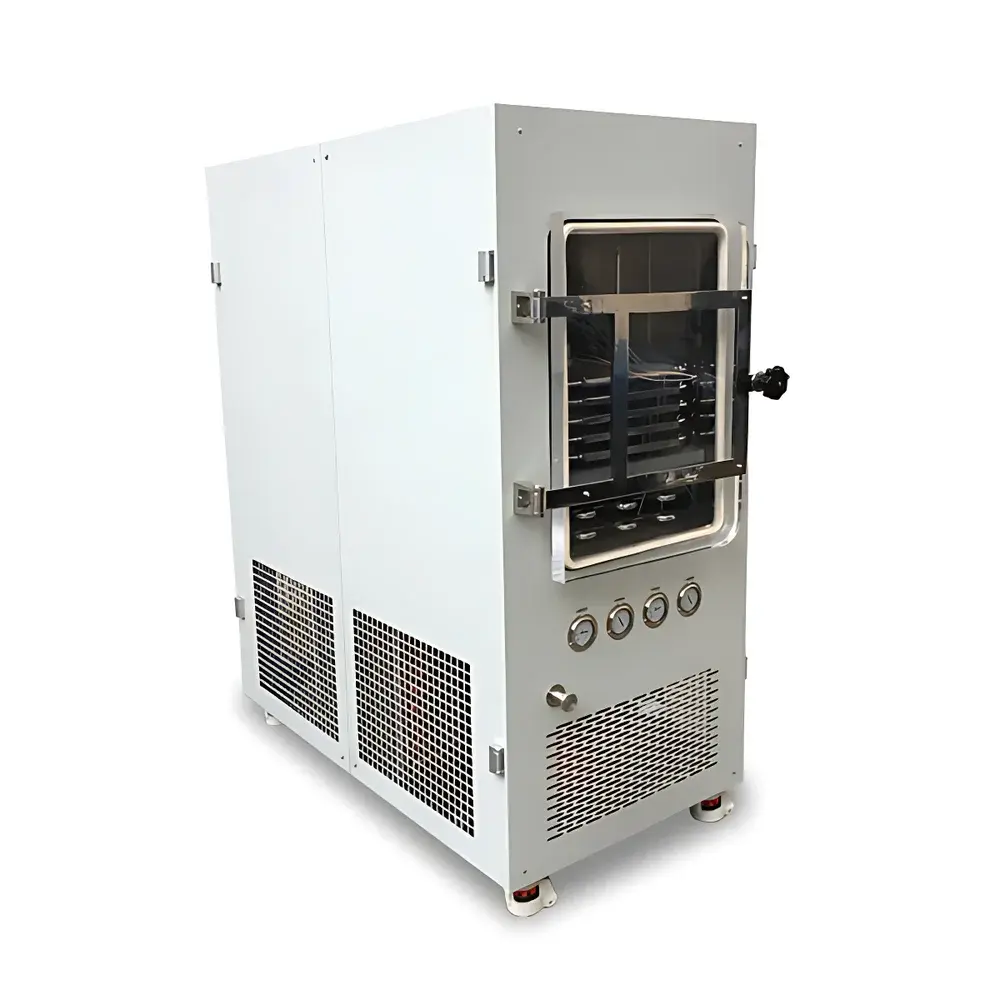
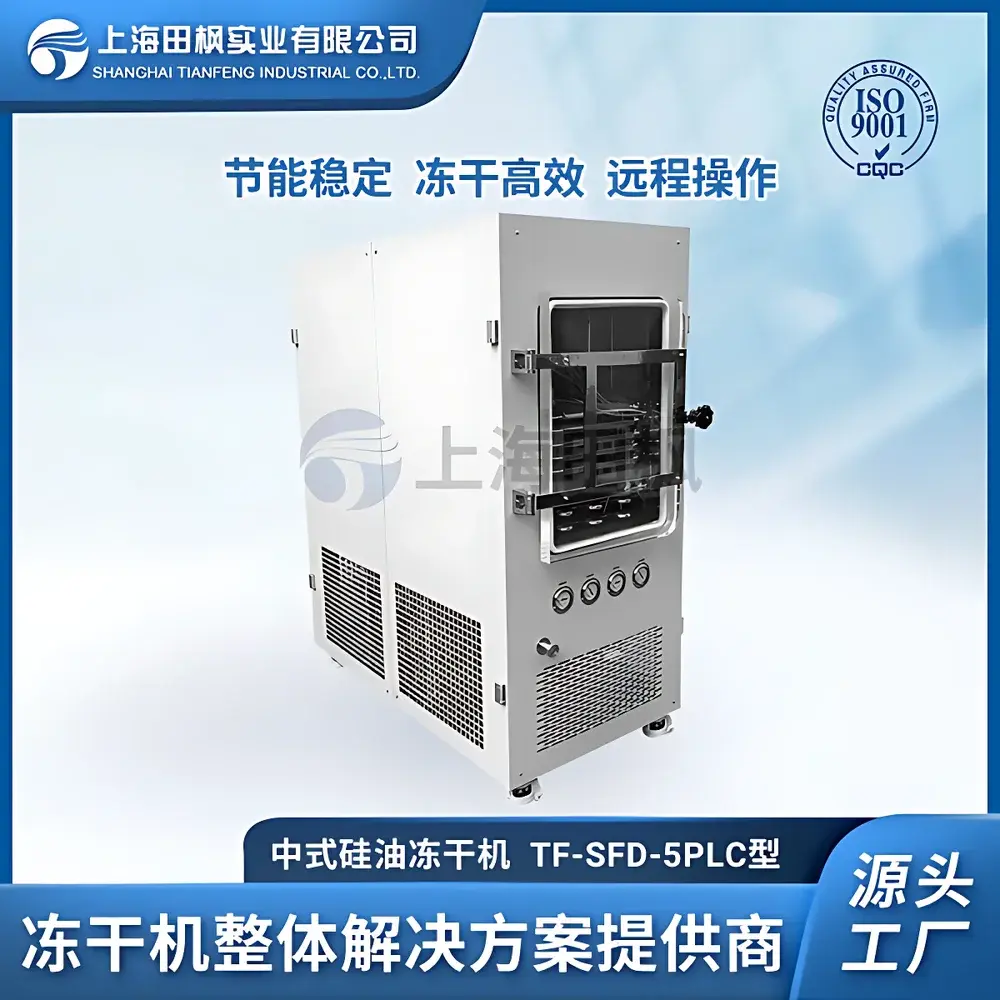
Tianfeng SFD-5m² Benchtop Freeze Dryer for Nanopowder and Lactic Acid Bacteria Processing
| Brand | Tianfeng |
|---|---|
| Origin | Shanghai, China |
| Manufacturer Type | OEM Manufacturer |
| Product Category | Domestic |
| Model | SFD-5 Standard Plate-Type |
| Instrument Type | Standard Shelf-Type Freeze Dryer |
| Application Scope | Pilot-Scale Processing |
| Lyophilization Area | 0.52 m² |
| Ultimate Vacuum | ≤5 Pa |
| Condensate Capacity (24 h) | 8 L |
| Cold Trap Temperature | ≤−70 °C |
| Main Unit Dimensions | 480 × 360 mm |
| Shelf Configuration | 3+1 shelves |
| Shelf Dimensions (W × L) | 360 × 480 mm |
| Shelf Spacing | 70 mm |
| Shelf Temp Range | −50 °C to +80 °C |
| Control System | PLC with Ethernet interface, 7″ color touchscreen, password-protected operation |
| Data Logging | Real-time vacuum & shelf temperature curves, full audit trail of operator actions |
| Optional | In-situ eutectic point detection module |
| Chamber Viewport | High-transparency acrylic door |
| Gas Inlet Valve | Equipped for inert gas backfilling (N₂ or Ar) |
| Power Requirement | 4.5 kW |
| Net Weight | 450 kg |
| Compliance | ISO 9001:2000 certified design and manufacturing |
Overview
The Tianfeng SFD-5m² Benchtop Freeze Dryer is an engineered pilot-scale lyophilization system designed for reproducible, process-controlled freeze drying of thermolabile biologicals—including lactic acid bacteria cultures—and high-value nanomaterials such as metal oxide nanopowders, polymer micelles, and liposomal formulations. Operating on the fundamental principle of sublimation under deep vacuum, the system removes water from frozen samples via primary drying (ice sublimation) followed by secondary drying (desorption of bound water), preserving structural integrity, viability, and physicochemical stability without thermal degradation. Its in-situ pre-freezing capability eliminates manual transfer, reducing contamination risk and enabling precise control over nucleation and ice crystal morphology—critical for maintaining bacterial membrane functionality and nanoparticle dispersion homogeneity. The unit integrates a high-efficiency dual-stage cascade refrigeration system with a ≤−70 °C cold trap, ensuring rapid vapor capture and stable vacuum conditions below 5 Pa throughout extended cycles.
Key Features
- In-situ freezing and drying in a single chamber, minimizing handling and cross-contamination risks during sensitive bioprocesses.
- Silicon oil–heated shelves with ±0.5 °C temperature uniformity (≤1 °C shelf-to-shelf gradient) and programmable ramp/soak profiles across −50 °C to +80 °C—enabling optimization of annealing, primary drying rate, and desorption kinetics.
- PLC-based control architecture with Ethernet connectivity, supporting remote monitoring, centralized lab data integration, and secure user authentication via configurable access levels and password protection.
- Real-time graphical logging of shelf temperature, chamber pressure, and condenser temperature; all operational events—including parameter changes, alarm triggers, and manual interventions—are timestamped and stored with full audit trail compliance.
- Seven-inch capacitive touchscreen HMI with intuitive navigation, multi-language support (English default), and dynamic visualization of drying progress via customizable curve overlays.
- Reinforced square tray design (360 × 480 mm per shelf, 70 mm spacing, 4 total shelves) ensures mechanical stability under load and facilitates cleaning between batches—essential for GMP-aligned QC/QA workflows.
- Dry inert gas inlet valve (N₂ or Ar compatible) enables controlled reconstitution atmosphere management and oxygen-sensitive sample handling post-drying.
Sample Compatibility & Compliance
The SFD-5 accommodates diverse sample formats: standard vials (Φ16 mm: up to 1914 units/batch; Φ20 mm: up to 1008 units), serum bottles, open trays, and custom containers up to 8 L total liquid volume. It supports lyophilization of probiotic suspensions (e.g., Lactobacillus, Bifidobacterium), viral vectors, protein nanoparticles, and nanostructured ceramics where residual moisture content must remain below 1–2% w/w. The system’s design and documentation align with foundational quality system requirements per ISO 9001:2000. While not pre-certified for FDA 21 CFR Part 11, its electronic record architecture—including immutable timestamps, operator ID logging, and change history—provides a technically sound foundation for validation under GLP or GMP environments. Optional in-situ eutectic point detection supports rational cycle development per ICH Q5C and USP <1208> guidelines.
Software & Data Management
Control firmware implements deterministic real-time scheduling for synchronized shelf heating, vacuum regulation, and condenser cooling. All process parameters—including setpoints, actual values, alarms, and user actions—are written to non-volatile memory at ≥1 Hz resolution. Export formats include CSV and PDF reports with embedded metadata (batch ID, operator, start/end time, version stamp). Data files are structured for seamless ingestion into LIMS or ELN platforms via standard Ethernet protocols (Modbus TCP, HTTP API). Audit trails meet ALCOA+ principles (Attributable, Legible, Contemporaneous, Original, Accurate, Complete, Consistent, Enduring, Available) when deployed within validated network infrastructure.
Applications
- Stabilization of lactic acid bacteria for probiotic formulation development and shelf-life studies.
- Lyophilization of nanosuspensions and colloidal dispersions to prevent aggregation and preserve zeta potential.
- Pilot-scale process development for sterile pharmaceutical intermediates requiring low-residual-moisture solid dosage forms.
- Preparation of reference standards and calibration materials in metrology laboratories.
- R&D of battery electrode nanomaterials (e.g., Si/C composites) where solvent removal must avoid particle sintering.
- Preservation of enzyme-loaded nanocarriers and plasmid DNA complexes for gene therapy research.
FAQ
Is this system suitable for GMP manufacturing environments?
It is designed for pilot-scale R&D and process development—not commercial production—but its documentation, traceability features, and robust construction support IQ/OQ/PQ validation in regulated settings.
Can shelf temperature be independently controlled per zone?
No—temperature is uniform across all shelves; however, the ≤1 °C inter-shelf gradient ensures consistent drying performance across the full 0.52 m² area.
What vacuum pump is recommended for optimal performance?
A two-stage oil-lubricated rotary vane pump rated ≥12 m³/h at 5 Pa is advised; dry scroll pumps may be used but require careful sizing to maintain ≤5 Pa under full condensate load.
Does the system support automated cycle transfer between instruments?
Yes—process programs (up to 5 stored, each with 24 segments) can be exported/imported via USB, enabling method replication across identical SFD-5 units.
Is remote troubleshooting supported?
Ethernet connectivity allows secure VNC-based diagnostics when configured behind enterprise firewalls; no cloud dependency or vendor-hosted services are required.



