
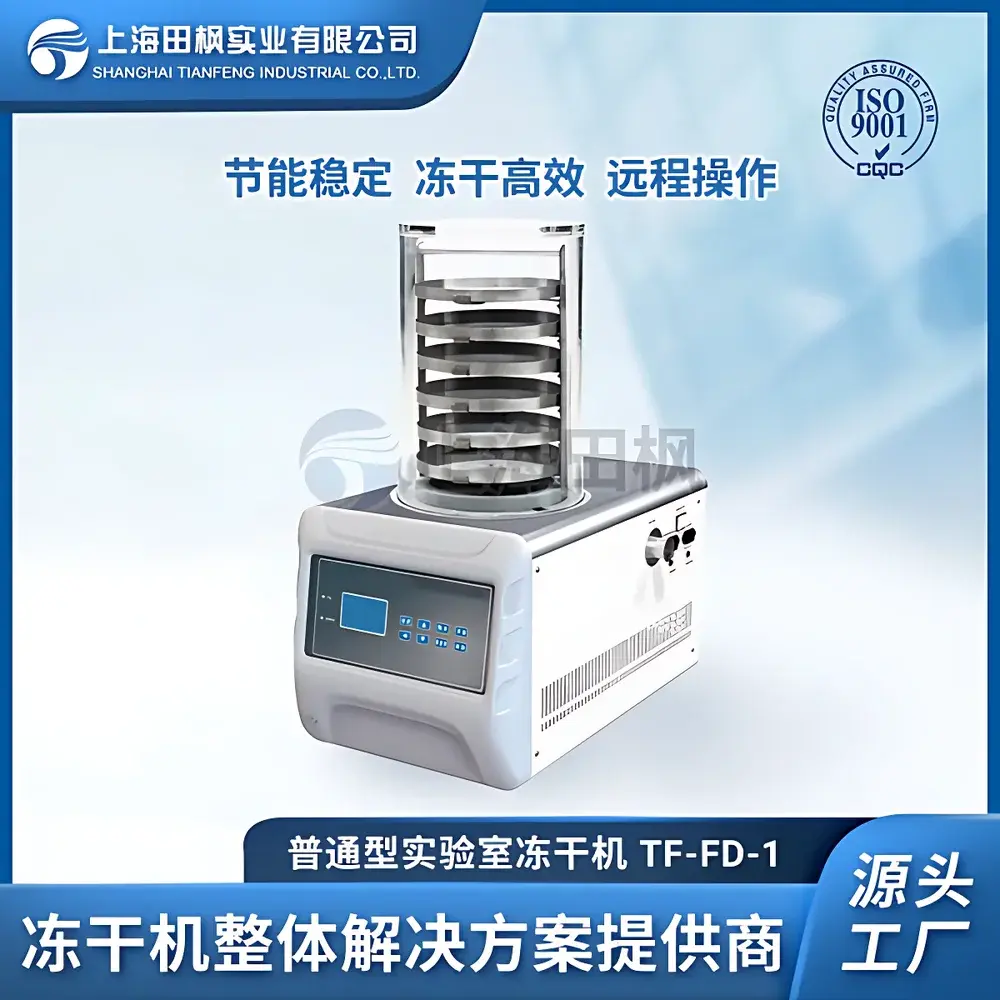
Tianfeng TF-FD-1 Standard Benchtop Laboratory Freeze Dryer
| Brand | Tianfeng |
|---|---|
| Origin | Shanghai, China |
| Manufacturer Type | Direct Manufacturer |
| Product Category | Domestic |
| Model | TF-FD-1 Standard Type |
| Freeze-Drying Area | 0.12 m² |
| Ultimate Vacuum | <15 Pa (at no-load) |
| Condenser Temperature | <−50 °C |
| Ice Capacity | 3 kg/24 h |
| Power Consumption | 1100 W |
| Dimensions (W×D×H) | 370 × 650 × 360 mm |
| Electrical Supply | 220 V, 50 Hz |
Overview
The Tianfeng TF-FD-1 Standard Benchtop Laboratory Freeze Dryer is a purpose-engineered lyophilization system designed for reliable, reproducible freeze-drying of heat-sensitive biological, pharmaceutical, and cultural heritage specimens under controlled low-temperature vacuum conditions. Based on the principle of sublimation—where ice transitions directly from solid to vapor phase without passing through liquid—the TF-FD-1 enables preservation of structural integrity, biochemical activity, and morphological fidelity in delicate samples such as enzymes, vaccines, microbial cultures, archaeological tissue fragments, and botanical specimens. Unlike conventional thermal drying methods that induce denaturation, oxidation, or collapse, this system operates primarily below 0 °C during primary drying and maintains shelf temperatures ≤60 °C during secondary drying—ensuring minimal thermal stress. Its stainless steel construction, transparent acrylic drying chamber, and integrated condenser facilitate real-time process monitoring and compliance with fundamental Good Laboratory Practice (GLP) requirements.
Key Features
- Robust single-stage refrigeration system with high-efficiency compressors, achieving stable condenser temperatures below −50 °C for efficient water vapor capture
- Stainless steel (AISI 304) drying chamber and cold trap—corrosion-resistant, non-porous, and compliant with ISO 14644-1 Class 8 cleanroom-compatible cleaning protocols
- 0.12 m² effective lyophilization area accommodates four standard Φ200 mm sample trays; optimized geometry ensures uniform heat transfer and pressure distribution
- Ultimate vacuum capability of <15 Pa (measured at no-load), maintained via oil-free dual-stage vacuum pump interface (pump not included)
- Intuitive 7-inch capacitive touchscreen interface with real-time graphical display of chamber pressure, condenser temperature, and elapsed time; supports user-defined PID parameter tuning
- Optional in-chamber pre-freezing eliminates manual transfer steps, reducing contamination risk and improving batch consistency—critical for archaeometric specimen stabilization
- Integrated inert gas purge valve (N₂ or Ar compatible) enables oxygen-sensitive drying and final backfilling under controlled atmosphere
- Modular design supports future upgrades including shelf heating (for controlled secondary drying), data logging (CSV export), and eutectic point detection modules
Sample Compatibility & Compliance
The TF-FD-1 is validated for use with aqueous and mildly volatile solvent-based formulations typical in life science research and conservation science laboratories. It accommodates vials, serum bottles, petri dishes, and irregularly shaped artifacts mounted on custom support fixtures. While not certified to FDA 21 CFR Part 11 out-of-the-box, its architecture supports audit-ready operation when paired with validated third-party data acquisition software and electronic signature workflows. The system meets baseline mechanical and electrical safety standards per IEC 61010-1 and complies with CE marking requirements for laboratory equipment. For GLP/GMP-aligned environments, optional temperature mapping and vacuum validation kits are available to support IQ/OQ documentation.
Software & Data Management
The embedded controller records time-stamped process variables—including chamber pressure, condenser temperature, and system status—at user-configurable intervals (1–60 s). Exported logs are structured in UTF-8 encoded CSV format, compatible with MATLAB, Python pandas, and LIMS platforms. Optional USB-connected thermal printer or Ethernet-enabled remote monitoring modules allow integration into centralized lab infrastructure. All firmware updates are delivered via secure signed binaries; version history and calibration timestamps are retained internally for traceability.
Applications
This system serves diverse applications across academic, clinical, and cultural preservation domains: long-term stabilization of microbial strains and cell lines; preparation of reference standards for analytical chemistry; lyophilization of antibody conjugates and diagnostic reagents; dehydration of fragile paleobotanical or entomological specimens prior to SEM imaging; and conservation-grade drying of water-damaged archival documents and organic archaeological finds. Its compact footprint and energy-efficient operation make it suitable for shared core facilities where space and utility budgets are constrained.
FAQ
What types of samples are compatible with the TF-FD-1?
Biological matrices (e.g., serum, bacterial suspensions), pharmaceutical intermediates, food extracts, and low-solvent-content cultural heritage materials—including parchment, textile fibers, and desiccated plant remains—are routinely processed. Samples with >15% organic solvent content require prior concentration or alternative condenser configuration.
Is in-chamber pre-freezing standard or optional?
In-chamber pre-freezing is an optional upgrade; base configuration requires external ultra-low temperature freezer pre-treatment. When installed, it enables full-cycle automation from freezing through primary and secondary drying.
Does the system meet regulatory requirements for pharmaceutical development?
The TF-FD-1 satisfies foundational engineering controls required by ICH Q5C and USP , but formal qualification (IQ/OQ/PQ) must be performed by the end user in accordance with site-specific SOPs and local regulatory expectations.
Can the vacuum level be monitored and logged continuously?
Yes—chamber pressure is sampled and recorded in real time via a calibrated Pirani gauge; raw data and trend plots are accessible via the touchscreen interface and exportable for review.
What maintenance is required for sustained performance?
Routine tasks include periodic desiccant replacement in the vacuum line, condenser defrosting after each cycle, and annual verification of refrigerant charge and seal integrity—procedures documented in the bilingual (English/Chinese) service manual supplied with each unit.
Related Products



