
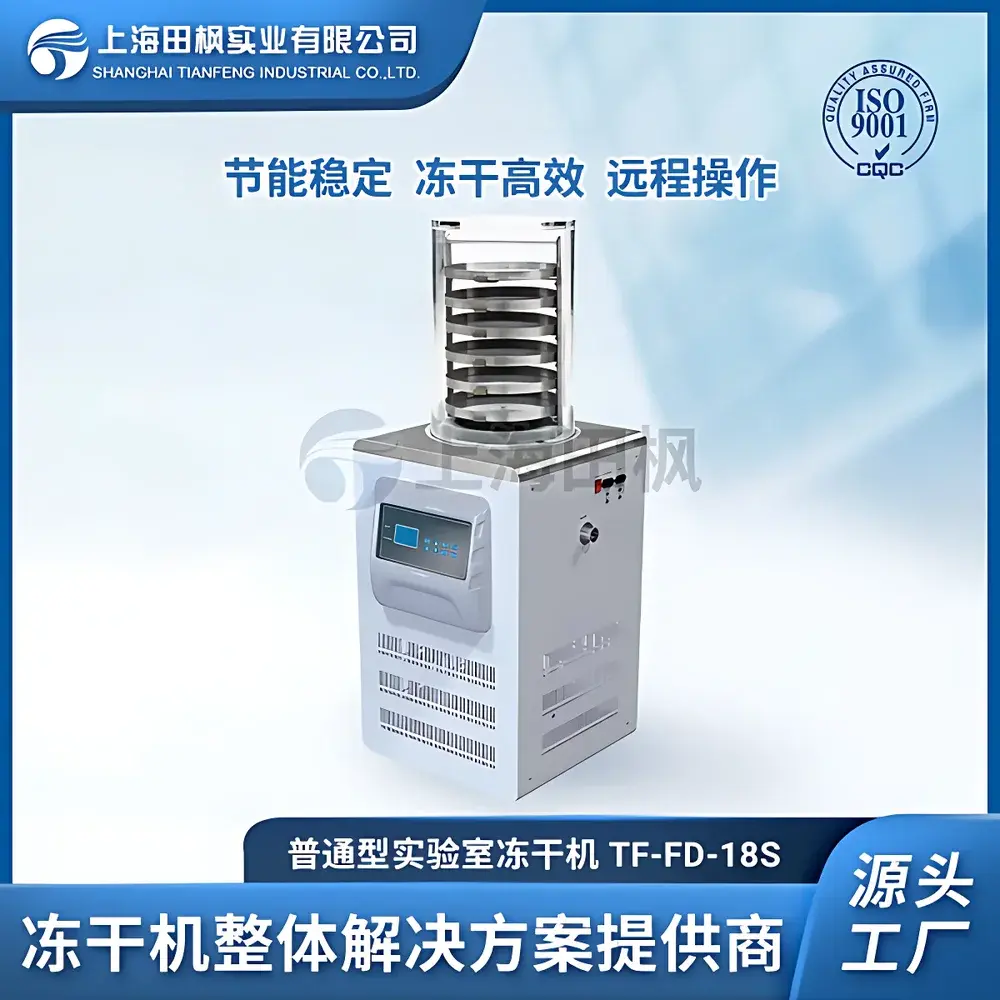
Tianfeng TF-FD-18S Benchtop In-Situ Freeze Dryer (Standard Type)
| Brand | Tianfeng |
|---|---|
| Origin | Shanghai, China |
| Manufacturer Type | Direct Manufacturer |
| Equipment Type | Standard Shelf-Type Freeze Dryer |
| Application Scope | Laboratory Use |
| Lyophilization Area | 0.18 m² |
| Ultimate Vacuum | <15 Pa (at no-load) |
| Condenser Capacity | 6 kg/24 h |
| Condenser Temperature | <−60 °C |
| Power Supply | 220 V, 50 Hz |
| Rated Power | 1700 W |
| Dimensions (H×W×D, excl. drying chamber) | 960 × 550 × 550 mm |
| Shelf Configuration | 4-layer Φ240 mm stainless steel shelves |
| Control Interface | Touchscreen LCD with real-time shelf temperature & vacuum curve logging |
| Heating System | Electrically heated shelves with programmable ramp/soak profiles |
| Construction | 304 stainless steel condenser & chamber interior |
| Viewing Window | High-transparency acrylic door |
| Optional Accessories | In-chamber inert gas backfill valve, co-lyophilization point tester, data logger compliant with GLP audit trails |
Overview
The Tianfeng TF-FD-18S is a benchtop, in-situ lyophilizer engineered for precision-controlled freeze drying of thermolabile biological and pharmaceutical samples in research and development laboratories. It operates on the fundamental principle of sublimation: aqueous samples are first frozen solid at low temperatures, then subjected to high vacuum (<15 Pa), enabling ice to transition directly from solid to vapor without passing through the liquid phase. This preserves structural integrity, bioactivity, and reconstitution fidelity—critical for vaccines, monoclonal antibodies, enzyme preparations, diagnostic reagents, and cell-based therapeutics. Unlike conventional drying methods that induce thermal degradation or collapse, the TF-FD-18S maintains sample morphology within its native ice matrix, yielding a highly porous, mechanically stable cake with rapid, complete rehydration upon addition of sterile water or buffer. Its in-situ pre-freezing capability eliminates manual transfer between freezer and dryer—reducing contamination risk, improving process repeatability, and supporting Good Manufacturing Practice (GMP)-aligned workflows.
Key Features
- In-situ freezing and drying in a single integrated chamber, eliminating sample handling between phases and minimizing exposure to ambient contaminants.
- Electrically heated stainless steel shelves (4 layers, Φ240 mm each) with ±1 °C uniformity, enabling precise control of primary and secondary drying stages via user-defined temperature ramps and holds.
- Cascade refrigeration system achieving condenser temperatures below −60 °C, ensuring efficient vapor capture even for moderately volatile solvents and high-moisture loads up to 6 kg per 24-hour cycle.
- Touchscreen HMI with real-time graphical display of shelf temperature, chamber pressure, and time-stamped lyophilization curves—supporting immediate process assessment and retrospective analysis.
- Full 304 stainless steel construction for condenser, shelf supports, and internal chamber surfaces—resistant to corrosion, compatible with rigorous cleaning protocols, and compliant with ISO 14644-1 Class 5 cleanroom-compatible installation.
- Optically clear acrylic drying chamber door with integrated safety interlock—enabling continuous visual monitoring of ice formation, sublimation front progression, and cake morphology without compromising vacuum integrity.
- Integrated inert gas backfill valve (optional) for controlled nitrogen or argon reintroduction post-drying, preventing oxidation and facilitating aseptic vial stoppering under positive pressure.
Sample Compatibility & Compliance
The TF-FD-18S accommodates a broad range of laboratory-scale formats: standard glass petri dishes (Φ240 mm), multi-well plates, serum vials (2–20 mL), and custom trays. Its 0.18 m² shelf area supports batch processing of up to 120 × 5 mL vials or equivalent surface coverage. The system meets essential performance criteria referenced in pharmacopoeial standards including USP “Lyophilization of Parenterals”, EP 2.9.40 “Freeze-Drying”, and ISO 20988:2007 “Biotechnology — General requirements for lyophilization processes”. When equipped with optional electronic loggers and audit-trail-enabled software, it satisfies FDA 21 CFR Part 11 requirements for electronic records and signatures in regulated environments. All wetted parts comply with USP Class VI biocompatibility testing, and the unit is designed for integration into GLP-compliant laboratory quality systems.
Software & Data Management
The embedded controller logs timestamped data at configurable intervals (1–60 seconds) for shelf temperature, chamber pressure, condenser temperature, and runtime. Export is supported via USB to CSV format for offline analysis in MATLAB, Python, or commercial statistical process control (SPC) platforms. Optional validated software modules provide IQ/OQ documentation templates, deviation tracking, and electronic signature support aligned with Annex 11 and ALCOA+ data integrity principles. Real-time alarms trigger on vacuum loss, shelf overtemperature, or condenser saturation—ensuring operator awareness and process safeguarding. Data retention exceeds 30 days onboard, with external backup capability via network-connected NAS devices.
Applications
This lyophilizer serves R&D labs engaged in formulation development of biologics, vaccine candidates, and diagnostic kits; QC/QA units performing stability studies per ICH Q5C; academic groups studying cryopreservation of stem cells or microbial cultures; and contract development organizations executing Phase I–II clinical trial material manufacturing. Typical use cases include drying of lyophilized ELISA reagents, freeze-dried probiotic powders, stabilized CRISPR-Cas9 ribonucleoprotein complexes, and reference standards for mass spectrometry. Its −60 °C condenser enables reliable processing of formulations containing up to 10% ethanol or acetone—extending utility beyond aqueous systems into small-molecule API stabilization.
FAQ
What is the maximum sample volume capacity per cycle?
The TF-FD-18S supports up to 6 kg of total water removal over 24 hours. For typical biological buffers (e.g., 5–10% solids), this corresponds to approximately 6–12 L of initial solution across the 0.18 m² shelf area.
Can the system be validated for GMP use?
Yes—when configured with qualified temperature sensors (Class A PT100), calibrated vacuum transducers, and 21 CFR Part 11-compliant software, the TF-FD-18S supports full IQ/OQ/PQ execution per ASTM E2500 and ISPE Baseline Guide Vol. 5.
Is remote monitoring supported?
The unit includes Ethernet connectivity; third-party SCADA integration (e.g., Ignition, Siemens Desigo) is achievable via Modbus TCP protocol with OEM-provided register mapping.
What maintenance is required for long-term reliability?
Routine tasks include monthly oil inspection of the dual-stage vacuum pump, quarterly condenser defrosting, annual refrigerant leak check, and biannual calibration of shelf temperature sensors using NIST-traceable dry-block calibrators.
Does the system support automatic end-point detection?
While not equipped with inline PAT tools (e.g., tunable diode laser absorption spectroscopy), the controller infers drying completion via pressure rise test (PRT) logic and shelf temperature stabilization—both configurable in the drying protocol.



