
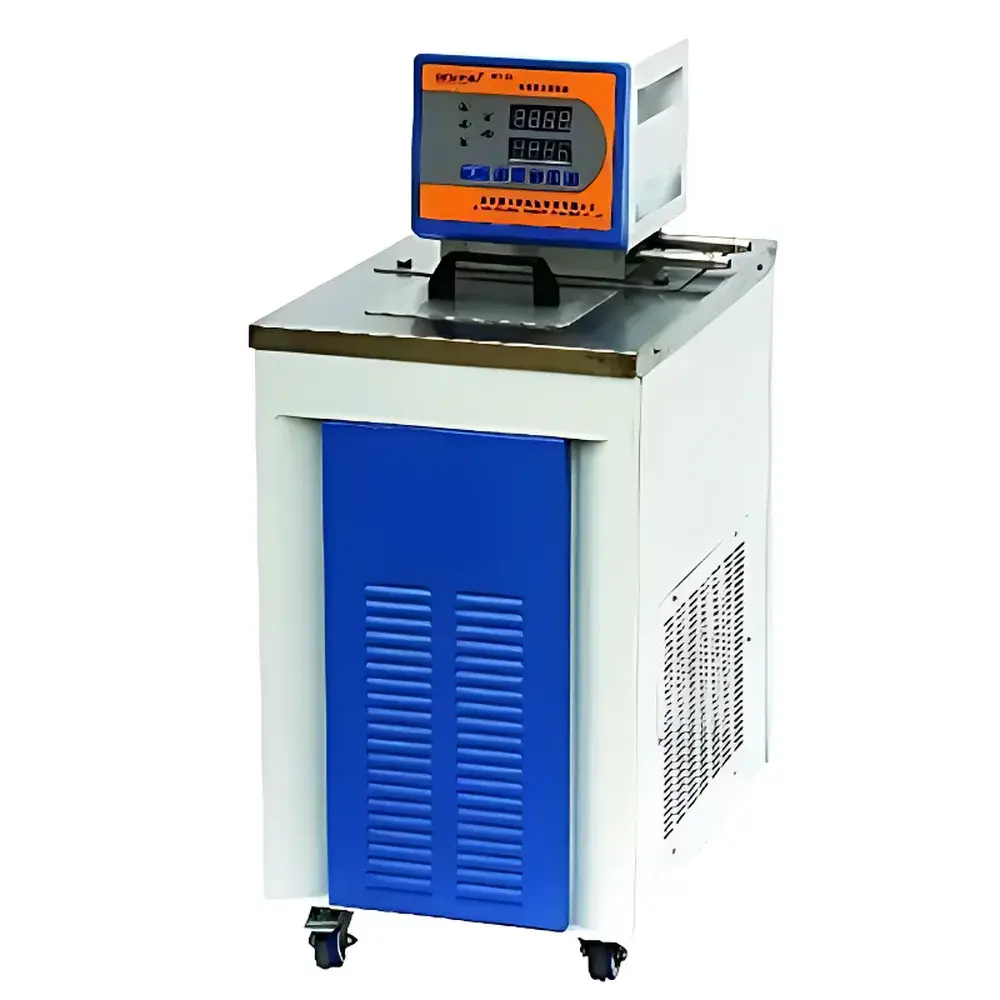
Tianfeng TF-HX-20C Low-Temperature Constant Temperature Circulator
| Brand | Tianfeng |
|---|---|
| Origin | Shanghai, China |
| Manufacturer Type | Direct Manufacturer |
| Product Category | Domestic |
| Model | TF-HX-20C |
| Instrument Type | Constant-Temperature Bath Circulator |
| Circulation Mode | Internal & External |
| Temperature Control | Refrigeration & Heating |
| Bath Volume | 20 L |
| Temperature Range | −30 °C to +99 °C |
| Temperature Stability | ±0.1 °C |
| Power Supply | 220 V / 50 Hz |
| Rated Power | 850 W |
| Dimensions (Operating) | 280 × 250 × 180 mm |
| Overall Dimensions | 550 × 368 × 898 mm |
| Cooling Method | Air-Cooled Hermetic Compressor |
| Control Interface | Touch-Sensitive Soft Keys |
| Display | Digital LED (Temperature & Timer) |
| Safety Features | Over-Temperature & Differential-Temperature Alarm |
| Compliance | ISO 9001:2000 Certified |
Overview
The Tianfeng TF-HX-20C Low-Temperature Constant Temperature Circulator is a precision-engineered, dual-mode (refrigeration and heating) thermal control system designed for laboratory environments requiring stable, uniform, and programmable temperature fields. Operating on the principle of forced convection via an integrated high-efficiency circulation pump, it maintains thermal equilibrium through closed-loop feedback control using a PID algorithm—ensuring minimal thermal drift and rapid response to load perturbations. Unlike passive water baths, this unit actively regulates both internal bath temperature and externally connected apparatus via dual-path fluid circulation, enabling precise thermal conditioning of external devices such as rotary evaporators, viscometers, electrophoresis systems, cryogenic medical accessories (e.g., cooling caps and therapeutic blankets), and vacuum pumps (including diffusion, ion, and molecular pumps). Its operational range spans from −30 °C to +99 °C, making it suitable for applications demanding sub-zero stability as well as high-temperature consistency—critical in polymer characterization, enzyme kinetics, pharmaceutical stability testing, and low-temperature reaction monitoring.
Key Features
- Air-cooled, hermetically sealed compressor with imported components—optimized for high refrigeration capacity and long-term reliability under continuous operation
- Dual circulation architecture: independent internal recirculation for bath homogeneity and external outlet port (with quick-connect fittings) for secondary thermal management of peripheral instruments
- Stainless steel 304 inner tank—corrosion-resistant, non-reactive, and compliant with GLP-compliant cleaning protocols
- Microprocessor-based PID temperature controller with digital LED display for real-time monitoring of setpoint, actual temperature, and elapsed time
- Advanced thermal design incorporating an optimized evaporator geometry—enabling faster cooldown rates and improved spatial temperature uniformity (±0.05 °C typical across bath volume)
- Intuitive touch-sensitive soft-key interface—eliminating mechanical wear and supporting user-defined operational sequences
- Programmable timer functions: delayed startup and scheduled shutdown for unattended overnight or weekend experiments
- Integrated safety logic: over-temperature cutoff and differential-temperature alarm (triggered when bath-to-sensor deviation exceeds preset threshold), logged with timestamp for audit traceability
Sample Compatibility & Compliance
The TF-HX-20C accommodates a broad spectrum of sample containers and experimental configurations—including standard Erlenmeyer flasks, jacketed reactors, capillary viscometers, and immersion probes—without compromising thermal fidelity. Its 20 L stainless steel reservoir provides sufficient volume for stable heat capacity buffering while remaining compact enough for benchtop integration. The unit complies with ISO 9001:2000 quality management standards throughout design, manufacturing, and final inspection. While not certified to IEC 61010-1 for hazardous location use, its electrical architecture meets CE-marking requirements for laboratory equipment safety (EN 61010-1:2010). For regulated environments, the digital temperature logging capability supports 21 CFR Part 11–compatible data integrity workflows when paired with validated third-party software; raw temperature records are exportable via RS232 or optional USB interface for inclusion in GxP documentation packages.
Software & Data Management
The circulator operates autonomously without mandatory software dependency; however, optional communication modules enable serial data streaming (ASCII format) of real-time temperature, setpoint, and alarm status at configurable intervals (1–60 s). When interfaced with laboratory information management systems (LIMS) or electronic lab notebooks (ELN), these streams support automated metadata tagging and trend analysis. All parameter changes—including setpoint adjustments, timer programming, and alarm thresholds—are recorded locally with timestamps in non-volatile memory, providing an immutable operational log for internal audits or regulatory review. Firmware updates are performed via secure USB flash drive import, ensuring version control and traceability per ISO/IEC 17025 Clause 5.9.2.
Applications
- Chemical synthesis requiring cryogenic initiation or exothermic reaction quenching (e.g., Grignard reactions, lithiation steps)
- Biophysical assays involving temperature-dependent protein folding/unfolding, DSC calibration, or membrane fluidity studies
- Materials science testing: coefficient of thermal expansion (CTE) measurements, rheological profiling of thermosets, and thermal aging of composites
- Pharmaceutical QC: dissolution apparatus temperature verification (USP ), stability chamber validation, and cold-chain simulation
- Instrument support: active cooling of high-power lasers, electron microscope stages, and NMR probe preamplifiers
- Food science: accelerated shelf-life testing, freezing point depression analysis, and texture profile assessment under controlled thermal ramping
FAQ
What is the minimum achievable temperature with the TF-HX-20C, and how long does it take to reach −30 °C from ambient?
The unit achieves −30 °C under no-load conditions in approximately 90 minutes. Actual cooldown time varies with thermal mass, ambient temperature, and insulation of connected external loops.
Can the external circulation port be used for both cooling and heating modes?
Yes—the same fluid path supports bidirectional thermal transfer; the direction and magnitude of heat exchange depend solely on the setpoint relative to ambient and load characteristics.
Is the stainless steel bath compatible with organic solvents such as acetone or chloroform?
The 304 stainless steel construction resists short-term exposure to common organics; prolonged immersion in halogenated solvents is not recommended without prior compatibility verification per ASTM G128.
Does the device support remote monitoring via Ethernet or Wi-Fi?
Standard configuration includes RS232 only; Ethernet or Wi-Fi connectivity requires optional OEM-integrated gateway hardware and firmware upgrade.
What maintenance intervals are recommended for optimal long-term performance?
Compressor oil and refrigerant levels should be verified annually; condenser coil cleaning is advised every six months in dust-prone environments; calibration of the PT100 sensor is recommended biannually per ISO/IEC 17025 guidelines.



