
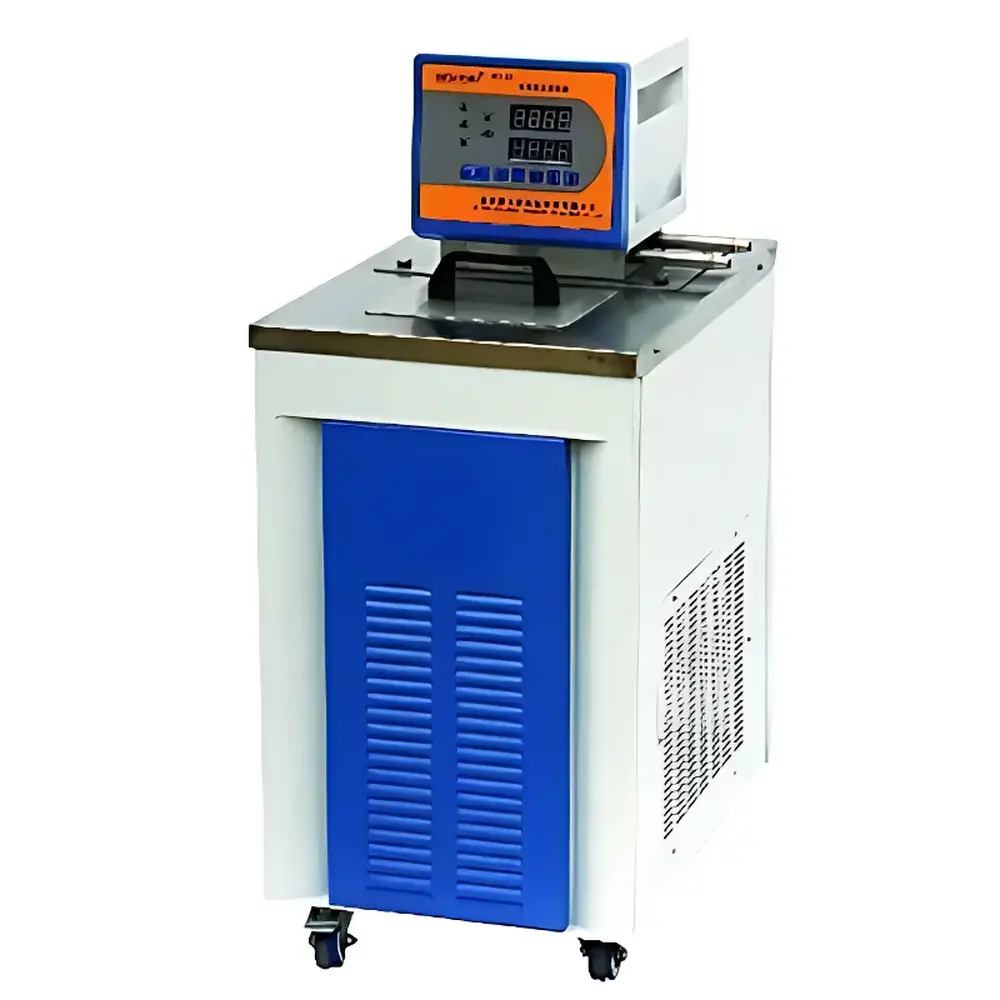
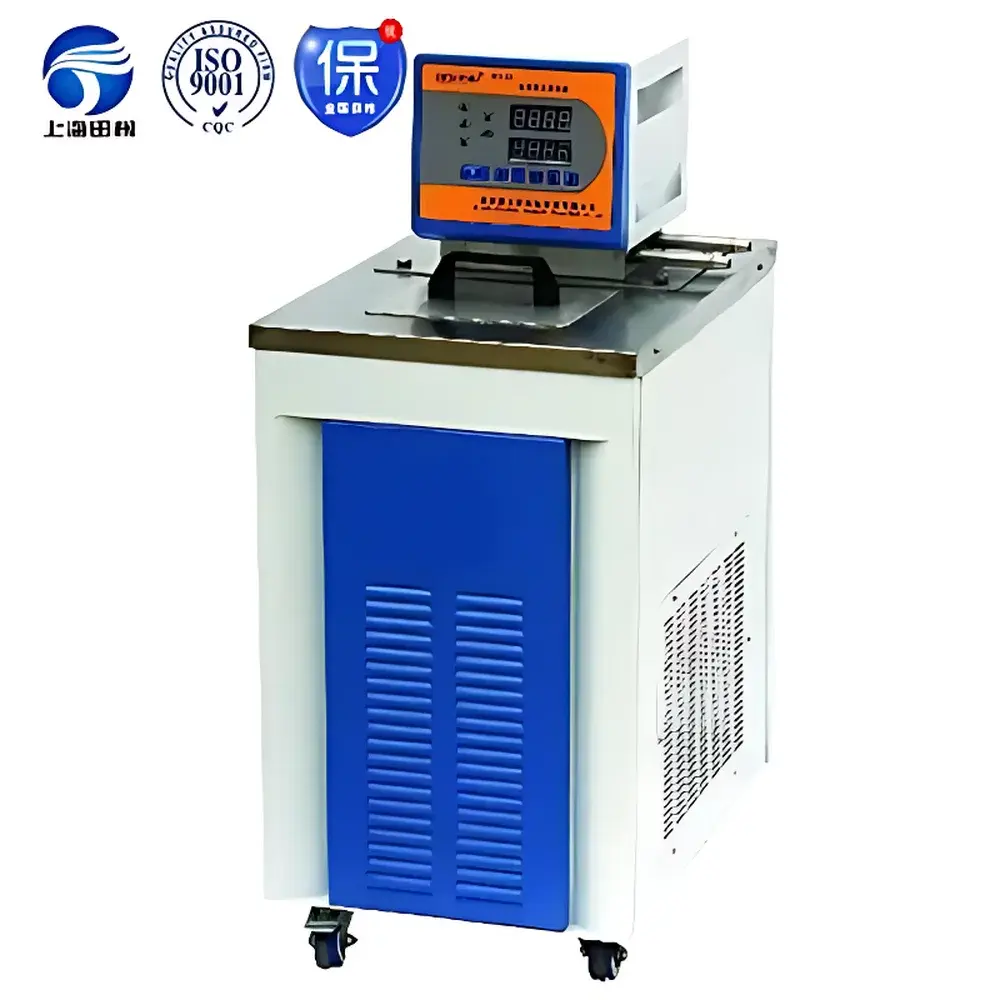
Tianfeng TF-HX-20D Advanced Precision Circulating Chiller/Heater
| Brand | Tianfeng |
|---|---|
| Origin | Shanghai, China |
| Manufacturer Type | Direct Manufacturer |
| Product Category | Domestic |
| Model | TF-HX-20D |
| Instrument Type | Constant-Temperature Circulating Bath |
| Circulation Mode | Internal & External |
| Temperature Control | Refrigeration & Heating |
| Bath Volume | 20 L |
| Temperature Range | −40 °C to +99 °C |
| Temperature Stability | ±0.1 °C |
| Power Supply | 220 V / 50 Hz |
| Rated Power | 850 W |
| External Dimensions (L×W×H) | 550 × 368 × 898 mm |
| Operating Panel Dimensions (L×W×H) | 280 × 250 × 180 mm |
| Cooling System | Air-Cooled Hermetic Compressor (Imported) |
| Control Interface | Touch-Sensitive Soft Keys |
| Display | Dual Digital LED (Temperature & Timer) |
| Safety Features | Over-Temperature Alarm, Differential-Temperature Alarm, Auto Shutdown |
Overview
The Tianfeng TF-HX-20D Advanced Precision Circulating Chiller/Heater is a dual-mode, high-stability temperature control system engineered for laboratory and industrial applications requiring precise thermal management across an extended range of −40 °C to +99 °C. Based on closed-loop refrigeration-heating thermodynamics and optimized heat exchange architecture, the unit integrates a high-efficiency air-cooled hermetic compressor with a PID-controlled heating circuit to deliver rapid thermal response and exceptional uniformity within the 20 L stainless-steel bath chamber. Its internal/external circulation capability enables both in-bath experiments and remote temperature conditioning—making it suitable as a primary thermal source or auxiliary cooling/heating module for externally connected instrumentation.
Key Features
- High-precision temperature regulation with ±0.1 °C stability at setpoint, validated under steady-state conditions per ISO 17025-aligned calibration protocols;
- Dual-mode operation: simultaneous refrigeration and heating via independent compressor and resistive heating circuits, eliminating thermal lag during ramp transitions;
- Optimized evaporator design based on large-volume refrigerant distribution principles, ensuring homogeneous temperature distribution throughout the bath volume;
- Microprocessor-based PID controller with digital touch interface, real-time temperature/time display, programmable start/stop scheduling, and configurable alarm thresholds;
- Stainless-steel inner tank (304 grade) resistant to corrosion from aqueous, organic, and mildly acidic solutions commonly used in analytical and synthetic workflows;
- Integrated safety protections including over-temperature cutoff, differential-temperature deviation alert, and automatic shutdown upon sensor fault detection;
- Compact footprint (550 × 368 × 898 mm) with front-accessible fluid ports and reinforced hose fittings compatible with standard 10–16 mm ID silicone or fluoropolymer tubing.
Sample Compatibility & Compliance
The TF-HX-20D supports compatibility with a broad spectrum of sample media—including water, ethanol, ethylene glycol/water mixtures, silicone oils, and low-viscosity heat-transfer fluids—without degradation of thermal performance or material integrity. Its construction complies with IEC 61010-1:2010 for electrical safety in laboratory equipment. While not certified for medical device use under FDA 21 CFR Part 820, the system meets general-purpose requirements for GLP-compliant environments when operated within documented SOPs. Traceable temperature verification is supported via external Pt100 probe input (optional accessory), enabling alignment with ISO/IEC 17025 metrological traceability frameworks.
Software & Data Management
The unit operates autonomously via embedded firmware without mandatory PC connectivity; however, optional RS485 or USB-to-serial interface modules enable integration into centralized lab monitoring systems (e.g., LabVIEW, SCADA, or custom Python-based data loggers). All operational parameters—including setpoint history, alarm events, and runtime duration—are timestamped and stored in non-volatile memory for post-experiment audit review. For regulated environments, optional firmware upgrades support 21 CFR Part 11-compliant electronic signatures and audit trail generation when paired with validated third-party software platforms.
Applications
- Thermal conditioning of rotary evaporators, vacuum freeze dryers, and circulating water vacuum pumps in organic synthesis and pharmaceutical R&D;
- Active cooling of high-power analytical instruments such as SEM/TEM cold stages, ion pumps, diffusion pumps, and RF amplifiers;
- Controlled-temperature viscometry, calorimetry, and reaction kinetics studies requiring long-duration thermal stability;
- Biological applications including electrophoresis buffer cooling, cryopreservation staging, and temperature-dependent enzyme activity assays;
- Material testing in polymer science, rheology, and phase-change characterization where reproducible thermal gradients are critical;
- Calibration support for temperature-sensitive sensors, reference standards, and metrology fixtures in QA/QC laboratories.
FAQ
What is the minimum operating temperature achievable with the TF-HX-20D using standard coolant mixtures?
When filled with a 50:50 ethylene glycol/water mixture, the unit reliably maintains −40 °C at ambient temperatures ≤25 °C and relative humidity <60%. Performance may vary slightly under high ambient load conditions.
Can this unit be integrated into a GMP-compliant manufacturing environment?
Yes—when deployed with documented IQ/OQ protocols, calibrated external probes, and configured with audit-trail-enabled firmware, the TF-HX-20D supports qualification under EU Annex 11 and USP guidelines for ancillary equipment.
Is external circulation flow rate adjustable?
The built-in centrifugal pump delivers up to 18 L/min at 0.2 MPa pressure head; flow is manually regulated via integrated needle valves on the outlet manifold, allowing fine-tuned delivery to secondary systems.
Does the unit support continuous unattended operation?
Yes—programmable timer functions, thermal fault redundancy, and stable power consumption (<850 W nominal) enable 72+ hour uninterrupted operation under monitored conditions.
What maintenance intervals are recommended for optimal longevity?
Compressor oil inspection every 12 months, condenser coil cleaning quarterly, and annual verification of PID tuning parameters using NIST-traceable reference thermometers are advised per manufacturer technical bulletin TB-HX-2023-04.



