
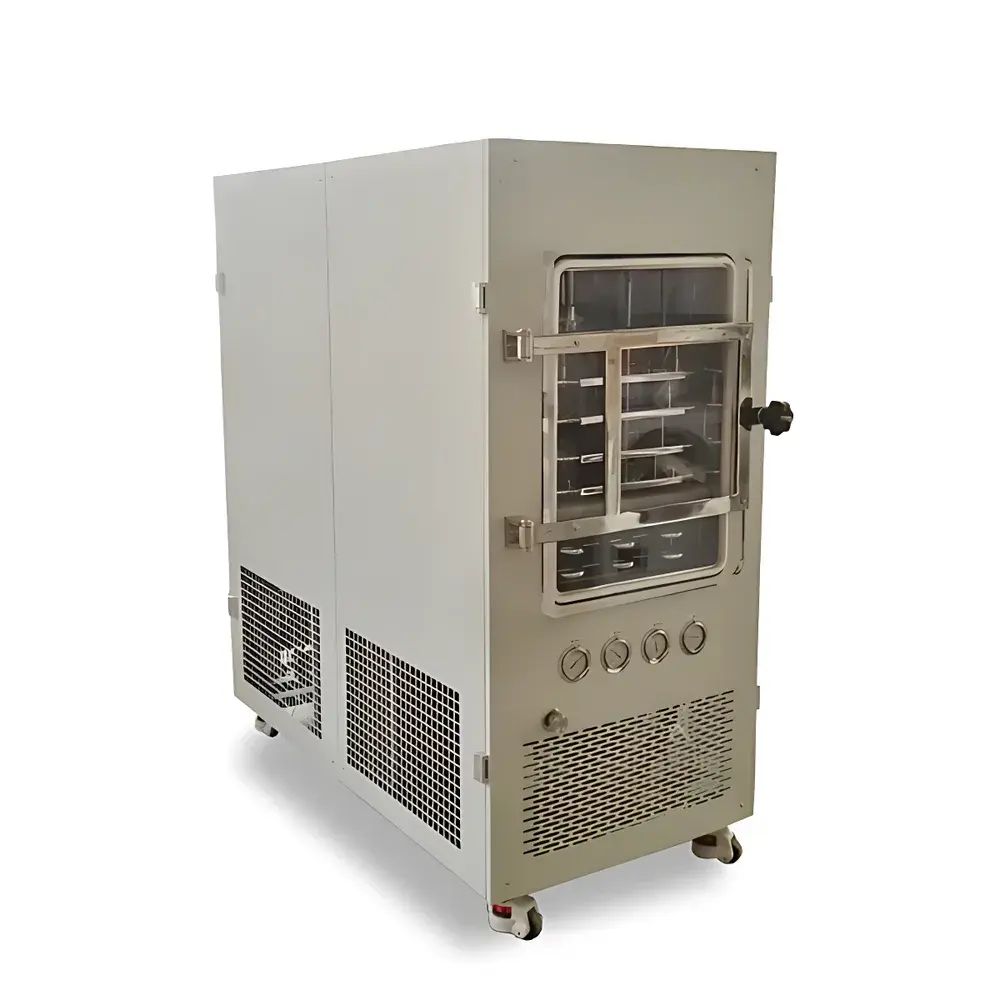
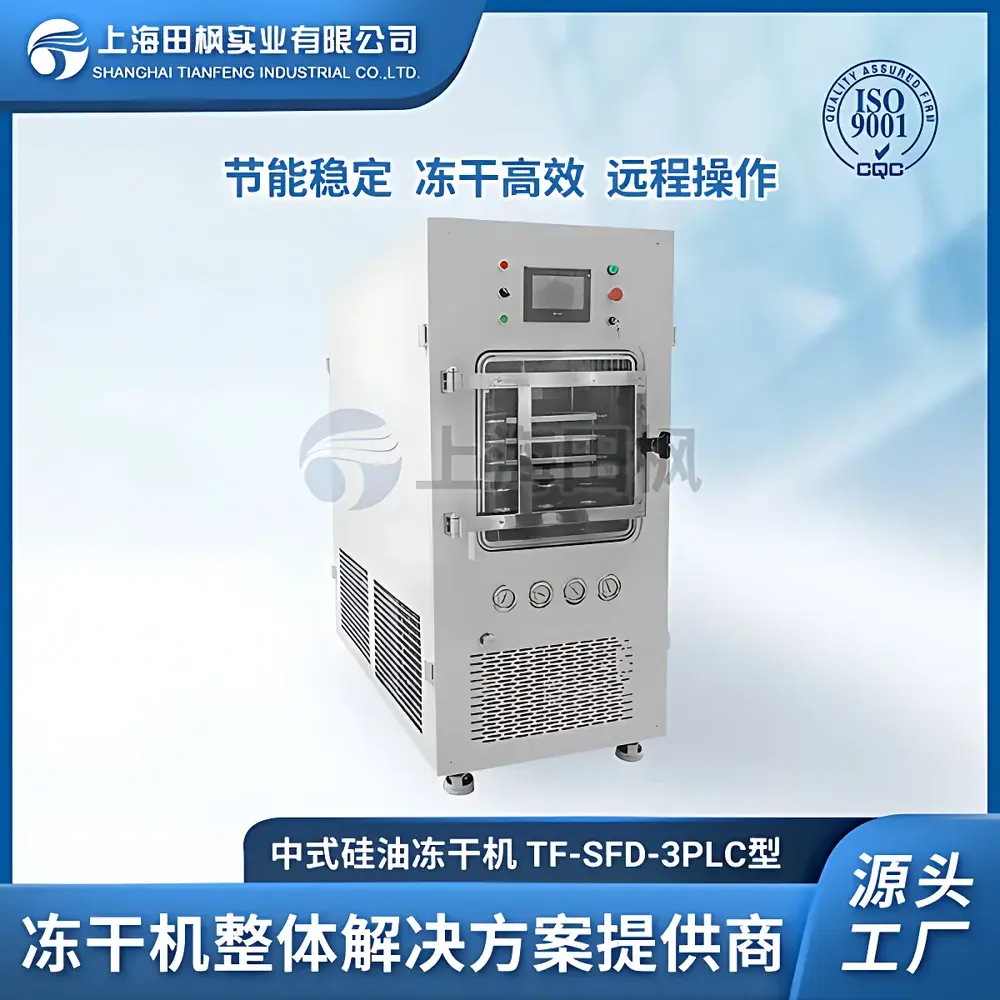
Tianfeng TF-SFD-3 Laboratory-Scale Production Freeze Dryer
| Brand | Tianfeng |
|---|---|
| Origin | Shanghai, China |
| Manufacturer Type | Direct Manufacturer |
| Equipment Type | Standard Shelf-Type Freeze Dryer |
| Application Scope | Pilot-Scale Production & R&D |
| Freeze-Drying Area | 0.3 m² |
| Ultimate Vacuum | ≤5 Pa |
| Condenser Temperature | ≤−70 °C |
| Ice Capacity (24 h) | 5 kg/24 h |
| Shelf Dimensions | 300 mm × 380 mm |
| Shelf Quantity | 4 (3 working + 1 spare) |
| Shelf Spacing | 70 mm |
| Shelf Temperature Range | −50 °C to +80 °C |
| Power Consumption | 3.5 kW |
| Net Weight | 430 kg |
| Chamber Viewing Window | High-Transparency Acrylic Door |
| Control System | PLC with Touchscreen HMI |
| Data Logging | Real-Time Vacuum & Shelf Temperature Curves, Full Audit Trail |
| Optional Features | In-situ Eutectic Point Detection, Inert Gas Purge Valve (N₂/Ar), Password-Protected Operation Mode |
Overview
The Tianfeng TF-SFD-3 is a laboratory-scale production freeze dryer engineered for reproducible, scalable lyophilization of heat-sensitive botanical and biological materials. It operates on the principle of sublimation under deep vacuum: frozen water in the sample transitions directly from solid to vapor without passing through the liquid phase, preserving structural integrity, bioactivity, and chemical stability. Designed for pilot-line validation and small-batch manufacturing—particularly for traditional herbal preparations—the system integrates in-situ pre-freezing, programmable shelf temperature control, and high-efficiency condensation. Its 0.3 m² effective shelf area supports standardized vial, tray, or dish-based loading configurations, making it suitable for process development aligned with GMP-compliant workflows in herbal pharmaceutical, nutraceutical, and natural product research laboratories.
Key Features
- In-situ freezing and drying within a single chamber—eliminates transfer-related contamination and thermal shock.
- Silicone oil-heated shelves with ±0.5 °C temperature uniformity (≤1 °C max shelf-to-shelf deviation) ensure consistent drying kinetics across all loads.
- Programmable control architecture: up to 5 independent drying protocols, each with 24 customizable segments (freeze rate, hold time, ramp slope, pressure setpoint, etc.).
- Real-time data acquisition: continuous logging of shelf temperature, chamber pressure, condenser temperature, and elapsed time; exportable as CSV or PDF reports.
- Full audit trail functionality compliant with FDA 21 CFR Part 11 requirements—including user login history, parameter modification timestamps, and electronic signature support (when configured with authentication module).
- High-transparency acrylic chamber door enables visual monitoring of ice formation, sublimation front progression, and cake morphology without breaking vacuum.
- Integrated inert gas purge valve (N₂ or argon) for oxygen-sensitive samples and post-drying headspace conditioning prior to stoppering.
- Robust condenser design rated for ≤−70 °C operating temperature and 5 kg/24 h ice capture capacity—optimized for batch processing of aqueous herbal extracts, fruit powders (e.g., hawthorn), green tea suspensions, and mucilage-rich botanicals.
Sample Compatibility & Compliance
The TF-SFD-3 accommodates diverse herbal matrices including leafy herbs (e.g., green tea leaves), fleshy fruits (hawthorn slices), rhizomes (ginseng, licorice), fungal bodies (reishi, cordyceps), animal-derived materials (dried seahorse, deer antler gelatin), and marine biomass (sea cucumber, abalone). Its temperature and vacuum flexibility supports category-specific lyo-cycles per documented Chinese Pharmacopoeia–aligned practices: e.g., −38 °C pre-freeze for volatile terpene-rich herbs; −50 °C hold for collagenous animal tissues; and variable primary drying ramps (0.1–0.5 °C/min) calibrated to collapse temperature (Tc) estimates. The system meets ISO 22000 prerequisite program requirements for equipment hygiene and supports GLP documentation standards when paired with validated SOPs and calibration records.
Software & Data Management
Equipped with an industrial-grade PLC and 7-inch capacitive touchscreen HMI, the TF-SFD-3 runs embedded firmware supporting multi-user access levels (operator, supervisor, administrator) with configurable password policies. All process parameters—including vacuum setpoints (0.1–10 Pa range), shelf heating/cooling rates, and condenser defrost triggers—are fully adjustable during runtime. Raw sensor data is stored internally (≥30-day buffer) and exportable via USB or Ethernet. Optional software add-ons enable remote monitoring via Modbus TCP, integration into LIMS environments, and automated report generation aligned with ICH Q5C stability testing guidelines.
Applications
- Development and scale-up of lyophilized herbal formulations: hawthorn fruit powder, green tea extract, goji berry concentrate, and schisandra polysaccharide fractions.
- Stabilization of thermolabile phytochemicals—flavonoids, anthocyanins, iridoids—without degradation or oxidation.
- Preparation of sterile-ready botanical intermediates for capsule filling or tablet compression under ISO Class 5 cleanroom-compatible operation.
- Process characterization studies: determination of critical quality attributes (CQAs) including residual moisture (<5% w/w), reconstitution time (<60 s), and morphological integrity (via SEM cross-section analysis).
- Support for regulatory submissions requiring demonstration of process robustness—e.g., WHO TRS 986 Annex 5, USP , and Chinese GMP Annex I for sterile products.
FAQ
What is the maximum batch capacity for vials using Φ16 mm and Φ20 mm formats?
The unit accommodates up to 1,200 vials (Φ16 mm) or 600 vials (Φ20 mm) per cycle, assuming standard 5–10 mL fill volumes and uniform monolayer distribution.
Does the system support validation protocols such as IQ/OQ/PQ?
Yes—factory-installed sensors are NIST-traceable; full validation documentation packages (including protocol templates, test scripts, and summary reports) are available upon request.
Can shelf temperature be ramped independently during primary and secondary drying?
Yes—each of the 24 programmable segments allows discrete control of shelf temperature, chamber pressure, and dwell time, enabling precise modeling of drying resistance and mass transfer dynamics.
Is the condenser capable of handling solvents other than water?
The standard condenser is optimized for aqueous systems; for organic solvent lyophilization (e.g., ethanol-based extracts), optional low-temperature upgrades (−85 °C) and corrosion-resistant coatings are recommended.
How is data integrity ensured during long-duration cycles (e.g., >30 hours)?
All logged parameters are written redundantly to non-volatile memory and synchronized with internal RTC; power failure recovery preserves active program state and resumes from last valid segment.
Related Products



