
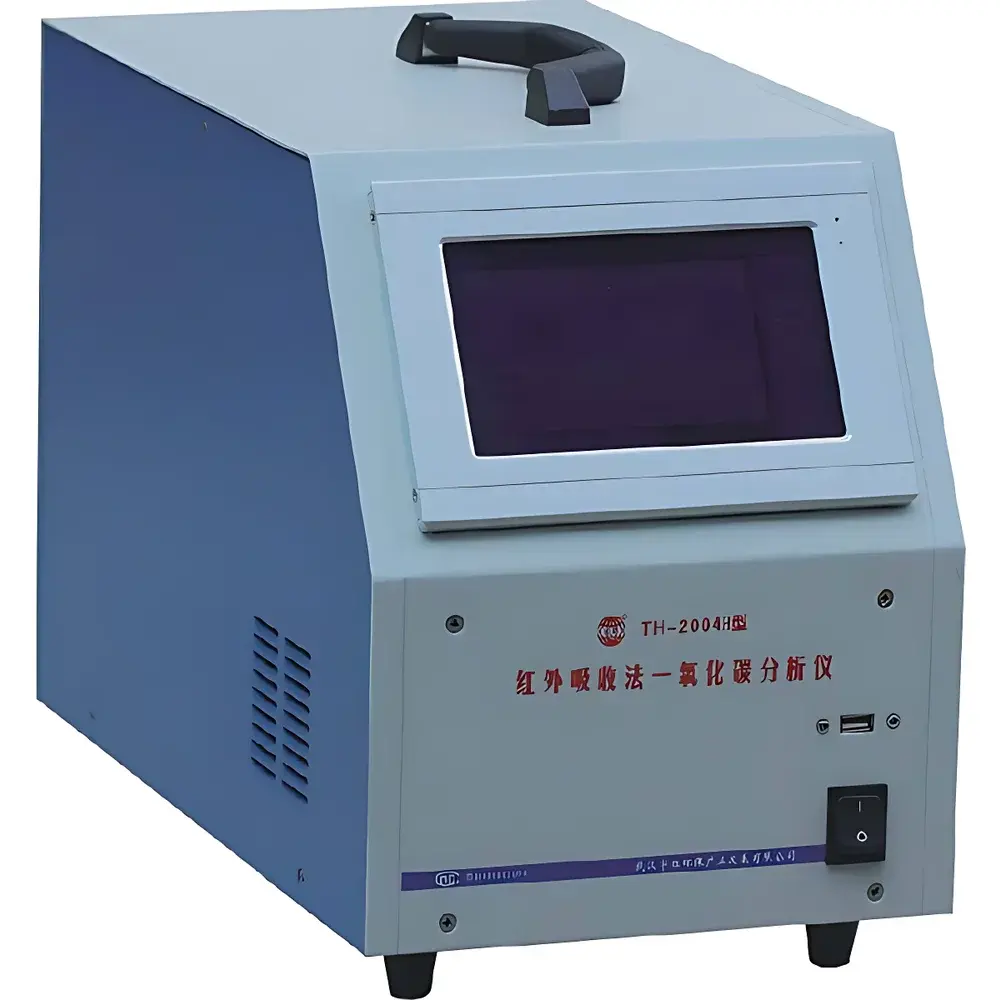
Tianhong TH-204H Portable Carbon Monoxide Analyzer
| Brand | Tianhong |
|---|---|
| Origin | Hubei, China |
| Model | TH-204H |
| Instrument Type | Portable |
| Detection Target | Single-component (CO) |
| Minimum Detectable Concentration | 0.01 ppm |
| Repeatability | ±1% FS |
| Resolution | 0.01 ppm |
| Response Time (T90) | 100 s |
| Zero Drift | ≤0.1 ppm / 24 h |
| Span Drift | ≤0.1 ppm / 24 h |
| Linearity Error | ±1% FS |
Overview
The Tianhong TH-204H Portable Carbon Monoxide Analyzer is a field-deployable gas detection instrument engineered for high-precision, real-time measurement of carbon monoxide (CO) in ambient air, indoor environments, industrial workspaces, and emergency response scenarios. It operates on the principle of Gas Filter Correlation Infrared (GFC-IR) spectroscopy — a highly selective and interference-resistant optical technique. The analyzer exploits the strong, characteristic infrared absorption band of CO at 4.67 µm. A rotating filter wheel alternately introduces CO-specific and nitrogen (N₂)-passing optical filters into the beam path from a broadband infrared source. This creates two modulated light signals: a reference beam (blocked from interacting with sample CO) and a measurement beam (fully exposed to the sample gas). An IR detector quantifies the intensity ratio between these beams, enabling concentration calculation via the Lambert–Beer law. Unlike conventional NDIR systems, GFC-IR inherently suppresses cross-sensitivity to water vapor, CO₂, and hydrocarbons by spectral correlation, delivering superior specificity and long-term stability in variable environmental conditions.
Key Features
- 7-inch full-touch color display with intuitive UI supporting both English and Chinese language modes
- Multi-unit concentration display: ppb, ppm, µg/m³, and mg/m³ — user-selectable in real time
- Auto-ranging capability with seamless switching across low- and mid-range CO concentrations
- Real-time graphical trend visualization; zoomable time-series plots with adjustable time windows
- Integrated temperature and barometric pressure compensation algorithms compliant with ISO 4223 and EPA Method TO-11A requirements
- Adaptive signal processing firmware optimizing dynamic response time and signal-to-noise ratio under varying flow and humidity conditions
- Remote calibration and diagnostic access via secure Ethernet or optional Wi-Fi module (firmware v2.3+)
- Internal data logger storing one record every 5 minutes for up to 12 months (≈87,600 entries); exportable via USB or SD card in CSV format
- Configurable multi-level alarm system with audible/visual alerts and relay outputs for external notification
- Dual-power operation: rechargeable Li-ion battery (≥10 h continuous runtime) and AC adapter compatibility
- Pre-heat mode enables rapid deployment — instrument achieves thermal and optical stabilization within 5 minutes of startup
Sample Compatibility & Compliance
The TH-204H is designed for direct analysis of ambient air, stack effluents (with optional dilution module), and confined-space atmospheres. It accepts sample gas at standard flow rates of 0.5–1.0 L/min through a built-in particulate filter and hydrophobic membrane. No chemical scrubbers or catalytic converters are required. The analyzer meets key international performance benchmarks including EN 14625:2012 (ambient air quality — CO measurement), ASTM D6348-18 (standard test method for determination of gaseous compounds by GC), and is suitable for use in EPA-compliant ambient monitoring networks. Its drift specifications (≤0.1 ppm/24 h zero and span) satisfy QA/QC requirements for Level 2 reference-grade portable analyzers per U.S. EPA’s Ambient Air Monitoring Guidance (40 CFR Part 58, Appendix A).
Software & Data Management
Data acquisition, configuration, and reporting are managed through Tianhong’s proprietary PC-based software suite (TH-Link v4.1), compatible with Windows 10/11. The software supports GLP-compliant audit trails, user access levels (admin/operator), and electronic signature logging for calibration events. Raw sensor outputs, environmental metadata (T, P, RH), and diagnostic flags are timestamped and stored with UTC synchronization. Export functions include PDF reports with embedded calibration certificates, Excel-compatible datasets, and direct integration with third-party SCADA or LIMS platforms via Modbus TCP or ASCII serial protocol. Firmware updates are performed over-the-air or via local file upload, preserving all user-defined configurations.
Applications
- Ambient air quality monitoring networks (urban, roadside, background stations)
- Indoor air quality (IAQ) assessment in commercial buildings, schools, and hospitals
- Industrial hygiene surveys and occupational exposure limit (OEL) compliance verification (OSHA PEL, ACGIH TLV)
- Emergency response and hazmat incident assessment (e.g., fire aftermath, vehicle exhaust leaks)
- Method validation and inter-laboratory comparison studies
- Mobile monitoring campaigns using vehicle-mounted or handheld deployment
- Calibration transfer verification against certified reference gases traceable to NIST SRM 1690
FAQ
What is the recommended calibration frequency for routine field use?
For compliance with ISO/IEC 17025 and EPA guidance, we recommend zero and span calibration every 7 days when used continuously; weekly bump testing with 10 ppm CO standard is acceptable for interim verification.
Can the TH-204H measure CO in high-humidity environments?
Yes — the optical path includes a heated sample chamber and dual-stage condensate trap; relative humidity tolerance extends to 95% RH non-condensing without performance degradation.
Is the instrument certified for intrinsic safety in hazardous locations?
No — the TH-204H is not ATEX or IECEx certified; it is rated for general-purpose use only (IP54 enclosure rating).
Does the analyzer support external analog output for integration with building management systems?
Yes — standard 4–20 mA and 0–10 V analog outputs are configurable for CO concentration, with isolated circuitry and user-defined scaling.
How is measurement traceability maintained?
All factory calibrations are performed using NIST-traceable CO standards (±0.5% uncertainty); calibration certificates include uncertainty budgets and are archived in the internal memory alongside each calibration event.







