
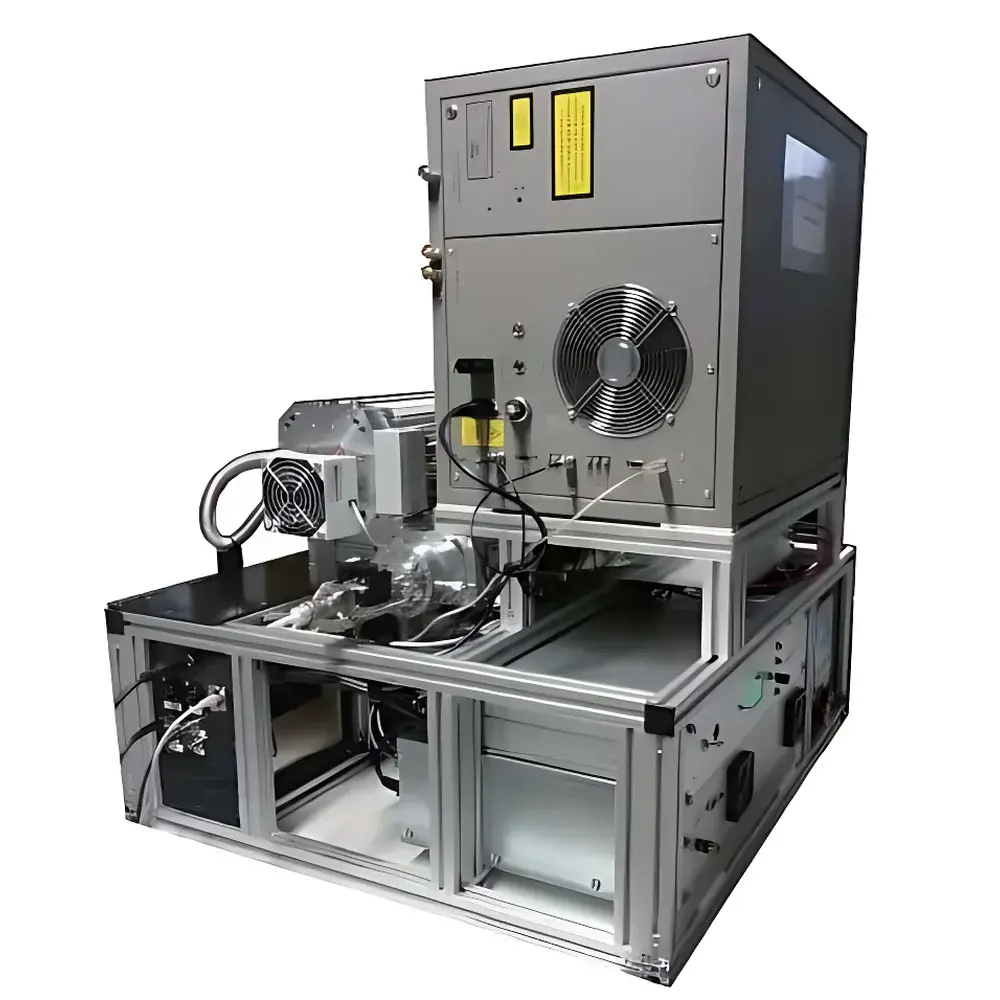
Tianhong TH-310 Time-of-Flight Aerosol Mass Spectrometer
| Brand | Tianhong |
|---|---|
| Model | TH-310 |
| Instrument Type | Single-Particle Aerosol Time-of-Flight Mass Spectrometer (SP-AMS) |
| Sampling Method | Aerodynamic Lens Inlet |
| Particle Sizing Principle | Dual-Laser Light Scattering (Vacuum Aerodynamic Diameter, dₐₑᵣₒ) |
| Ionization | 266 nm UV Pulsed Laser (One-Step Desorption/Ionization) |
| Mass Analyzer | Bipolar Reflectron Time-of-Flight (TOF-MS) |
| Detection Rate | ≥100 particles/s |
| Application Scope | Real-Time PM₂.₅ Source Apportionment, Single-Particle Chemical Composition Analysis, Secondary Aerosol Process Monitoring |
Overview
The Tianhong TH-310 Time-of-Flight Aerosol Mass Spectrometer is a high-resolution, real-time single-particle analytical platform engineered for quantitative characterization of ambient aerosols at the individual particle level. Based on established principles of aerodynamic focusing and time-of-flight mass spectrometry, the TH-310 integrates an aerodynamic lens inlet, dual-scatter laser velocimetry, and synchronized 266 nm ultraviolet pulsed laser desorption/ionization to determine both vacuum aerodynamic diameter (dₐₑᵣₒ) and bipolar mass spectra (positive and negative ions) for each detected particle. Unlike bulk-integrated techniques such as filter-based IC/ICP-MS or traditional aerosol mass spectrometry (e.g., AMS), the TH-310 preserves single-particle heterogeneity—enabling direct correlation between size-resolved morphology proxies and molecular-level chemistry. Its design aligns with international standards for atmospheric aerosol instrumentation, supporting traceable measurements under variable ambient concentrations without offline sample preparation or dilution.
Key Features
- Real-time, single-particle analysis with simultaneous sizing and bipolar mass spectral acquisition
- Aerodynamic lens inlet optimized for efficient transmission of particles in the 0.2–3.0 µm dₐₑᵣₒ range
- Dual-laser scattering system for precise velocity measurement and dₐₑᵣₒ calculation with sub-micrometer resolution
- Co-located trigger and ionization lasers with head-on particle–laser interaction geometry, maximizing ionization efficiency and detection fidelity
- High-repetition-rate UV laser (≥1 kHz) enabling sustained detection rates exceeding 100 particles per second
- No sample pre-treatment, no dilution required—operational across wide ambient PM₂.₅ concentration gradients (0.1–100 µg/m³)
- Integrated data acquisition firmware supporting timestamp-synchronized particle event logging, including scatter intensity, transit time, and full m/z spectra
Sample Compatibility & Compliance
The TH-310 is validated for ambient airborne particulate matter—including urban, rural, marine, and combustion-derived aerosols—as well as controlled laboratory-generated particles (e.g., engine exhaust, biomass burning smoke, mineral dust, secondary organic aerosol surrogates). It complies with key methodological frameworks used in regulatory and research contexts: ASTM D6246 (Standard Guide for Aerosol Measurement), ISO 29463-3 (High-efficiency filters for aerosol separation), and EU Directive 2008/50/EC Annex XII (guidance on PM source apportionment). While not FDA-cleared, its data structure and audit trail capabilities support GLP-compliant workflows when deployed in environmental research laboratories adhering to ISO/IEC 17025:2017 requirements for testing and calibration laboratories.
Software & Data Management
The TH-310 operates with proprietary acquisition and analysis software delivering raw particle event files (.spc), calibrated mass spectra, and classified particle databases. The software implements two complementary source apportionment algorithms: (1) Feature Ion Ratio (FIR) profiling, aligned with published marker ion sets from EPA SPECIATE and EMEP receptor modeling; and (2) Pseudo-Chemical Mass Balance (pCMB), which maps single-particle spectral signatures onto predefined source categories using constrained non-negative matrix factorization (NMF). Both methods incorporate transmission efficiency corrections derived from aerodynamic lens transfer functions and Mie scattering cross-section models. All processing steps are logged with full metadata (instrument settings, calibration dates, operator ID), satisfying traceability requirements for peer-reviewed publication and regulatory reporting.
Applications
- Real-time source apportionment of PM₂.₅ in urban air quality monitoring networks
- Mechanistic studies of secondary aerosol formation pathways (e.g., SOA aging, nitrate partitioning, chloride depletion)
- Source characterization of mobile emissions (diesel/gasoline engines, aircraft, shipping)
- Climate-relevant aerosol property assessment: hygroscopicity proxies, light-absorbing carbon fractionation, mixing state quantification
- Industrial hygiene monitoring for engineered nanomaterials and process aerosols (e.g., battery cathode synthesis, pharmaceutical powder handling)
- Validation of regional chemical transport models (CTMs) through direct comparison of simulated vs. observed particle-type distributions
FAQ
What particle size range is measurable by the TH-310?
The instrument detects particles with vacuum aerodynamic diameters between approximately 0.2 µm and 3.0 µm, with optimal transmission and sizing accuracy in the 0.3–2.5 µm range.
Does the TH-310 require calibration standards for routine operation?
Yes—polystyrene latex (PSL) spheres are used for aerodynamic sizing calibration, while internally calibrated mass spectra rely on known elemental ion peaks (e.g., C⁺, CH⁺, Na⁺, K⁺, NO₂⁻) verified against NIST-traceable reference materials.
Can the TH-310 distinguish internally mixed vs. externally mixed particles?
Yes—by resolving co-detected positive and negative ion signals within a single particle event, the system identifies internal mixing states (e.g., sulfate–nitrate–organic cores) with statistical confidence based on ion co-occurrence frequency and intensity correlation.
Is the TH-310 compatible with existing atmospheric data infrastructure (e.g., AQS, EBAS)?
Raw and processed outputs conform to netCDF-4 and HDF5 formats with CF-1.8 metadata conventions, enabling direct ingestion into EPA AirNow, EEA AirBase, and EBAS archival pipelines via standardized API interfaces.
What maintenance protocols are recommended for long-term field deployment?
Daily vacuum system checks, weekly laser energy monitoring, bi-monthly aerodynamic lens cleaning with inert gas purge, and quarterly mass calibration using perfluorotributylamine (PFTBA) standard—all documented in the manufacturer’s Field Maintenance Manual (Rev. 3.2).







