
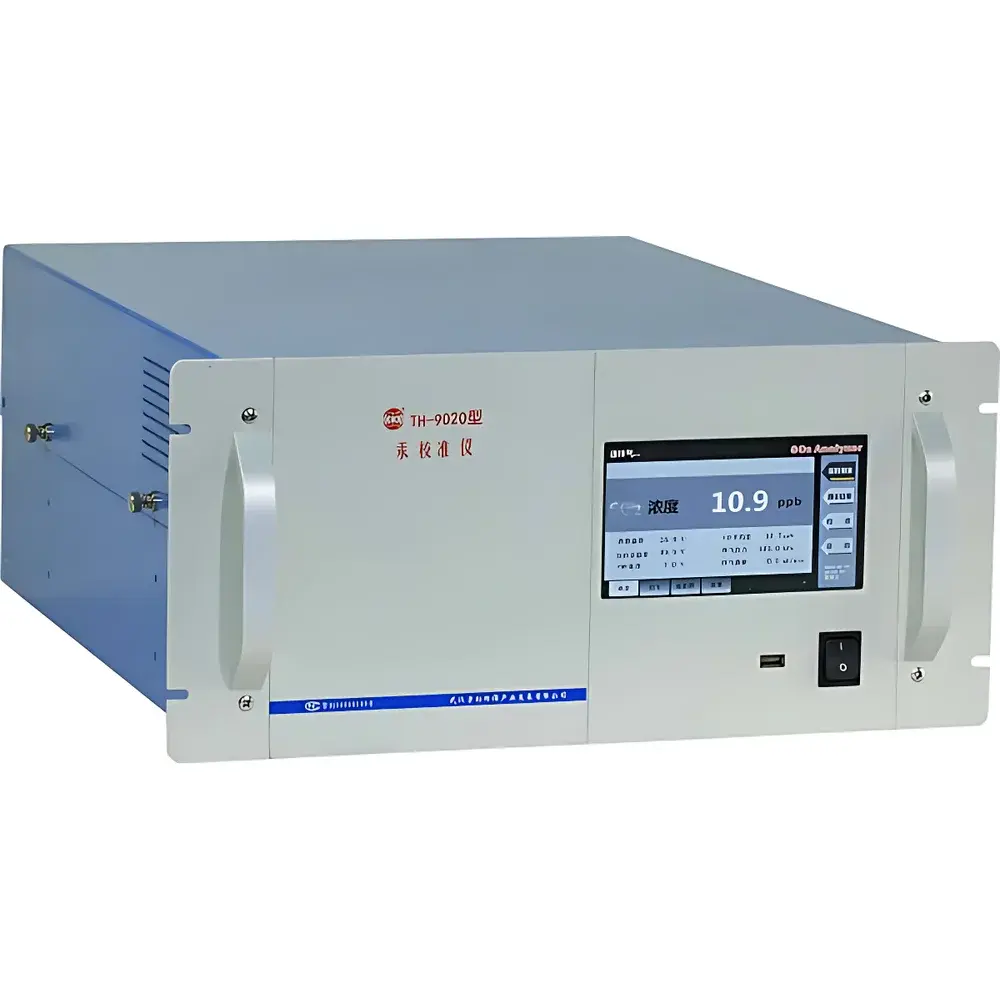
Tianhong TH-9020 Elemental Mercury Permeation Calibrator
| Brand | Tianhong |
|---|---|
| Origin | Hubei, China |
| Model | TH-9020 |
| Output Range | 0.5–50 µg/m³ elemental mercury (Hg⁰) in zero air |
| Permeation Source | Imported temperature-controlled permeation device |
| Temperature Control Accuracy | ±0.1 °C |
| Mass Flow Controllers | High-precision digital MFCs (±1% full scale) |
| Display | 7-inch capacitive touchscreen interface |
| Gas Path | Electropolished stainless steel with passivated internal surfaces |
| Compliance | Designed for ISO/IEC 17025-compliant calibration workflows and EPA Method 29 / ASTM D6784 alignment |
Overview
The Tianhong TH-9020 Elemental Mercury Permeation Calibrator is a trace-level gas standard generator engineered to produce stable, gravimetrically traceable concentrations of elemental mercury vapor (Hg⁰) in ultra-pure zero air. Unlike compressed cylinder-based Hg⁰ standards—which are unavailable in mainland China due to mercury’s high reactivity, adsorption affinity, and regulatory restrictions—the TH-9020 employs a thermally regulated permeation tube principle to generate dynamic, on-demand calibration gases. The instrument operates on the fundamental principle of controlled thermal desorption: zero air, purified to <0.1 ppb hydrocarbon and <1 ppb CO/NOₓ, passes through precision digital mass flow controllers before entering a thermostatically stabilized permeation furnace (setpoint range: 30–60 °C, stability ±0.1 °C). Within this furnace, an imported, NIST-traceable mercury permeation source releases Hg⁰ vapor at a predictable, temperature-dependent rate governed by the Arrhenius equation. The liberated mercury vapor is then diluted with additional zero air in a precisely metered mixing zone, enabling continuous output of certified Hg⁰ concentrations from 0.5 to 50 µg/m³—covering the full dynamic range required for stack testing, CEMS verification, and laboratory reference instrument calibration per EPA Performance Specification 12A and EN 14181.
Key Features
- Imported, pre-characterized mercury permeation source with certificate of permeation rate (µg/day) and temperature coefficient, ensuring metrological traceability to national standards;
- Dual-channel high-accuracy digital mass flow controllers (MFCs), calibrated against primary standards, delivering flow reproducibility better than ±0.5% of reading across 10–1000 sccm range;
- Electropolished 316L stainless steel gas path with SilcoNert®-coated internal surfaces to minimize Hg⁰ adsorption, memory effects, and surface-catalyzed oxidation;
- Integrated 7-inch industrial-grade capacitive touchscreen HMI with intuitive menu navigation, real-time flow/temperature monitoring, and programmable calibration sequences (e.g., multi-point bracketing, ramp profiles);
- Onboard data logging (≥30 days at 1-min intervals) with timestamped records of setpoints, actual flows, furnace temperature, and system status—exportable via USB for audit compliance;
- Modular design supporting optional integration with external ozone scrubbers, humidification modules, or automated valve manifolds for unattended multi-gas calibration protocols.
Sample Compatibility & Compliance
The TH-9020 is compatible with all major elemental mercury analyzers—including cold vapor atomic fluorescence spectrometry (CVAFS), cold vapor atomic absorption (CVAAS), and gold amalgamation–based systems—as well as flue gas mercury CEMS platforms (e.g., Ontario Hydro, Sorbent Trap, and direct Hg⁰ measurement variants). Its output gas matrix meets ISO 8573-1 Class 1 purity requirements for compressed air and conforms to the zero-air specifications outlined in EPA Method 10 and ASTM D5012. When operated under documented SOPs, the calibrator supports GLP and ISO/IEC 17025 quality systems; its electronic logs satisfy FDA 21 CFR Part 11 requirements for audit trails when paired with validated software export procedures.
Software & Data Management
The embedded firmware enables full local control without PC dependency. Calibration methods can be saved, recalled, and duplicated with user-defined names and version tags. All operational parameters—including permeation source ID, calibration date, ambient pressure/temperature compensation settings, and dilution ratios—are stored with each run. Data export is supported via USB flash drive in CSV format, preserving column headers compatible with LIMS and QA/QC reporting tools (e.g., Empower, LabWare). Optional OEM SDK allows integration into centralized plant-wide CEMS validation networks using Modbus TCP or OPC UA protocols.
Applications
- Primary calibration of fixed-site mercury CEMS installed on coal-fired power plants, waste incinerators, and cement kilns;
- Periodic performance verification of portable Hg⁰ analyzers used during stack testing per EPA PS-12A and EN 15267-3;
- Generation of reference standards for sorbent trap recovery efficiency studies (ASTM D6784 Annex A3);
- Method development and uncertainty budgeting for laboratories accredited to ISO/IEC 17025;
- Supporting traceability chains for national metrology institutes conducting interlaboratory comparisons of Hg⁰ measurement capabilities.
FAQ
Is the TH-9020 compliant with U.S. EPA or European regulatory calibration requirements?
Yes—the instrument’s design, documentation, and operational protocols align with EPA PS-12A Section 5.2 (permeation device calibration), EN 14181 QAL2 requirements, and ISO 6145-8 for dynamic gas mixing.
Can the permeation source be replaced or recalibrated by the user?
Permeation sources are factory-characterized and shipped with individual calibration certificates. Replacement requires return to authorized service centers; field recalibration is not supported due to metrological integrity requirements.
What zero air specifications are required for optimal performance?
Zero air must contain ≤0.1 ppb total hydrocarbons, ≤1 ppb CO and NOₓ, and ≤0.5 ppm H₂O; recommended supply pressure: 120–150 kPa(g), dew point ≤ –40 °C.
Does the TH-9020 support automated multi-point calibration sequences?
Yes—up to 10 user-defined concentration steps can be programmed with dwell times, ramp rates, and auto-sequencing logic, fully logged and exportable.
How often does the system require maintenance or verification?
Mass flow controllers should be verified annually against NIST-traceable standards; furnace temperature uniformity checks are recommended every 6 months; permeation source lifetime is typically 12–18 months depending on operating temperature and duty cycle.
Related Products







