
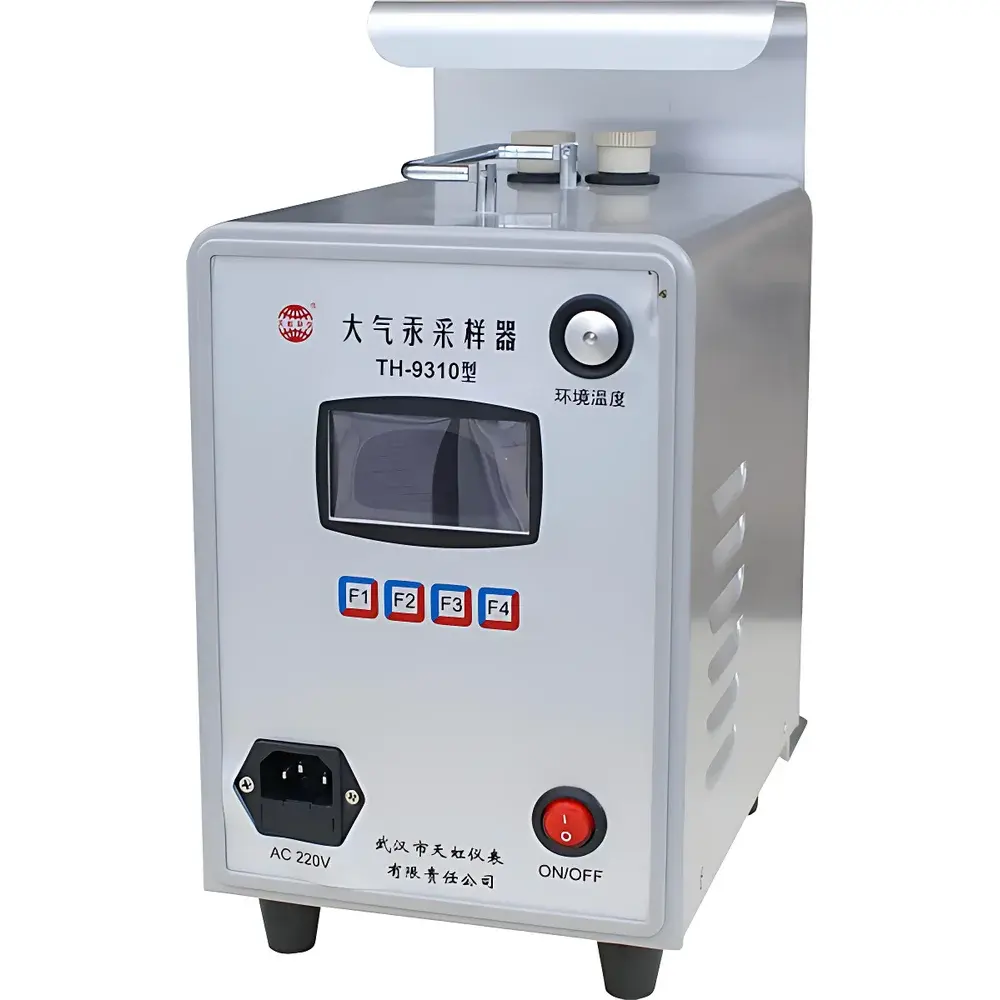
Tianhong TH-9310 Atmospheric Mercury Sampler
| Brand | Tianhong |
|---|---|
| Origin | Hubei, China |
| Model | TH-9310 |
| Instrument Type | Single-Channel Gas Sampler |
| Flow Range | 200–3000 sccm |
| Maximum Vacuum Pressure | 2000 Pa |
| Flow Stability | ±5% |
| Flowmeter Accuracy | ±2.5% |
| Service Life at Max Flow & Backpressure | ≥5000 hours |
| Continuous Operation Time at Max Flow & Backpressure | 2–8 h |
| Data Storage Capacity | 700 sampling records |
| Environmental Parameter Sensors | Ambient Temperature, Barometric Pressure, Actual Flow Rate |
| Pump Type | Imported Parker Brushless Diaphragm Pump |
| Compliance | EPA Method 30B, Q/WTH46–2013 |
Overview
The Tianhong TH-9310 Atmospheric Mercury Sampler is a field-deployable, single-channel active gas sampling instrument engineered for quantitative collection of gaseous elemental mercury (Hg⁰) and oxidized mercury species (e.g., Hg²⁺ compounds) from ambient air and flue gas streams. It operates on the principle of controlled-volume, time-integrated adsorption using standardized activated carbon or gold-coated quartz adsorption tubes—fully aligned with U.S. EPA Method 30B for total gaseous mercury determination in coal-fired emissions. The device employs a precision mass flow-controlled aspiration system to draw sample air through the adsorbent medium at user-selectable, stable flow rates within 200–3000 sccm. Its integrated environmental sensors continuously monitor and log real-time barometric pressure, ambient temperature, and actual volumetric flow—enabling accurate standard cubic centimeter per minute (sccm) normalization per ISO 10780 and ASTM D6784 requirements. Designed for regulatory-grade field use, the TH-9310 meets the technical specifications outlined in enterprise standard Q/WTH46–2013, which defines performance criteria for adsorption-tube-based mercury sampling from stationary sources.
Key Features
- Single-channel architecture with programmable flow control across 200–3000 sccm, optimized for EPA Method 30B-compliant sampling durations and breakthrough volumes;
- High-stability flow regulation (±5% over operating range) supported by a calibrated thermal mass flow sensor (±2.5% full-scale accuracy);
- Integrated Parker brushless diaphragm pump delivering consistent vacuum up to 2000 Pa, engineered for >5000 hours service life under maximum load conditions;
- Onboard temperature-controlled adsorption tube holder maintaining uniform thermal environment (typically 30–40 °C) to prevent condensation and maximize Hg capture efficiency;
- Touchscreen HMI with intuitive navigation, multilingual interface support (English default), and real-time parameter visualization;
- Built-in automated leak-check sequence prior to sampling initiation—verifying system integrity against ASTM D7520 and EN 14181 QA/QC protocols;
- Local data storage for up to 700 complete sampling records, each tagged with tube ID, start/stop timestamps, environmental metadata, and flow history;
- Field-calibratable flow sensor with backup/restore functionality for calibration coefficients—supporting traceable maintenance per ISO/IEC 17025 laboratory requirements.
Sample Compatibility & Compliance
The TH-9310 is validated for use with standard 1/4″ OD quartz or stainless-steel adsorption tubes packed with iodated carbon, gold-coated sand, or other EPA Method 30B-specified sorbents. It supports both manual and time-programmed sampling modes, accommodating variable duty cycles required for ambient monitoring networks (e.g., urban roadside, background stations) and source testing applications (e.g., coal-fired power plants, waste incinerators). Regulatory alignment includes full conformance with U.S. EPA Method 30B (2019 edition), Chinese enterprise standard Q/WTH46–2013, and technical prerequisites of HJ 543–2017 (Chinese standard for mercury emission monitoring from stationary sources). All firmware and data logging routines are structured to support audit-ready documentation for GLP and ISO 17025-accredited laboratories.
Software & Data Management
Data export is performed via USB 2.0 interface in CSV format, compatible with LIMS integration and post-processing tools such as Mercury Speciation Analysis Software (MSAS) or custom Python/Pandas workflows. Each record contains synchronized timestamps, corrected volume (at 25 °C, 101.325 kPa), temperature-compensated flow profile, and leak-test pass/fail status. Firmware supports optional password-protected user roles (operator, technician, administrator) and configurable auto-shutdown logic to preserve battery life during extended deployments. While the device does not implement FDA 21 CFR Part 11 electronic signature controls natively, its immutable local logs—paired with external timestamped calibration certificates—fulfill ALCOA+ data integrity principles for environmental compliance reporting.
Applications
- Ambient air quality monitoring of gaseous mercury near industrial zones, mining areas, and municipal waste facilities;
- Stack testing of coal combustion units, cement kilns, and non-ferrous metal smelters per EPA Performance Specification 12A;
- Mobile monitoring campaigns along transportation corridors where vehicular emissions contribute to atmospheric Hg burden;
- Baseline studies supporting environmental impact assessments (EIA) and permitting under national air pollutant discharge standards;
- Method validation and interlaboratory comparison exercises involving adsorption-tube-based Hg speciation protocols.
FAQ
Does the TH-9310 support dual-tube parallel sampling?
No—the TH-9310 is configured exclusively as a single-channel sampler. Dual-tube configurations require separate instrumentation or multiplexed systems not covered under this model.
Can the internal flowmeter be recalibrated in the field without sending the unit to a service center?
Yes—field recalibration is supported using NIST-traceable dry calibrators (e.g., primary piston provers or critical orifice standards), with coefficient backup/restore functionality preserving historical calibration integrity.
Is the temperature control of the adsorption tube holder adjustable?
The heater maintains a fixed setpoint of 35 ±2 °C to comply with EPA 30B thermal stability requirements; no user-adjustable setpoint is provided to ensure method consistency.
What battery options are available for extended unattended operation?
The TH-9310 operates on an internal rechargeable Li-ion pack (rated for ≥4 h at 1000 sccm); external 12 V DC input enables continuous operation via vehicle power or solar-charged auxiliary batteries.
How is data traceability ensured during multi-site field deployments?
Each sampling record embeds GPS-derived location metadata (when paired with optional external GNSS module), tube serial number, operator ID, and cryptographic hash of raw sensor outputs—facilitating chain-of-custody documentation per ISO 17025 clause 7.5.2.
Related Products







