
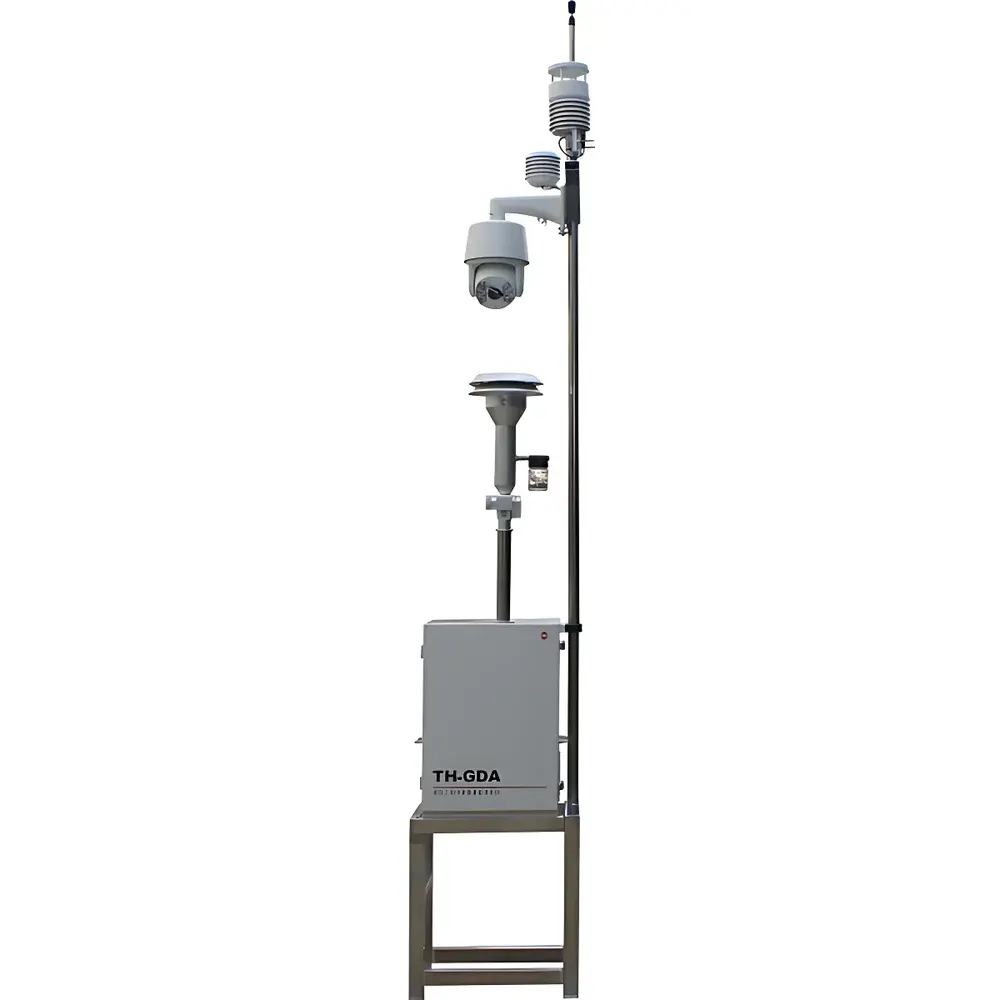
Tianhong TH-GDA Construction Site Environmental Quality Monitoring System
| Brand | Tianhong |
|---|---|
| Origin | Hubei, China |
| Manufacturer Type | Authorized Distributor |
| Country of Origin | China |
| Model | TH-GDA |
| Price Range | USD 7,000–14,000 (typical configuration includes PM2.5 sampler) |
| Flow Rate Range | 16.4–17.0 L/min |
| Vacuum Pressure | >50 Pa |
| Flow Stability | 16.7 L/min |
| Maximum Flow Error | ±0.1 L/min |
| Continuous Operation Duration at Max Flow & Backpressure | 24 hrs |
| Rated Service Life at Max Flow & Backpressure | ≥50,000 hrs |
Overview
The Tianhong TH-GDA Construction Site Environmental Quality Monitoring System is an integrated, regulatory-compliant environmental monitoring platform engineered for real-time, multi-parameter surveillance of construction site emissions and ambient conditions. Designed in strict accordance with China’s Ministry of Ecology and Environment (MEE) standards—including HJ 653-2013 for particulate matter measurement—the system employs a dual-technology approach for aerosol quantification: β-ray absorption coupled with a Dynamic Heating System (DHS) to minimize humidity-induced bias in PM₂.₅ mass concentration determination. This methodology ensures traceable, gravimetrically referenced measurements reported in μg/m³ with 0.1 μg/m³ display resolution. The system operates continuously across extreme ambient temperatures (−30 °C to +60 °C), maintaining precise volumetric flow control (16.7 L/min) via PID-regulated mass flow valves—critical for regulatory-grade data integrity under variable inlet resistance. Its modular architecture supports concurrent monitoring of airborne particulates (PM₁, PM₂.₅, PM₅, PM₁₀, TSP), broadband noise (LAeq, Lmax, Lmin), meteorological parameters (wind speed/direction, temperature, humidity, atmospheric pressure), geospatial positioning (GPS), and high-resolution video surveillance—all synchronized and time-stamped to ISO 8601 format.
Key Features
- Regulatory-grade PM₂.₅ measurement using β-ray attenuation with DHS, certified per HJ 653-2013 and validated by the China National Environmental Monitoring Centre (CNEMC) across four quarterly performance evaluations.
- Industrial-grade flow control system: PID-driven proportional valve maintains 16.7 L/min at ±0.1 L/min accuracy under backpressures exceeding 50 Pa; rated for 24-hour continuous operation at maximum load.
- Outdoor-rated acoustic monitoring module featuring IEC 61672-1 Class 1 digital microphone array with wind/rain/bird-perch mitigation, optional real-time 1/3-octave spectral analysis, and automated electro-acoustic calibration.
- Integrated ultrasonic anemometer (wind speed/direction), thermohygrometer, and barometric sensor—five-parameter meteorological suite with zero-maintenance design and NIST-traceable calibration documentation.
- IP66-rated CMOS video subsystem with 360° pan-tilt-zoom (PTZ) capability, optical zoom, onboard H.265 encoding, and edge-triggered image capture upon parameter exceedance.
- Embedded industrial PC with 10.1″ capacitive touchscreen, full Chinese UI, local data storage (>10 years at 1-min intervals), and redundant communication paths (RS232/RS485 + 4G LTE CAT4).
Sample Compatibility & Compliance
The TH-GDA system is explicitly validated for ambient air sampling in high-dust, high-vibration construction environments. Its PM inlet configuration complies with EN 12341:2014 (PM₁₀), EN 14907:2005 (PM₂.₅), and ISO 20581-1:2020 (β-ray reference method). All cutting heads (PM₁, PM₂.₅, PM₁₀, TSP) carry CNEMC-issued verification reports confirming aerodynamic cutoff sharpness and penetration efficiency. Noise measurements conform to IEC 61260-1:2014 (Class 1 octave-band filters) and GB/T 3222-2009 (Chinese site noise standard). GPS positioning meets Galileo/EGLS and BeiDou dual-constellation requirements with <3 m CEP accuracy. The entire system supports audit-ready data logging aligned with GLP principles, including immutable timestamps, operator ID tagging, and change history for all configuration parameters.
Software & Data Management
Data acquisition is managed by a Linux-based embedded controller running a deterministic real-time kernel. All sensor inputs—including analog voltage signals (meteorology), digital pulse counts (flow meters), serial ASCII streams (GPS), and MJPEG/H.265 video frames—are timestamped at hardware interrupt level using a TCXO-synchronized clock (±0.5 s/year drift). Local database storage uses SQLite3 with WAL journaling for crash resilience. Remote transmission follows MQTT v3.1.1 over TLS 1.2, with configurable QoS levels and automatic retransmission of unacknowledged packets. Central server integration supports OPC UA and HTTP RESTful APIs for interoperability with municipal environmental information platforms (e.g., MEE’s “Blue Sky” cloud infrastructure). Audit trails record every data point modification, user login/logout, firmware update, and alarm event—fully compliant with 21 CFR Part 11 electronic record requirements when deployed in regulated municipal oversight contexts.
Applications
- Real-time compliance monitoring for municipal construction site emission permits (e.g., Beijing Municipal Regulation No. 291, Shanghai Construction Dust Control Ordinance).
- Automated alerting for exceedances of local PM₂.₅ (e.g., 35 μg/m³ 24-hr avg) or LAeq(8h) thresholds (e.g., 70 dB(A) in residential proximity zones).
- Forensic correlation of dust spikes with wind direction shifts, precipitation events, or specific construction activities (e.g., excavation, concrete pouring) via synchronized multi-sensor time-series analysis.
- Long-term trend assessment of construction-phase environmental impact across project lifecycles—supporting ESG reporting and post-construction remediation validation.
- Integration into smart city IoT frameworks as a node in distributed environmental sensor networks, feeding data to urban air quality forecasting models.
FAQ
Does the TH-GDA system meet international certification requirements for export use?
The core PM₂.₅ module satisfies ISO/IEC 17025:2017 testing laboratory accreditation criteria when operated within its specified environmental envelope. While not CE-marked or EPA EQVM-listed, its β-ray/DHS methodology is functionally equivalent to U.S. EPA Reference Method PS-4 and EU MCERTS-approved instruments.
Can the system operate autonomously during extended power outages?
Yes—integrated UPS support (optional) provides ≥4 hours of backup runtime; solar-charged battery kits are available for off-grid deployment.
Is raw sensor data accessible via open protocols for third-party analytics platforms?
All telemetry is exposed via documented Modbus RTU (RS485), MQTT, and JSON-over-HTTPS interfaces with publicly published register maps and message schemas.
What maintenance intervals are recommended for long-term reliability?
PM filter tape replacement every 30 days; acoustic windscreen cleaning quarterly; annual verification of flow calibration against NIST-traceable dry calibrator (recommended but not mandatory).
How is cybersecurity addressed in remote data transmission?
4G LTE traffic is encrypted end-to-end using TLS 1.2+ with certificate pinning; device authentication uses X.509 client certificates; no default passwords or Telnet/FTP services are enabled by factory firmware.
Related Products







