
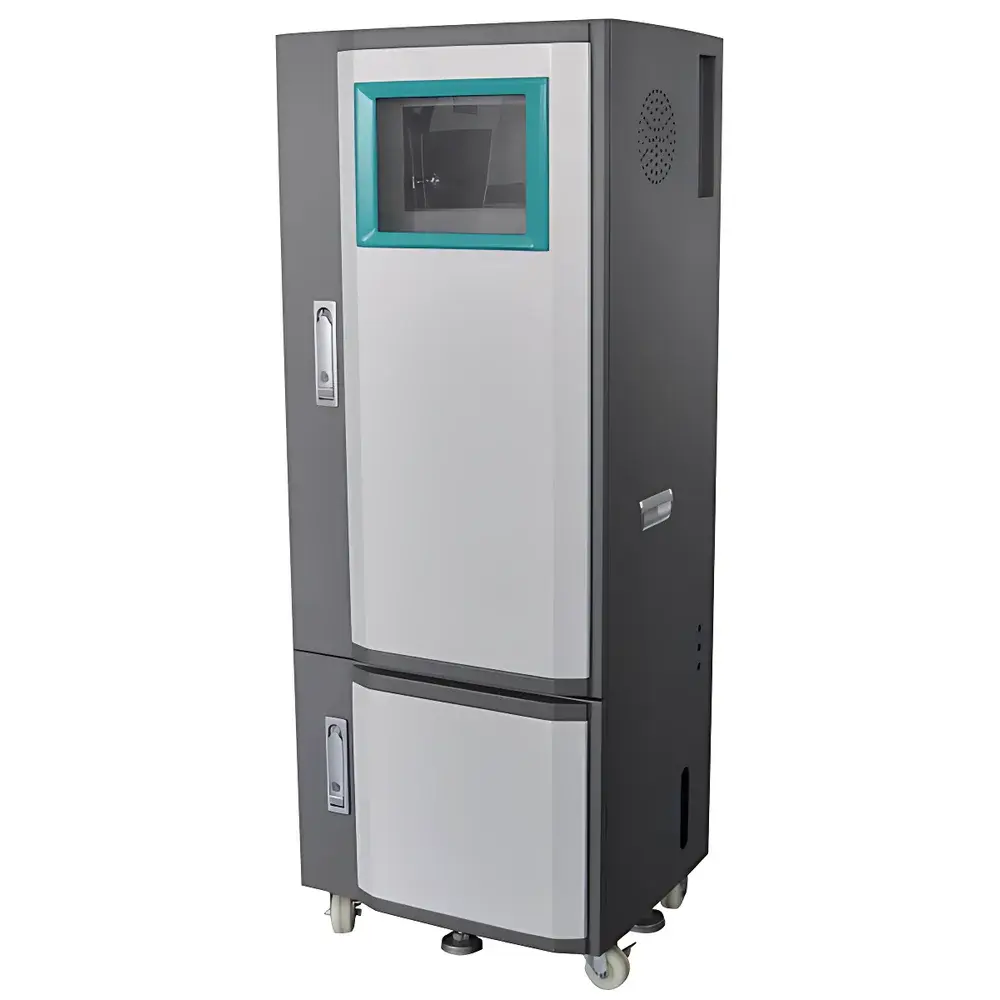
Tianhong TH-ZX300 Online Total Phosphorus Analyzer
| Brand | Tianhong |
|---|---|
| Origin | Hubei, China |
| Model | TH-ZX300 |
| Measurement Parameter | Total Phosphorus |
| Instrument Type | Online Analyzer |
| Measurement Range | 0–10 mg/L and 0–50 mg/L (dual-range) |
| Accuracy | ±3% of reading |
| Detection Limit | 0.005 mg/L |
| Resolution | 3% (relative) |
| Fluidic Components | Imported solenoid valves (USA/Japan/Germany) |
| Reagent Consumption | Low-volume precision metering via optical sensing |
| Data Storage | ≥10,000 records with USB export capability |
| Compliance | Designed for continuous unattended operation in municipal WWTPs and surface water monitoring stations |
| Software | Embedded Linux-based control system with auto-calibration, dual-mode operation (online/auto vs. offline/manual), and audit-ready data logging |
Overview
The Tianhong TH-ZX300 Online Total Phosphorus Analyzer is an industrial-grade, fully automated spectrophotometric analyzer engineered for continuous, real-time monitoring of total phosphorus (TP) concentration in wastewater treatment plants, drinking water intake points, rivers, lakes, and industrial effluent streams. It operates on the molybdenum blue colorimetric method—standardized under ISO 6878 and EPA Method 365.3—where orthophosphate released from acid digestion of all phosphorus-containing species reacts with ammonium molybdate and ascorbic acid to form a stable phosphomolybdenum blue complex. Absorbance is measured at 880 nm using a high-stability LED light source and temperature-compensated photodetector. The instrument integrates digestion, reagent dosing, mixing, reaction timing, and optical detection into a single compact flow cell architecture, eliminating manual intervention and ensuring long-term stability under variable hydraulic and ambient conditions.
Key Features
- Optically isolated measurement chamber with built-in temperature compensation and automatic baseline correction to minimize drift caused by ambient light, humidity, or lamp aging.
- Imported solenoid selection valves (U.S., Japanese, and German origin) with <10 µL dead volume, enabling precise fluid routing and minimizing cross-contamination between calibration and sample cycles.
- Optical volumetric metering system replaces traditional peristaltic pumps for reagent delivery—eliminating tube wear-related inaccuracies and supporting sub-milliliter reagent dosing with ±1% volumetric repeatability.
- Negative-pressure sampling via corrosion-resistant peristaltic pump with integrated air-gap isolation, preventing direct contact between aggressive digestants (e.g., persulfate/H2SO4) and pump tubing.
- PTFE-modified transparent tubing (ID ≥1.5 mm) resists biofouling and particulate clogging, validated for continuous operation with suspended solids up to 100 mg/L.
- High-resolution 24-bit ADC module ensures signal integrity across dynamic ranges; firmware supports configurable measurement intervals (15 min to 24 h) and adaptive digestion time based on sample turbidity.
Sample Compatibility & Compliance
The TH-ZX300 accepts raw influent, secondary effluent, and surface water samples without pre-filtration (though optional 80-µm inline filtration is recommended for high-sediment environments). It complies with ISO/IEC 17025 traceability requirements for calibration verification and supports GLP-compliant audit trails—including operator ID, timestamped calibration events, reagent lot tracking, and error logs. All digestion and colorimetric protocols align with ISO 6878:2004 and DIN EN ISO 15681-1. While not FDA 21 CFR Part 11 certified out-of-the-box, its embedded logging architecture meets foundational data integrity criteria for regulatory reporting in EU Water Framework Directive (WFD) and China’s HJ 535–2009 standard enforcement contexts.
Software & Data Management
The analyzer runs a deterministic embedded Linux OS with a web-accessible GUI (HTTPS-enabled) and local touchscreen interface. Key software capabilities include: (1) Dual operational modes—Online (fully autonomous, scheduled measurements with auto-zero and auto-span) and Offline (manual calibration/sampling using dedicated calibration tubes, with segregated data storage); (2) Auto-calibration routines using NIST-traceable phosphate standards (0.1, 1.0, 5.0 mg/L P); (3) Local data retention of ≥10,000 timestamped records (TP value, digestion temp, absorbance, error flags), exportable via USB 2.0 in CSV format; (4) Modbus TCP and 4–20 mA analog output for integration with SCADA or DCS systems; (5) Configurable alarm thresholds with relay outputs for high/low TP excursions or system fault conditions.
Applications
Typical deployment scenarios include: continuous phosphorus load monitoring at municipal wastewater treatment plant influent/effluent points; compliance reporting for discharge permits (e.g., China’s GB 18918–2002 Class I-A limits); early-warning detection of agricultural runoff events in watershed monitoring networks; process optimization in tertiary denitrification-phosphorus removal units; and long-term trend analysis in eutrophication-sensitive reservoirs and estuaries. The dual-range capability (0–10 mg/L for sensitive effluent control; 0–50 mg/L for raw sewage screening) provides flexibility across treatment stages without hardware modification.
FAQ
What digestion method does the TH-ZX300 use for total phosphorus determination?
It employs high-temperature acid persulfate digestion (120 °C, 30 min) followed by molybdenum blue spectrophotometry at 880 nm, consistent with ISO 6878.
Can the instrument operate without external power backup?
Yes—it includes brownout protection and resumes measurement automatically after power recovery, retaining all configuration and last valid result.
Is remote firmware update supported?
Firmware updates are performed via secure USB import only; no OTA or cloud-based update mechanism is implemented to ensure system integrity.
How often must reagents be replaced?
With typical 1-hour measurement intervals, reagent kits (digestion acid, molybdate, ascorbic acid) last approximately 30 days; low-consumption design reduces annual reagent cost by >40% versus conventional analyzers.
Does the analyzer support multi-point calibration?
Yes—up to three-point calibration using user-defined standard concentrations, with linear regression and R² validation displayed in real time.
Related Products







