
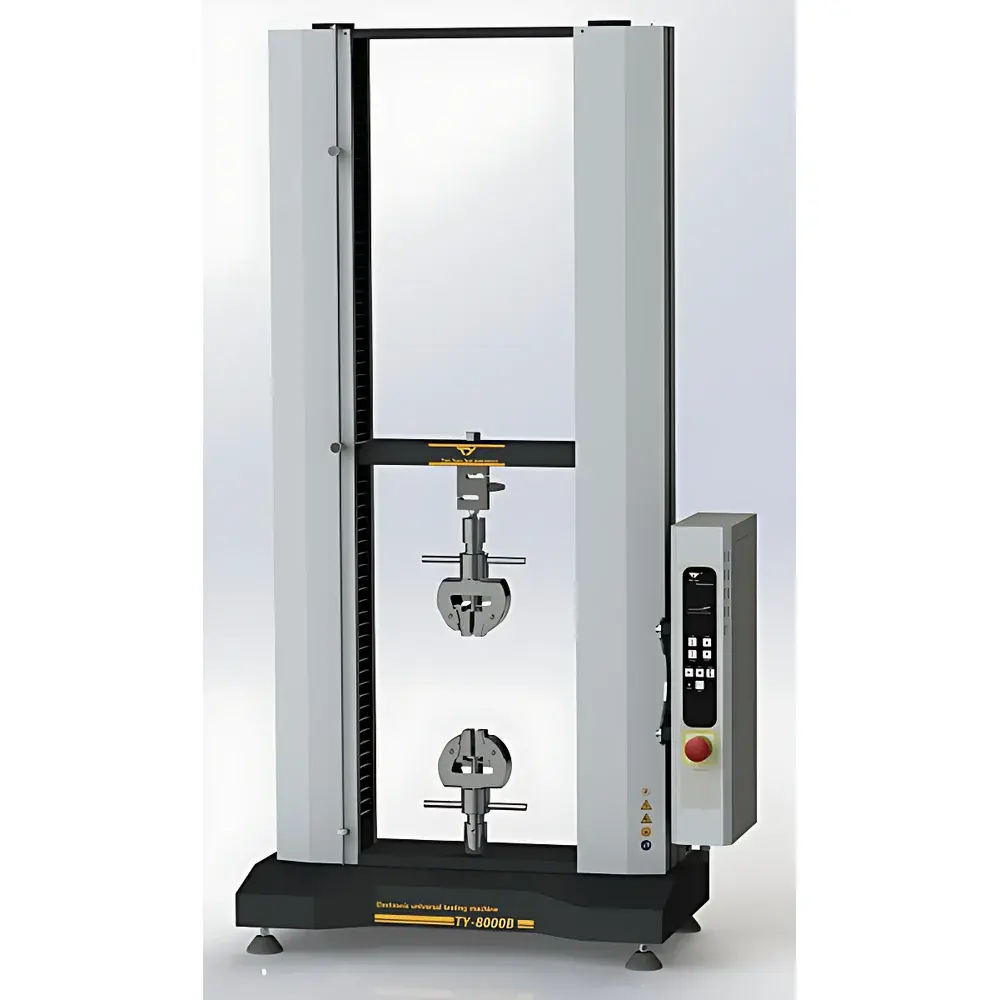
TianYuan TY-8000B Electronic Universal Tensile Testing Machine
| Brand | TianYuan |
|---|---|
| Origin | Jiangsu, China |
| Manufacturer Type | Manufacturer |
| Product Category | Domestic |
| Model | TY-8000B |
| Price Range | USD 2,800 – 7,000 |
| Instrument Type | Electronic Tensile Testing Machine |
| Maximum Test Load | 5 kN |
| Force Measurement Range | 1–100% of Full Scale (FS) |
| Force Accuracy | ≤ ±0.5% FS |
| Maximum Travel Distance | 900 mm |
| Displacement Resolution | 0.01 mm |
| Speed Range | 1–500 mm/min |
| Speed Accuracy | ≤ ±0.8% |
| Load Resolution | 1/60,000 FS |
| Effective Test Width | 360 mm |
| Dimensions (W×D×H) | 720 × 440 × 1550 mm |
| Weight | 180 kg |
| Power Supply | 220 V AC, 50 Hz |
Overview
The TianYuan TY-8000B Electronic Universal Tensile Testing Machine is a precision-engineered electromechanical system designed for static mechanical property evaluation of metallic and non-metallic materials under uniaxial loading conditions. Operating on the principle of controlled displacement-driven force measurement, it employs a high-rigidity load frame, precision-ground ball screw actuation, and closed-loop servo control to deliver repeatable, traceable, and standards-compliant tensile, compression, bending, shear, tear, peel, and puncture tests. Its architecture conforms to the fundamental metrological requirements defined in ISO 7500-1 (static calibration of uniaxial testing machines) and ASTM E4 (verification of force-measuring systems), ensuring reliable quantification of mechanical parameters including ultimate tensile strength, yield strength (offset method), elongation at break, Young’s modulus, flexural modulus, and Poisson’s ratio.
Key Features
- High-fidelity force measurement using calibrated load cells from Ningbo Keli — compliant with GB/T 13634 (transducer verification) and traceable to national metrological standards.
- DSP + MCU dual-core digital control system enabling real-time feedback, adaptive load regulation, and synchronized data acquisition at up to 1 kHz sampling rate.
- Stepper-servo hybrid drive system with JieMeiKang servo driver and Taiwan TBI recirculating ball screw — delivering smooth motion, minimal backlash (< 0.02 mm), and long-term positional stability.
- Modular software architecture supporting multi-curve plotting: Load vs. Displacement, Load vs. Time, Displacement vs. Time, Stress vs. Strain, and Load vs. Extensometer Extension.
- Integrated extensometer interface (two-point clip-on type) compatible with GB/T 12160 Class 1 accuracy requirements for strain measurement during elastic and plastic deformation phases.
- Full-range force resolution of 1/60,000 FS ensures high sensitivity across low-load polymer testing and high-strength metal characterization without range switching.
Sample Compatibility & Compliance
The TY-8000B accommodates specimens conforming to standardized geometries per ISO 6892-1 (metallic tensile), ISO 527-2 (plastics), ASTM D638 (tensile properties of plastics), ASTM D3039 (composite tensile), and GB/T 228.1 (metallic materials). It supports flat, round, and custom-profile specimens up to 360 mm wide and 900 mm traversable height (excluding grips). The system meets mandatory Chinese national standards GB/T 2611 (general technical requirements for testing machines) and GB/T 16491 (electronic universal testing machines), and its verification protocol aligns with ISO 7500-1 Class 1 accuracy class. Calibration certificates include uncertainty statements per ISO/IEC 17025 requirements, facilitating GLP-compliant lab audits and regulatory submissions.
Software & Data Management
TianYuan’s proprietary test software provides full-cycle workflow management: test method configuration, real-time curve monitoring, automatic yield point detection (0.2% offset), peak capture, and post-test analysis via graphical overlay, derivative calculation (e.g., tangent modulus), and statistical reporting. All raw data are stored in structured binary format with embedded metadata (operator ID, timestamp, environmental conditions, calibration status). Export options include CSV, XLSX, and PDF report templates pre-formatted to ASTM E1582 or ISO 10360 guidelines. Audit trail functionality records user actions, parameter changes, and calibration events — supporting compliance with FDA 21 CFR Part 11 when deployed in regulated QC environments.
Applications
This system is routinely deployed in R&D laboratories, quality control departments, and third-party testing facilities for mechanical validation of elastomeric waterstops (e.g., rubber-based hydrophilic expansion strips used in civil infrastructure joints), thermoplastic polyolefin membranes, vulcanized rubber compounds, geotextiles, adhesives, coated fabrics, and composite laminates. Its programmable test profiles enable simulation of service-relevant loading modes — including slow-rate creep assessment (per ISO 899-1), cyclic fatigue pre-conditioning, and multi-step ramp-hold sequences required for sealing material certification per EN 13948 or GB/T 18173.2.
FAQ
Does the TY-8000B support ASTM D412 and ISO 37 for rubber tensile testing?
Yes — the machine includes pre-configured test methods aligned with both standards, including specimen geometry definitions, grip separation rates, and stress-strain normalization routines.
Is the system compatible with external extensometers from other vendors?
It accepts analog ±10 V or digital RS-422 inputs from third-party extensometers meeting LVDT or optical encoder interface specifications outlined in GB/T 12160.
Can test data be integrated into LIMS or ERP platforms?
Via optional OPC UA or Modbus TCP gateway modules, raw channel data and summary metrics can be streamed to enterprise systems in real time.
What maintenance intervals are recommended for long-term accuracy retention?
Annual force calibration and biannual mechanical inspection (ball screw lubrication, alignment verification, and drive belt tension check) are advised per GB/T 16825 maintenance guidelines.
Is software validation documentation available for regulated industries?
Yes — IQ/OQ protocols, risk assessments, and electronic signature validation reports are provided upon request for GMP/GLP deployment scenarios.



